


 Francais
 Deutsch
 Italiano
Refine Your Search
Melville Rhode Island 1943 stock footage and images
- Showing 2353 to 2358 of 6726 results more
more Hide
Hide
A 20mm gun crew on forecastle of LCI underway in the Pacific Ocean during World War II.
A Landing Craft Infantry underway in the Pacific Ocean during World War II. View of a island. A man sucks lemon. A Landing Craft Infantry (LCI) passes. A man handles lines on a LCI deck. Men stand on forecastle of a LCI staring at the island. Men work on the LCI. A LCI underway. A United States Navy OS2U Kingfisher aircraft fly overhead. Island in the background. 20mm gun crew on forecastle of LCI fire on the island.
The Tower of Sun,Court of Flowers and fountains in San Francisco Bay, California during Golden Gate International Exposition
Golden Gate International Exposition on Treasure Island in San Francisco Bay, California. The Tower of Sun in the Treasure Island. A fountain in the foreground. Fountains in the treasure island. People walk along a water pool. The Court of Flowers. Entrance to the treasure island. The tower of sun at night.
Vice President Nixon and Senator Kennedy debate over Quemoy and Matsu issue prior to presidential elections in the U.S.
The fourth presidential election debate held between Democratic nominee Senator John F. Kennedy and Republican nominee U.S. Vice President Richard Nixon in New York, United States on 21st October 1960. ABC News correspondent Quincy Howe speaks during the debate and allows NBC correspondent John Chancellor to pose a question to Richard Nixon a . Correspondent Chancellor asks a question about Quemoy and Matsu issue. Vice President Nixon points out inconsistency of Senator Kennedy. He further explains it by saying that Senator Kennedy signed a resolution in 1955 which gave the president the power to use United States forces to defend Formosa (Taiwan) and offshore islands. But he also voted for an amendment which was lost, an amendment which would have drawn a line and left out those islands. Vice President Nixon supports President Eisenhower's position. Correspondent Howe asks Senator Kennedy to comment on the topic. He speaks about President Eisenhower sending a mission to persuade Chiang Kai-shek in the spring of 1955 to withdraw from Quemoy and Matsu because they were exposed. The President was unsuccessful. He refers to the fact that in 1958, as a member of the Senate Foreign Relations Committee, he was very familiar with the position that the United States took in negotiating with Communist China (PRC) on these two islands. He further that the U.S. was unable to persuade China's Chiang Kai-Shek to withdraw and thus it was decided by the U.S. to defend the islands.
United States Maritime Services Administrative Office and Training station at Avalon City.
Entrance of U.S. Maritime Services Administrative Office. Lieutenant Commander R.J.Casilli (USNR Executive Officer) and Lieutenant Commander Z.K.Fonyo (USMS Training Officer) chatting outside the office. Board sign of 'United States Maritime Service Training Station - Santa Catalina Island'. Trainees moving out for the noon muster in island villa barracks.
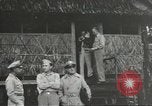
U.S. Army Chief of Staff, George C. Marshall, visits 6th Army Headquarters during World War II
George C. Marshall, U.S. Army Chief of Staff, stands on the top step of a wood and woven palm building, headquarters of the U.S. 6th Army, on Goodenough Island, New Guinea, during World War 2. Lieutenant General George C. Kenney, Commander of Allied Air Forces and the U.S. Fifth Air Force, stands with two other officers on the ground in front of the hut. General Douglas MacArthur Supreme Commander of Allied Forces in the Southwest Pacific Area (SWPA) joins Marshall and poses, standing to his left. General Marshall leaves the building to enter a car. Next, he is seen standing on the ramp of an airfield. MacArthur is also seen briefly, standing next to Marshall. General Marshall converses with Lieutenant General Walter Kreuger, Commander of the Sixth United States Army in the South West Pacific Area, and with General Kenney. General MacArthur and General Kenney, followed by other officers, walk back from a B-17 bomber (General Marshall's airplane) after saying goodbye to General Marshall. General Kreuger remains at the door of Marshall's B-17, bidding Marshall farewell. The B-17 is next seen taking off from the runway.
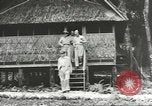
General Douglas MacArthur inspects 6th Army headquarters in New Guinea, during World War II
General Douglas MacArthur (Supreme Commander of Allied Forces in the Southwest Pacific Area) steps from the wood and palm structure, serving as Headquarters of the 6th Army, on Goodenough Island, New Guinea, during World War 2. He poses with Lieutenant General Walter Kreuger, Commander of the Sixth Army in the South West Pacific Area. Members of Kreuger's staff pose with them. After the picture-taking, MacArthur shakes hands with one of the staff officers, as the group make their way to jeeps. Next, MacArthur is seen posing with several armed soldiers wearing steel combat helmets. They salute MacArthur as he walks away. General Kreuger stands in front of the headquarters hooch conversing with two of his staff. He and one of his staff hurry to a jeep, with two stars on the front plate. They drive away. . Generals MacArthur and Kreuger are seen sitiing in back seat of a jeep with modified roof cover. MacArthur converses with staff officers. They are next seen walking through a grove of trees, with staff officers behind them. Later, MacArthur leads the entourage along a pathway, with tents visible in background. As they walk, he converses with Major General Edwin F.Harding, Commander of the 32nd Infantry Division. An official photographer lingers in background. MacArthur and Kreuger lead the group past a large mess tent. (At this point the footage repeats starting back with their entry into the grove of trees and ending as they pass the mess tent.) After that MacArthur is seen speaking to two bareheaded officers. He then speaks with several soldiers, individually, as Generals Kreuger and Harding stand nearby. MacArthur converses with a Field Grade officer. He visits an infirmary tent and speaks to a patient and to members of the medical staff, including a woman Lieutenant nurse. He and General Kreuger are seen inspecting various areas in the camp.
CRITICALPAST.COM: About Us | Contact Us | FAQs - How to Order | License Agreement | My Account | My Lightboxes | Shopping Cart | Advanced Search | Featured Collections | Website Terms & Conditions | Privacy Policy ©2026 CriticalPast LLC.
License Agreement |
Terms & Conditions |
Privacy Policy
©2026 CriticalPast LLC.