


 Francais
 Deutsch
 Italiano
Refine Your Search
Melville Rhode Island 1943 stock footage and images
- Showing 2851 to 2856 of 6726 results more
more Hide
Hide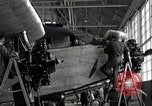
A Ford trimotor airplane in hangar being prepared for flight. The aircraft inflight on its way to Lake St. Agnes, Quebec,Canada
Mechanics perform pre-departure maintenance on a Ford trimotor airplane at a hangar in Detroit, Michigan. Later, pilots Floyd Bennett and Bert Balchen, and others, board and take off. Aerial view from above, of the airplane flying en route to Lac Ste. Agnes (Lake St. Agnes) Quebec, Canada, to bring supplies needed to repair the Junkers aircraft "Bremen" that had crash-landed on Greenly Island after a transatlantic flight.
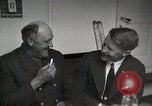
Canadian Bush pilot, Duke Schiller and cameraman Ray "Swede" Fernstrom relaxing
Canadian Bush pilot, Duke Schiller (in coat and tie) and cameraman Ray "Swede" Fernstrom, relaxing after return from Greenly Island in Quebec, Canada, where they had flown to assist the crew of the Junkers airplane "Bremen" that force-landed after completing a transatlantic flight. They relax with a drink. Fernstrom smokes a cigarette.
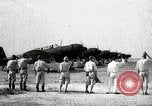
Japanese warplanes take off from an airfield in the Pacific. Pilots given big sendoff with waving flags.
Japanese Nakajima airplanes take off from an airfield on Japanese-held island in Pacific. Soldiers and people stand on the airfield. People watch the planes take off. Soldiers wave flags. Japanese officer waves hat on the platform. People in the background. Civilians wave at departing Japanese planes. (World War II period).
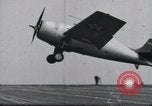
F4F aircraft crash on aircraft carrier, USS Wasp (CV-7) prior to U.S. entry into World War II
Crash of a Grumman F4F-3 aircraft from U.S. Navy Squadron VF-42, on the carrier, USS Wasp, early in 1941. In a slow motion sequence, a U.S. Navy F4F-3, with F-42-17 painted on its side (BuNo 2537) is seen rounded out too high for landing, above all arresting cables, and drifting into the carrier's island, where it impacts, losing its right wing, and flipping over to crash inverted on the flight deck. Sailors stand in the background. After the aircraft settles, a sailor runs across the deck to render aid. (Note: Navy Squadrons VF-42 and VF-71, assigned to the USS Wasp, received their F4F-3 Wildcats in January and February of 1941 under Bureau of Aeronautics contract C-68219, order number 48-020. These aircraft were painted overall aluminum with VF-42 having willow green tails and VF-71 having black tails. Later in 1941 the aircraft were repainted overall light gray.)
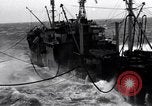
Fleet Oiler, USS Neches (AO-47) fuels an aircraft carrier during heavy seas in World War II
U.S. Fleet Oiler, USS Neches ( AO-47) is seen refueling an aircraft carrier during heavy seas and weather in the Pacific in World War 2. At one point the rudder of the USS Neches is seen exposed as she pitches. In final part of the sequence, the number 47 can be seen clearly on the bow of the Neches as viewed from a covered deck on the carrier. Note: A crew member on the Neches added the following inforrmation: "This fueling of the fleet was just days before we sailed into an inlet off the island of Okinawa. Several days later we shot down a suicide plane while anchored there in the inlet. I was the sightsetter on the 5 inch gun that shot the plane down. We hit it on our third shot and it splashed into the water just shy of an LST, its target. The plane's original target was our Neches but, after the first shot, it turned and headed toward the LST. My memory tells me it was on April 7th."
Saga of a U.S. Navy Task Group, the USS Guadalcanal and escorts, that captures the German U Boat (U-505) in World War 2
Historic U.S. Navy capture of German submarine (U-505) during World War 2. Crew assembles on flight deck of the USS Guadalcanal (CVE-60). Its Captain, Daniel V. Gallery, looks out from deck above. A Task Group of the Atlantic Fleet, consisting of the Guadalcanal, and five Destroyer escorts: the Pillsbury, Chatelain, Pope, Flaherty and Jenks, proceeds to operate against German submarines West of the Cape Verde Islands. Aboard the Guadalcanal, men train to capture a submarine, intact, if possible. The boarding team includes: Chief Photographer's Mate, Clifford Werler; Chief Pharmacist, Raymond Jackson; LTJG Mylo Keck; Ensign Fred Mittaugh; and Electrician First Class, William Stein; Ensign James Griffin; Machinist Mate 2nd Class, Walter Waller and Commander Earl Torcino. On June 4, 1944, the USS Chatelein makes sound contact with a submarine. The Task Group attacks it and forces it to surface under heavy gunfire. The German crew is rescued. Task Force boarding party successfully occupies and prevents the U-505 from sinking.
CRITICALPAST.COM: About Us | Contact Us | FAQs - How to Order | License Agreement | My Account | My Lightboxes | Shopping Cart | Advanced Search | Featured Collections | Website Terms & Conditions | Privacy Policy ©2026 CriticalPast LLC.
License Agreement |
Terms & Conditions |
Privacy Policy
©2026 CriticalPast LLC.