


 Francais
 Deutsch
 Italiano
Refine Your Search
Melville Rhode Island 1943 stock footage and images
- Showing 313 to 318 of 6726 results more
more Hide
Hide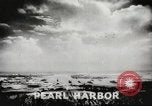
Japanese air attack on Pearl Harbor blows up U.S. battleships and destroyers in Honolulu, Hawaii during World War II.
A 1943 film about the December 7, 1941 Japanese air attack on Pearl Harbor in Honolulu, Hawaii during World War II. Film blends dramatized scenes with actual historic footage from the event. Formations of Japanese bombers approach Pearl Harbor. USS Arizona (BB-39) bombed. U.S. personnel aboard USS Arizona as the ship is bombed. Smoke billows up from the explosion. U.S. sailors aboard USS Oklahoma (BB-37). USS Oklahoma and USS California (BB-44) are bombed by Japanese aircraft. U.S. troops fire machine guns at Japanese aircraft. USS Cassin (DD-372), USS Downes (DD-375), and USS Pennsylvania (BB-38) bombed in the dry dock of Pearl Harbor. Ships in flames. USS Oglala CM-4 sinks after being attacked. Air raid alarms sound in Honolulu. Japanese people in Honolulu as the Japanese air raid on Pearl Harbor continues. A Japanese man being interviewed after air raid says he cannot think that Japanese aircraft attacked Pearl Harbor.
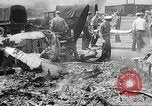
U.S. Navy officers and sailors attend prayer services for dead servicemen in Honolulu, Hawaii after the Pearl Harbor attack.
From a 1943 film blending dramatized scenes and actual archival footage about the conditions soon after the attack on Pearl Harbor in Honolulu, Hawaii in December 1941 by Japanese bombers during World War II. U.S. troops remove the dead bodies of soldiers who died in action. The U.S. flag on the grave of a U.S. soldier. Pictures and parents of U.S. service men of the Navy, the Marine Corps, the Army and Medical Corps who died during Pearl Harbor raid. The family of a U.S. Medical Corps Lieutenant who died during Pearl Harbor raid. Wife of the same lieutenant holds her baby born after the attack. Prayer services for the dead U.S. servicemen. Families of the dead servicemen lay wreaths and flowers around U.S. flags. U.S. Navy officers and sailors at shore attend the memorial services. Ceremony shows line of U.S. Navy sailors laying garlands around each U.S. flag bearing the names of U.S. servicemen who died during Pearl Harbor attack. An Army Chaplain and Navy officers attend the prayer services. Palm trees on the beach.
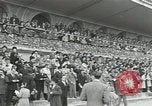
Scenes from German occupied Paris France; French collaborator Ferdinand De Brinon gives a speech to German officers (WW2)
Scenes shot in 1942 and 1943 from inside German occupied Paris, France during World War II. German officers and civilians at the Longchamps racetrack in Paris, France. Horses run on a dirt track. German troops at the Eternal Light for the Tomb of the Unknown Warrior at the Arc de Triomphe. A German Panther tank captured by the FFI (French Forces of the Interior) in 1944. French collaborator Ferdinand De Brinon speaks into a microphone. German officers listen carefully. Collaborators Marcel Deat, and Laval's son in law, Comte Rene de Chambrun also seen. French Regimental flag held by French collaborator militia. A crowd outside Notre Dame Cathedral. French Marshal Philippe Petain arrives in a car. French collaborationist troops stand at attention. Ceremony for the Legion against the Soviet Russia shows assemblage and German Swastikas on a wall.
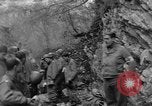
U.S. Army forces assault the German Winter Line of Defense during the Italian campaign of World War II
American troops of the 45th Infantry Division, are seen in mountains after breaking through the first segment of the German Winter Line, near San Pietro Infine, Italy, in World War 2. It is Christmas Day, 1943 and they occupy Mount Lungo. They receive Christmas dinner in their individual mass kits and sit down on the ground to eat it. On December 28th, they employ pack mules and also use stretchers to retrieve remains of fallen 3rd Division defenders down the steep mountain trails of Mount Lungo. They place the carefully wrapped remains at the base of a bullet pock-marked stone structure. Scene shifts to Mount Sammucro where American troops take advantage of a brief lull in fighting. On 1 January, 1944, Second Corp reinforcements have arrived and Americans commence a new assault on the German Winter Line defenses, with an artillery barrage on German positions guarding San Vittore del Lazio. View of smoke rising from that town. Shelling of Mountaintop flanking Highway 6held by Germans. Groups of American troops firing mortars from valley below. Shells exploding on German positions. Closeup of American gun crew loading and firing a 155mm long tom field gun. Soldiers holding their ears when gun fires. Bombs dropped from American warplane aircraft explode near roads in the valley. Glimpse from U.S. warplane flying overhead, of smoke rising from German positions in the Winter Line. Soldiers of the 168th Infantry Regiment firing a recoiless rifle from wooded area. Shells striking at base of mountain. Troops of the U.S. 137 Infantry Regiment advancing on San Vittore. view in the Italian town on 7 January, 1944, when street fighting has ended. American soldiers are seen mingling with the civilian inhabitants. German military equipment destroyed and burning during the American Winter Line offensive. Captured German soldiers being taken into custody, searched, and processed as prisoners of war.
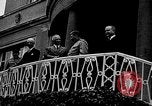
Allied National Leaders hold numerous conferences to plan and coordinate their efforts during World War II
First scene shows President Harry Truman shaking hands with Joseph Stalin on a porch of the Cecilienhof ( home of Crown Prince Wilhelm) in Potsdam, Germany. The two leaders are accompanied by their respective foreign ministers, James F. Byrnes, U.S. Secretary of State, and Soviet Minister of Foreign Affairs, Vyacheslav Molotov. Stalin descends steps from the building followed by Truman. View of the back lawn at Cecilienhof. View of its front entrance. Various views of the house and grounds. American, Soviet, and British flags flying from the building. Cars carrying the leaders on road to the Cecilienhof. President Truman and James Byrnes entering outside gate, followed by other attendees. Then Stalin is seen entering followed by Soviet officers and officials. U.S. General Dwight D. Eisenhower, Supreme Commander Allied Expeditionary Force (SCAEF) in Europea and U.S. Army Chief of Staff. George Marshall are seen walking together in a wooded glade on the meeting grounds. British Field Marshal Bernard Law Montgomery, entering the grounds for the meeting. British Prime Minister Winston Churchill, President Harry Truman, and Joseph Stalin stand on a step before an entrance to Cecilienhof. Truman places their hands together in a mutual handshake, at which Churchill and Stalin laugh. Views of the Kremlin and St. Basil's Cathedral, in Red Square, Moscow, Russia where foreign minsters of the United States, Britain, and the Soviet Union are seen meeting meeting in conference at the Spiridonovka Palace in October, 1943. Closeup of Soviet Prime Minister Vyacheslav Molotov, British Prime Minister, Anthony Eden, and U.S. Secretary of State, Warren Hull, successively signing a document. Scene shifts, to a C-47 transport aircraft flying over great pyramid of Giza in Cairo, Egypt. Next, the front of the Soviet Embassy in Teheran, Iran, is shown. The "Big Three" (Stalin, Roosevelt, and Churchill) sit on the porch of the building. Military officers from their countries stand behind them. Narrator (Franklin D. Roosevelt) says they agreed to launch a gigantic attack on Germany. Scene shifts to Germany, where German military is paraded on public display, showing artillery, Panzer I tanks carried aboard army trucks, Heinkel He 111 bombers in formation overhead, and marching troops giving Nazi salute silhouetted against bright pavement. View shifts to the Livadia Palace, in Yalta, Crimea, Russia. Brief view of the "Big Three" and their staffs sitting around a conference table. Change of location to San Francisco, California, where flags of many nations are displayed along with a United Nations Logo. Representatives of the many nations sign the Charter of the United Nations, founding the U.N. organization on 26 June 1945. Film shifts to Germany where victorious American, British and Soviet troops shake hands and celebrate victory. They share drinks and toast victory.
Scenes from the Battle of Stalingrad during World War 2.
Siege of Stalingrad, from 1942 through 1943. Germans and Soviets battle for Stalingrad in the Union of Soviet Socialist Republic (USSR) during World War II. German Stuka dive bombers in a line for a take off. A formation of German Stukas JU-87s. Soviet troops march across a field. German Pz.III tanks go across dry land. German heavy artillery lay down a barrage on the city of Stalingrad. Explosions in the city. German troops advance across a scrubby terrain throwing hand grenades. German troops use flame throwers against Soviet troop positions. Shell bursts in the city. Smoke rises. Buildings in Stalingrad on fire. German soldiers advance into outskirts of Stalingrad which shows completely demolished buildings. Smoke rises in the city. Winter scenes show Soviet artillery firing at German troop positions following successful Soviet encirclement of German forces in Operation Uranus. A Soviet officer with his beard covered with frost. Soviet troops counterattack across snow covered fields. Aerial views of Soviet aircraft including Tupolev Tu-2. Dead German soldiers lying in a field. Soviet troops advance. Street to street fighting. Soviet machine guns fired.
CRITICALPAST.COM: About Us | Contact Us | FAQs - How to Order | License Agreement | My Account | My Lightboxes | Shopping Cart | Advanced Search | Featured Collections | Website Terms & Conditions | Privacy Policy ©2026 CriticalPast LLC.
License Agreement |
Terms & Conditions |
Privacy Policy
©2026 CriticalPast LLC.