


 Francais
 Deutsch
 Italiano
Refine Your Search
Melville Rhode Island 1943 stock footage and images
- Showing 3361 to 3366 of 6726 results more
more Hide
Hide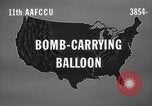
Japanese bomb balloons bound for the United States are shot down; examination of parachute and bomb apparatus
Evaluation of Japanese bomb-carrying balloons sent across the Pacific to the United States by Japan during World War 2. Gun camera footage of American fighter planes from Aleutian Island bases firing at Japanese balloons en route to the Pacific coast of the United States. A balloon bomb which reached the shores of the United States. but did not explode is examined by United States Army soldiers. They unfold the rice paper parachute portion of the balloon and examine its construction. Close-up views of the balloon control mechanism are shown, including a circular frame that would hold anti-personnel and incendiary bombs. Details of the wet cell battery and ballast weights are shown, including barometric aneroid switches which would operate to release ballast from simple hooks, as needed, to control balloon altitude. Narrator indicates it is believed the main purpose of the bombs was to start brush and forest fires.
U.S. 8th and 5th Cavalry Regiment troops entering outskirts of Manila. Officers refer to map on the street
United States 8th Cavalry and 5th Cavalry Regiment troops enter Manila, Philippine Islands during World War II. 8th Cavalry Regiment troops file past dead Japanese lying in a street. Major General Verne D. Mudge, commander, U.S. 1st Cavalry Division, and Regimental officers study a map at a street intersection.
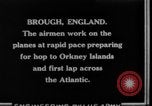
Airmen work on a Douglas World Cruiser and Lt. Smith superintends unpacking of a new engine in England.
U.S. Army Air Service Douglas World Cruisers (DWC) in London during their first flight around the world. In Brough, England airmen work on one of the world cruiser at a rapid pace preparing for a hop to the Orkney Islands and first lap across the Atlantic. A world cruiser maintenance man cleans the aircraft. Lieutenant Lowell H. Smith, pilot of the world cruiser, superintends unpacking of a new engine for his airplane. Several views of the engine changeover. The engines start. Ground crew members push pontoons. Several views of the replacing of wheels on pontoons.
People celebrate the Douglas World Cruisers aviators across the United States.
U.S. Army Air Service Douglas World Cruisers (DWC) in the United States during their first flight around the world. In Boston, Massachusetts Major General Patrick, head of the Army Air Service, praises his aerial pioneers and Mayor of Boston James Michael Curley presents Lieutenant Lowell H. Smith, and Lt. Erik H. Nelson watches. Views of the ceremony. Major General Patrick inspecting an aircraft. Aerial view of a squadron of airplanes flying over New York City. Aerial view of two world cruisers in flight. Edward. Prince of Wales, visiting the United States, is among those at Mitchel Field awaiting the aviators. He looks at the sky. Several people in the crowd look through binoculars. A world cruiser coming in for a landing at Mitchel Field, Long Island. View of the world cruisers on the airfield and the crowd around the aircraft. The Prince of Wales in the crowd. Several views of crowd welcoming the world cruisers.
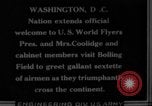
President John Calvin Coolidge, his wife and cabinet members greet Douglas World Cruisers aviators in Washington, DC
U.S. Army Air Service Douglas World Cruisers (DWC) in the United States during their first flight around the world. In Washington DC U.S. President John Calvin Coolidge, Mrs. Coolidge and cabinet members visit Bolling Field to greet airmen as they triumphantly cross the continent. President Coolidge's car. The President alights from the car. Views of the cabinet members. A crowd at Bolling Field, awaits arrival of the fliers, who were delayed in their flight from Mitchel Field, Long Island, by bad weather. The world cruisers land in formation, in rainy conditions. Two world cruisers parked wingtip to wingtip. The fliers are congratulated by President Coolidge and U.S. Secretary of War John W. Weeks. President Coolidge, wearing a rain coat, and other personnel examine the veteran airplanes.
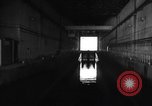
Post-World War II views of submarine pens in France. Views of New York City and harbor
Retrospective view inside a former German submarine pen in France, as narrator mentions its former use in World War 2. View from outside the structure. An American Airlines Douglas DC-4 passenger plane flying over Manhattan Island, New York City, with Empire State Building visible among other skyscrapers below. Aerial view of New York harbor, with ocean-going ships docked at terminals below. Traffic moving in the harbor, including barges, tugboats, and ships, displaying various national flags.
CRITICALPAST.COM: About Us | Contact Us | FAQs - How to Order | License Agreement | My Account | My Lightboxes | Shopping Cart | Advanced Search | Featured Collections | Website Terms & Conditions | Privacy Policy ©2026 CriticalPast LLC.
License Agreement |
Terms & Conditions |
Privacy Policy
©2026 CriticalPast LLC.