


 Francais
 Deutsch
 Italiano
Refine Your Search
Melville Rhode Island 1943 stock footage and images
- Showing 3379 to 3384 of 6726 results more
more Hide
Hide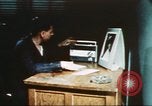
U.S. servicemen are kept informed through Stars and Stripes newspaper, radio and television telecasts in the South East Asia.
American servicemen are kept informed by newspapers and radio telecasts. In Guam, Mariana Islands : a serviceman seated at a table in a room listens to a radio and writes a letter to his wife. A radio disc jockey hosts a musical show and plays songs for listeners from a studio. In Korea : a soldier reads Stars and Stripes newspaper while getting a haircut. In South Vietnam: mechanics read a newspaper. Newspapermen work and write for the Pacific edition of Stars and Stripes newspaper. In Thailand : American servicemen watch a sports program at USO Club. A video taping technician works with recording devices at a television station. American soldiers watch a television show. A television engineer controls a program on air at the American Forces Korea Network. A man works on a typewriter.
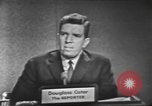
Kennedy and Nixon comment on nuclear disarmament before summit conference during a presidential election debate in the U.S.
The third Kennedy-Nixon Presidential Debate in the United States. Douglass Cater from Reporter magazine asks Democratic candidate Senator John F Kennedy about what sort of prolonged period does he envisage before there could be a summit conference and if he thinks that there could be any new initiatives on the grounds of nuclear disarmament during that period. Kennedy answers and talks about the need of strengthening of U.S. conventional forces and increasing missile production. On the question of nuclear weapon disarmament he states that the new administration should renew negotiations with the Soviet Union. He disagrees with the present administration's efforts regarding nuclear controls and general disarmament. He states that if he would get a chance he would make efforts to provide for control of nuclear weapons testing and begin general disarmament levels. Republican candidate U.S. Vice President Richard M Nixon mentions about his speech on this subject. He disagrees with Kennedy's statement that the administration is not making any effort because this is the highest level of operations in the whole State Department which is under the President himself. Roscoe Drummond from New York Herald Tribune asks Vice President Nixon about defending Quemoy and Matsu islands. Nixon answers and states that the U.S. should not deal with dictators and should not indicate which particular area it would defend. He gives the examples of the Korean War and World War II where the U.S. made a mistake. He says that Kennedy should change his position in this regard and not encourage the Chinese Communist and Soviet aggressors to react. Kennedy says that the treaty with the Republic of China excludes Quemoy and Matsu from the treaty area. He states that the treaty only includes defending of Formosa (Taiwan) and the Pescadores. He concludes that the U.S. should meet its commitments and raise war if the Chinese Communists attack the Pescadores and Formosa.
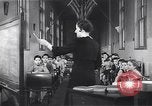
Foreign children as they listen and recite after the teacher in a Kindergarten Class at Immigration Building in New York.
Kindergarten at Ellis Island in New York, United States, part of the Baggage and Dormitory building. Small class of foreign immigrant children reciting in English. American flag in the background. Children as they listen and recite after the teacher.
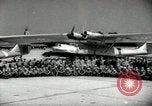
U.S. Navy Squadron deploys from San Diego, California, in its PBY-4 Catalina flying boats.
Flight crew members of U.S. Navy Squadron VP-1 (later changed to VP-21) sit in front of a Squadron PBY-4 for group photo before departing on a deployment (likely to Pearl Harbor). They disperse. Sailors are seen kissing their wives and girl friends goodbye. The Squadron aircraft is pushed down a seaplane ramp and departs, followed by others, one at a time. Friends and family wave as they depart. Aircraft numbers seen include 1-P-4; 1-P-6; and 1-P-10. A huge warship is seen behind the departing PBYs in several concluding scenes. The Squadron PBYs all display the insignia of a white elephant standing on a cloud holding a bomb with its trunk. The PBY-4 aircraft are distinguished by propeller spinners and flat hatches on their sides. The location appears to be North Island NAS, at San Diego.
Infantrymen of U.S. 36th Infantry Division, 143rd Regiment, 2nd Battalion cross Karls Canal in Leimersheim (WW2)
Infantrymen of U.S. 36th Infantry Division, 143rd Regiment, 2nd Battalion, Company 'F' in Leimersheim, Germany. Infantrymen cross Karls Canal in pontoon rafts to take position on the Rhine River outside town of Leimersheim during World War II. Infantrymen walk through woods at Karls Kope Island after crossing canal. Two infantrymen in prone position look through trees. Shoreline of an opposite riverbank. German pillboxes on east bank of Rhine River. Several infantrymen in pontoon raft cross canal, disembark, walk to a Jeep, and receive their food.
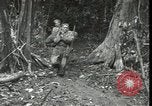
U.S. Marines and equipment moves through deep mud in Cape Gloucester during Pacific Campaign of World War II.
U.S. Marines in Cape Gloucester on island of New Britain during Pacific Campaign of World War II. Marines carry pyramidal tent through mud. Caterpillar tractor splashes through thick mud. Bulldozer hauls equipment through mud. Marines wade in stream and attach rope to stalled jeep. A Marine with a police dog.
CRITICALPAST.COM: About Us | Contact Us | FAQs - How to Order | License Agreement | My Account | My Lightboxes | Shopping Cart | Advanced Search | Featured Collections | Website Terms & Conditions | Privacy Policy ©2026 CriticalPast LLC.
License Agreement |
Terms & Conditions |
Privacy Policy
©2026 CriticalPast LLC.