


 Francais
 Deutsch
 Italiano
Refine Your Search
Miami Beach Florida USA 1963 stock footage and images
- Showing 6265 to 6270 of 26838 results more
more Hide
Hide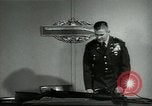
History of 1st Infantry Division, or Big Red One, focusing on deployment and action during Operation Torch in North Africa
Colonel William Wilson Quinn introduces an episode of "The Big Picture" that tells about the history of the 1st Infantry Division of the United States, called the "Big Red One." We see the boots and the shoes that 1st Infantry soldiers wore beginning with the Revolutionary War, through the Civil War, the First World War and the Second World War. Recruits are shown in training during World War 2 before deploying overseas in Operation Torch and the invasion of North Africa. Commanding General of the 1st Infantry Division, General Terry Allen, is seen during the Division's deployment to North Africa in World War II. Soldiers relaxing aboard troop ship. Naval barrage at night followed by amphibious assault on coast of Algeria. Animation shows the target areas of the division as they capture Oran. German counter attack is seen with bombers, tanks (including brief view of a German Tiger I tank), and artillery. American soldier standing with rifles shooting at low-flying German aircraft that are bombing their position. Scenes of German and American gun crews firing. Nazi German General Rommel seen in his staff car. Animation shows route of the Division with others towards the North. Heavy nighttime gunfire is seen. American soldiers meet and greet British troops of General Montgomery's 8th Army.
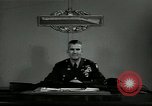
Colonel William Wilson Quinn talks about importance of the blue badge infantry soldiers of the United States Army
Colonel William Wilson Quinn on the show 'The Big Picture' in United States. Blue badge model framed on the wall in the background. He speaks about the importance of the blue badge of the rifleman or infantry man and the soldiers who wear the blue badge. He speaks about the great work of the infantrymen during the Korean War. He also speaks about the war at Sicily, the battle of the Bulge and the great work of various divisions. He says that the program 'The Big Picture' is the result of the great work of the Signal Corps combat cameramen who took the pictures and films of the Infantrymen.
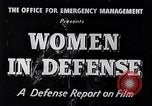
American women work as part of the National Defense Program, United States (WW2)
Wartime activities of women in United States during World War II, narrated by Hollywood actress Katharine Hepburn. A statue of a historic “Pioneer” American woman. American women work to save and help the nation. Women work at a laboratory as scientists. A woman looks under a microscope. Test tubes and other equipment on tables. Women handling chemicals in various flasks without protective gear. They work for the National Defense Program. A woman works near a machine that tests rubber or cloth for parachutes. Woman conducts abrasion test on clothing using a Wyzenbeek machine. She feeds guinea pigs and records their weights. Another woman works in the field of science. A woman gives a lecture on nutrition. A nutrition chart on wall. Other women attend the lecture. Women design working clothes for women. A woman wears a factory jumpsuit uniform.
American women actively participate in the National Defense Program as war production workers in United States.
Wartime activities of women in the United States during World War 2. American women wearing uniforms work at machines in factories, assisting with the war production effort. They perform work in operating machines including drill presses, sewing, and fine detail work with precision instruments. They sew airplane wing fabric and parachutes. They assemble and inspect precision instruments employing tiny bearings. The women war workers operate drill presses and lathes in a machine shop.
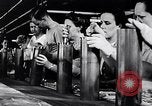
American women actively working and participating in the National Defense Program of the United States in World War II.
Wartime activities of women in United States during World War 2. American women war production workers busy in an ammunition factory helping men with war production. They check the shells at the munitions plant. A woman gives a lecture. A chart on wall. Other women attend the lecture. They wrap surgical dressings for the Red Cross. A woman gives blood to blood bank. Doctor and nurses take the blood in a glass container and put it in a box. The women participate in the defense program and war effort, filling many roles previously occupied by men fighting in World War 2.
Dramatization: The German view about the American women in United States.
Dramatization of the Nazi concept of American women as decadent playgirls unfit for working. Newspapers headline about end of the World War II. A man comes downstairs. He comes near a man in prison. The man in prison writes a book on the participation of the American women in the war. Men discuss among themselves. Photographs framed on the wall. They discuss a map and about the army of the United States. A man says that the American women army has done a lot for the victory of the United States. The other man states that there was no Women Army of America. He discusses with him the records and statistics of the expenditure of the American women. He says that they were all playgirls and not interested in working.
CRITICALPAST.COM: About Us | Contact Us | FAQs - How to Order | License Agreement | My Account | My Lightboxes | Shopping Cart | Advanced Search | Featured Collections | Website Terms & Conditions | Privacy Policy ©2026 CriticalPast LLC.
License Agreement |
Terms & Conditions |
Privacy Policy
©2026 CriticalPast LLC.