


 Francais
 Deutsch
 Italiano
Refine Your Search
Miami Beach Florida USA 1963 stock footage and images
- Showing 6991 to 6996 of 26838 results more
more Hide
Hide
Communication waves and the relation between power transmitted and received in Space Communications
United States Air Force training film about Space Communications and the related problems and developments. Animation: Planets, remotely controlled unmanned space research vehicles in space. Space communication links between the vehicles and Earth. Radio waves are reflected, refracted and absorbed. An antenna radiates waves that are dispersed. Communication and light waves on the frequency spectrum. Groundwave and Skywave transmission explained. Skywave transmission reflected back to Earth by the ionized layers in the Earth's upper atmosphere. Bouncing of signal in optimal conditions. Spacewave travels from transmitting to receiving antenna, and travels unaffected through the ionosphere into outer planetary space. Depicts laws that govern Line of Sight transmission: Relation between power transmitted and power received, and ideal and regular conditions. Explains the factors involved in the relation between the power transmitted and received. Comparison of communication and light waves. Inverse Square Law explained. The law applied to Space Communication: Signal generated from point source, energy dispersed in shape of sphere, energy spreads over expanding spherical area. Outlines a practical approach to strengthen received power: Directing the radiating energy, and enlarging area of the receiving antenna.
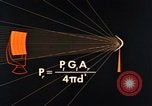
Formula expressing relation between transmitted and received power and factors affecting Space Communications.
Space Communications and the related problems and developments. Animation: Final formula expressing the relation between power transmitted and power received. Comparison of the distance between Earth and the moon, and Earth and Pluto. Factors effecting Space Communication. Payload factor: Effect of payload weight of a communication equipment, transport of equipment, need for small and light equipment. Limitations in miniaturization of components: Inaccessibility in term of maintenance and service. Depicts longevity of power based on available power sources. Advantages and drawbacks of chemical batteries, solar batteries, nuclear batteries. States methods for reducing power consumption: equipping vehicles with command transponders. Factors effecting Sapce Communication: Spatial environment and equipment used. Example of information required to study the planet Venus: atmospheric composition, surface temperature changes and exact period of rotation. Explains spatial movement and solution for this factor: Placing four equally spaced terrestrial stations around the globe, joint by reliable communication links for continuity and data reception.

Transmission and reception of data, and frequencies and bandwidth considerations in Space Communications.
Space Communications and the related problems and developments. Animation: Additional factors introduces into Space Communications by transmission and reception of data. Frequencies and bandwidths applicable to Space Communications. Factors to be weighed while considering bandwidth: Available power and transmission system required. Narrower bandwidths used to conserve power, they're also less affected by noise interference. Depicts consumption of power by television, spoken word and teletype bandwidths. Telemetry: low bandwidth and power consumption. Explains Telemetry. Theory of Modern Communication and Binary digits or BITS. Depicts information required from outer space like: radio activity level of the moon's surface, abundance of water vapor in the Martian atmosphere, and variation in surface temperature of Mercury. Telemetry utilizes relatively small bandwidth and thus used as preferable mode of communication for research vehicles.

Use of video, and the various Orbiting and Satellite Systems in Space Communications.
Space Communications and the related problems and developments. Animation: Use of video for Space Communications requires highly directive antennas for power economy. Depicts enlargement of capture area of antennas located at terrestrial reception points. Efficiency in signal processing of the receiving equipment increased, to reduce intrinsic noise by reducing temperature of components. A satellite in Earth's orbit for space and terrestrial communications. Explains the Passive Sattelite Relay System using reflecting spheres; Single Orbiting Active Satellite System using line of sight communication, ideal for weather forecasting and mapping; and the sophisticated active Day Period Cry Satellite Orbiting System equipped with transponders.

View through the windshield of a U.S. Air Force B-47 Stratojet strategic bomber and a KC-135 refueling boom.
A U.S. Air Force B-47 Stratojet strategic bomber in flight. View through windshield showing windshield wiper and out rear cockpit toward tail of aircraft. Aircraft in flight over clouds. KC-135 refueling boom seen attached and detaching. Belly of the B-47. View of the sun through the clouds.

U.S. Navy destroyer USS Shelton (DD-790) and a U.S. Air Force T-29
Aerial view of U.S. Navy destroyer, USS Shelton (DD-790) sailing. Aerial views of a U.S. Air Force T-29 ("Flying classroom") with radome under fuselage, in flight over water. Clouds over the aircraft. U.S. Air Force roundel on the starboard side of the plane.
CRITICALPAST.COM: About Us | Contact Us | FAQs - How to Order | License Agreement | My Account | My Lightboxes | Shopping Cart | Advanced Search | Featured Collections | Website Terms & Conditions | Privacy Policy ©2026 CriticalPast LLC.
License Agreement |
Terms & Conditions |
Privacy Policy
©2026 CriticalPast LLC.