


 Francais
 Deutsch
 Italiano
Refine Your Search
Miami Beach Florida USA 1963 stock footage and images
- Showing 8035 to 8040 of 26838 results more
more Hide
Hide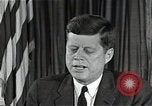
John F. Kennedy speaks about the importance of nuclear weapons tests and the care with which they will be resumed
U.S. President John F. Kennedy speaks on disarmament and testing of nuclear weapons in Washington D.C. A flag of United States on the stage. He talks about the negligible effects of resumed nuclear tests to be conducted under auspices of the Atomic Energy Commission and Department of Defense.
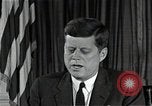
John F. Kennedy speaks about the change in technology and development of nuclear weapons in Washington D.C.
U.S. President John F. Kennedy speaks on disarmament and testing of nuclear weapons in Washington D.C. A flag of United States on the stage. A flag of United States on the stage. He talks about the constant change in nuclear weapon technology and development of the weapons according to the changes. He says that if the weapons have to be secure, flexible, and selective in impact, experiments with new designs have to be made. He also speaks about the development of low new series weapons for survival in a surprise attack. The weapons will be of low weight and high explosive content.
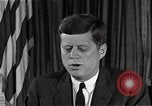
President John F. Kennedy speaks about conducting the nuclear tests for security reason in a speech in Washington D.C.
U.S. President John F. Kennedy speaks on disarmament and testing of nuclear weapons in Washington D.C. A flag of United States on the stage. He speaks that nuclear disarmament will lead to security. He clarifies that U.S. will perform tests on these nuclear weapons not for political or psychological reason but for security reason. He also talks about the negotiation with Soviet Union. “I have no doubt that most of our friends around the world have shared my own hope that we would never find it necessary to test again--and my own belief that, in the long run, the only real security in this age of nuclear peril rests not in armament but in disarmament. But I am equally certain that they would insist on our testing once that is deemed necessary to protect free world security. They know we are not deciding to test for political or psychological reasons--and they also know that we cannot avoid such tests for political or psychological reasons.” President Kennedy said.
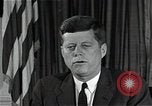
President John F. Kennedy speaks about New 18-Power Conference during a speech in Washington D.C.
U.S. President John F. Kennedy speaks on disarmament and testing of nuclear weapons in Washington D.C. A flag of United States on the stage. He talks about the New 18-Power Conference on 14th of march , in Geneva, where the U.S. will present a statement of agreed principles that has been worked out with Soviet Union and endorsed by United Nations.
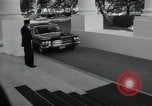
Political leaders arrive at the White House, including Senators Dirksen, Fulbright, Mansfield, and Humphrey
Limousine pulls up to White House, in Washington, DC, and Senate Minority leader, Everett Dirksen steps out. and enters the White House. U.S. Secretary of Labor, William Willard Wirtz, follows a companion out of a car and walks into the White House.They are greeted at the door by Senator J. William Fullbright, of Arkansas. Senate Majority leader, Mike Mansfield, of Montana arrives. U.S. Senate Democratic Whip Hubert Horatio Humphrey also enters the White House
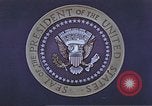
John F Kennedy inaugurated as 35th President of U.S. in Washington DC.
Transfer of office from outgoing President Dwight Eisenhower to President elect John F Kennedy. Exterior view of the White House after a snow fall. View of Kennedy sitting at his desk in the Oval Office. View of part of the National Mall in the snow, with Washington Monument in the distance in Washington DC. John F Kennedy with wife Jacqueline Kennedy, Dwight Eisenhower, Vice President Richard Nixon, former President Harry Truman, members of Congress, Supreme Court Judges, Diplomats, representatives of the art and literature community including contralto singer Marian Anderson and poet Robert Frost, Vice-President elect Lyndon Johnson, and others walking in the U.S. Capitol Building toward the inauguration ceremony seating. John F Kennedy takes Presidential Oath of Office administered by Chief Justice Earl Warren witnessed by a large crowd. President begins his Inaugural speech. 20 January 1961.
CRITICALPAST.COM: About Us | Contact Us | FAQs - How to Order | License Agreement | My Account | My Lightboxes | Shopping Cart | Advanced Search | Featured Collections | Website Terms & Conditions | Privacy Policy ©2026 CriticalPast LLC.
License Agreement |
Terms & Conditions |
Privacy Policy
©2026 CriticalPast LLC.