


 Francais
 Deutsch
 Italiano
Refine Your Search
Miami Beach Florida USA 1963 stock footage and images
- Showing 8401 to 8406 of 26838 results more
more Hide
Hide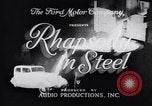
Plan for model 40 Tudor Sedan at Ford car factory in United States.
Picture of Henry Ford. Men work at desks in Ford factory. Men in laboratory. Spring testing machine. Men hover over planning desk. Workers rivet. Plan for model 40 Tudor Sedan. Views of furnaces of plants, workers. Man before large console of gages. Views of mill and processes of making steel. Large presses in operation, workers. Workers operate large board of gages. Testing goes on. Gears and parts on conveyor. Presses and drills in operation. Worker welds. Engine block on display. Blocks on conveyor. Drilling block.
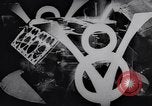
Production of model 40 Tudor Sedan at Ford car factory in United States.
Camshaft turned on conveyor at Ford car factory assembly line operation in United States. Pistons milled, on conveyor. Different machines in operation. Presses. Grills on conveyor. Parts on conveyor. Workers, both white and African American, assemble frame. Springs assembled on conveyor, being tested. Rear end assembly. Engine assembly. Carburetor assembly. Engine drop. Radiator installation. Parts on conveyor. Welding and riveting. Body assembly. Grinding. Painting body. Glass grinding. Glass on conveyor. Placing glass in car. Putting upholstery in car. Attaching body and fenders to frame. Tires. Hood. Views in steel mill. Ford car moving off assembly line. Sign "Production Schedule for Today, 5000"
African American farmers doing agricultural activities such as pick cotton and process sorghum in United States.
Excerpt from U.S. Deparment of Agriculture film "The Battle Is In our Hands." African American tenants pick cotton and process sorghum in fields. Farmers doing agricultural activities. Cattle at field. "Walls of Jericho" is sung by Paul Robeson in the background. (World War II period).
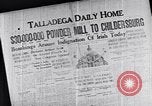
Growth of housing, military facilities, and military industries in Talladega, Alabama for World War 2
Growth of war industries in Talladega Alabama during World War II. Newspapers of Talladega, Alabama. A large crowd on barge, coming to land. Scene of an office. Workers at a construction site in Alabama. A man operates a crane. A big cylindrical elevator at hook of the crane lowers down. A truck at house. Dog outside house. A man operates a full track tractor at construction site. African American workers lay railway tracks for a railroad train service. Many scenes of the African American work crew working on the railroad tracks, and taking a break to drink water from a ladle. (Background sound track during these work scenes is a man singing the African American spiritual song "Joshua Fit the Battle of Jericho." A side rail pulls down as attach to hook of a crane. Tanks on rail coaches. Food loads arriving by railroad train cars to feed the growing population of war workers. Potatoes in sacks. A cook prepares food. People in war time production industry eat food at dining table in groups in a mess hall or dining hall. People do various construction jobs building infrastructure for war workers. A man operates a crane. A cylindrical box lowers down. Children play outside a mobile home trailer. A child with a cat. An open air theater. A bunk house with beds for rent. People at a cafeteria. A woman with children. Cars outside a cafeteria. A board reads 'Field Office'. Large crowd.
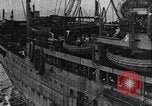
Soldiers march on streets holding rifles during World War I and veterans return to farming and dairying in United States.
A United States troop transport ship at sea during the first World War. U.S. Army troops (aka dough boys) aboard the ship. U.S. Army soldiers march in formation in a large city square area in Europe (likely France) holding rifles during World War 1. United States troop ships being loaded with American soldiers for World War I, and scenes of U.S. troops in WWI marching in the streets of a European city. Scenes from earlier during combat in the war. World War I allied soldiers on battle front in France. Soldiers run to a bomb crater area for shelter when crossing no man's land. Soldiers fire artillery. Artillery shells explode. Allied soldiers running across a battlefield as tanks run beside them toward the German enemy. People wave U.S. flags as First World War war ends with Armistice. Large crowd gathers in New York celebrating WWI armistice. Newspaper held high by a man with headline "Germany Surrenders". Views in the United States of hard times in American towns after World War I ended and war industries were no longer providing money. View of forests. Girl draws water from a well. Man and a boy operate a grindstone sharpening a saw. Farmers plowing fields with horse drawn plows during great depression era. People do agricultural works at fields. White farmer tilling a field. African American farmers working in fields and harvesting hay with help of a horse. African American farmers at cotton office. Cattle in field. Man and a woman milk cows with hands. Man pours milk in vessels. Milk processing before bottling including pouring milk through a cooling device. Men on tractor at fields. A board reads 'For the common defense'. Views of a factory. A man operates a switch on a switchboard for generating electricity. Views of a power generation plant. Narrator describes how America will prevent a slide into hard financial times again after World War 2 ends. From a 1942 production with footage from 1917 through 1942.
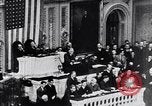
President Franklin D. Roosevelt addresses the Congress during "Four Freedoms" speech of 1942; also war production scenes
President Franklin D. Roosevelt addresses the U.S. Congress in his "Four Freedoms" speech during the State of the Union address on January 6, 1941, in Washington DC, United States. During his address, various war production worker and war materiel manufacturing images are also shown (before the entry of America into World War 2, but during lend-lease production): Tanks, airplanes and flying boat aircraft are shown. Workers at war production factories making artillery shells and munitions. Scenes at a manufacturing plant building bomber aircraft warplanes during World War 2. They appear to be B-25 Mitchell bombers. Workers work installing plexiglass nose cone gunner shield. They assemble various parts of airplanes. Scenes of biplane aircraft in formation and diving. Large, flat landing barge filled with American soldiers approaches a landing area.
CRITICALPAST.COM: About Us | Contact Us | FAQs - How to Order | License Agreement | My Account | My Lightboxes | Shopping Cart | Advanced Search | Featured Collections | Website Terms & Conditions | Privacy Policy ©2026 CriticalPast LLC.
License Agreement |
Terms & Conditions |
Privacy Policy
©2026 CriticalPast LLC.