


 Francais
 Deutsch
 Italiano
Refine Your Search
Miami Beach Florida USA 1963 stock footage and images
- Showing 8857 to 8862 of 26838 results more
more Hide
Hide
Spectators cheer as General and Admiral watch U.S. Army beat U.S. Navy in a traditional football match in Baltimore, Maryland.
U.S. Army beats U.S. Navy in a traditional football match in Baltimore, Maryland. General George C. Marshall, General Arnold and Admiral King arrive and take their seats. Army and navy troops march marking the start of the traditional ceremony. Large number of spectators from army, navy and other civilians take their seats in the stands. Navy cadets in the ground cheer for the army. Army soldiers sing songs for the navy. The football match starts. Players give a tough competition to each other as referee watches. Crowd watches and cheers. Army wins the match beating navy by 30-7. (World War II period).
Associate Justice Jackson swears in Edward R Stettinius as Secretory of States, at an official ceremony in Washington DC.
Supreme Court Associate Justice Jackson swears in Edward R. Stettinius as United States Secretory of States, at an official ceremony in Washington DC. After swearing in, General George C. Marshall and others shake hands and congratulate him. Stettinius addresses the assembly on a microphone. He then moves into his office, sits at his desk and reads files.
Documentary titled 'Challenge to Democracy' depicts homes for Japanese people relocated during World War II, in United States.
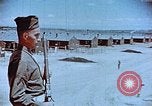
Documentary titled 'Challenge to Democracy' depicts relocation of Japanese Americans and people of Japanese ancestry due to perceived security reasons, in United States during World War II. People of Japanese origin moved by railroad train to a relocation house in Arkansas and at Heart Mountains, Wyoming (internment camps). Japanese civilians walk out of the railroad train at a station, carrying their luggage. Houses, barracks and Quonset huts at the relocation center. A military police guard with rifle on duty. A Japanese family enters its compartment and finds fully furnished comfortable house inside. A Japanese worker works on lumber. A small family inside a house. People dine together at a large mess hall. A car moves in the desert to plan a site for relocation center. Workers clear bush, level soil and do plantation using tractors. Farmers produce vegetables and fruits. Tractors plow farmlands. Farmers hoe crops and collect harvest. Harvest loaded in trucks and sent to mess of relocation house. Japanese mechanic repairs truck, lumbers at work. Workers paid for their work done at relocation house at an office. People inside a Community Enterprise Business Store.
Nisei, the second Japanese generation in U.S. involve in various works after released from relocation home during World War II.
Relocation of Japanese ancestry people, in United States due to security reasons, during World War II. Military Police guard with rifle at the entrance of Japanese-American internment camp in Missouri. Nisei, the Japanese of second generation in United States, at various works and profession after released from the relocation centers. Nisei farmers work in sugar beet field. A couple leaving the center gets its details checked by Military Police official and gets in a bus. A family released from an evacuation home. Details of evacuees read by an officer. Nisei work at corn field in Illinois, mechanical machines. Nisei nurse at a hospital aids a woman. Nisei man drives tractor, work on machines, feeds chicken, work in potato farms, with printing machines, at candy factory. Nisei women work making dolls, in garment factory, break eggs for military supply and stitch flags. A Nisei at a book binding factory shows his salary check.

16 million men register themselves in United States for the WWII draft, and President Roosevelt addresses from White House.
As World War II heats up, 16,500,000 men between ages 21 to 36 register themselves throughout the United States, signing up during the first peacetime conscription in U.S. history. (This was triggered by passage of the Selective Training and Service Act of 1940, also known as the Burke-Wadsworth Act, the genesis of "Selective Service.") Opening scene shows men lining up to register for the draft before the United States entered World War 2. Views of men filing out their registration forms. At 00:22 famous prize fighter, Barney Ross, is being registered. (He jokes that the registrar shaking his hand has too strong a grip.) At 00:34 Hollywood cowboy Gene Autry is seen registering. Close up view of street signs at Chinatown intersection of Bayard Street and Mott Street in New York City. Sign below it notes "School Street. Drive Slowly. Make no unnecessary noise." Line of many registrants of Chinese-American descent waiting in line, and processing paperwork. Scene changes to another area of the city, where a line of mostly African American men wait outside a registration building. Some cheer and wave for the camera. A police officer at the entrance hustles them inside, pulling some of them along. View of the exterior of the White House in Washington DC. United States President Franklin D Roosevelt addresses the nation's men of draft age, telling them that the call up of 800,000 men for training in year one, and less than one million men in each subsequent year, is a program of defensive preparation only. Roosevelt says to the registrants that "Democracy is your cause. The cause of youth." ( Note: clip is silent except for President Roosevelt speaking at the end.)

Cargo ships lined at harbor in Seattle, Washington to load with scrap metal on the eve of calling off scrap shipments to Japan.
On the eve of the embargo calling off shipments of scrap metal to Japan, cargo ships lined at harbor in Seattle, Washington to load with valuable junk for Nipponese war machines. Cranes load scrap metals to the cargo ships. Small tugs and boats near the ships at harbor.
CRITICALPAST.COM: About Us | Contact Us | FAQs - How to Order | License Agreement | My Account | My Lightboxes | Shopping Cart | Advanced Search | Featured Collections | Website Terms & Conditions | Privacy Policy ©2026 CriticalPast LLC.
License Agreement |
Terms & Conditions |
Privacy Policy
©2026 CriticalPast LLC.