


 Francais
 Deutsch
 Italiano

Refine Your Search
Miami Beach Florida USA 1963 stock footage and images
- Showing 8965 to 8970 of 26872 results more
 Hide
Color Sound
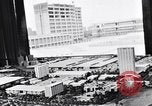
Campus of the University of Illinois at Chicago Circle (UICC) in Chicago, Illinois.
The modern campus of the University of Illinois, in Chicago. Film opens showing architectural model of the proposed new campus designed by Architect Walter Netsch of Skidmore, Owings and Merrill (SOM). Camera pans over the campus features, zooming in on the Circle Forum, a Greek-styled amphitheater built for plays, assemblies and concerts. Film shifts to students, and others, walking on a circular pavement. The University Hall is seen in background, flanked by two construction derricks. Views of various features of the spread out campus areas and buildings showing the concrete roofs forming the so-called "Great Court." Closeup vertical view of University Hall. More views of the extant campus. (construction is still underway.) Students walking along the Great Court with the multilevel construction visible. Closeups of students and others riding an escalator and conversing. Students in large classroom lecture hall where the Professor has written notes in chalk on a blackboard for the class, referring to revenue bills originating in the U.S. House of Representatives. Closeups of the Professor and students. Candid shots of a student's resting and relaxing in various places on the campus.
Various views of people and sites in old town neighborhoods of Chicago, Illinois.
Film opens with camera panning closeup over the exterior of St. Michael's Church, at 1633 North Cleveland Avenue, in Old Town, Chicago. Then, neighborhood views are seen from an open convertible car. Momentary glimpse, from above, of driver in the car. More neighborhood scenes and a pillar identifying Crilly Court. Views of various buildings in the neighborhood. A white standard poodle dog is seen looking out the open window of a car. A woman walks a black standard poodle dog along a commercial district sidewalk. Closeup of the poodle. Closeup glimpse of a woman and a man riding together on a motorcycle. A young man riding a motorcycle. Closeups of many people walking on the sidewalks and sitting on front steps of buildings, some dressed conservatively, and some with counter culture and hippie fashions. A commercial area of Old Town jammed with numerous small eateries close to one another. A man riding a bicycle in the midst of heavy traffic. Closeups of pedestrians walking on the sidewalks, and young people sitting on the sidewalk, next to buildings. A man stripped to the waist taking a cigarette (possibly a marijuana joint). He lights it. Scene shifts to a shop where women try on various wigs. Many people in typical 1960s fashions. Another street scene showing various eating places, including Paul Bunyan, at 1355 North Wells Street. Large umbrella light at entrance to Piper's Alley. Customers visiting various small shops and galleries, in Piper's Alley. An African American boy having his portrait drawn by a street artist. His mother watching. Glimpse of the boy's portrait.
Night life in downtown "Old Town" area of Chicago in 1965
Opens with montage of illuminated signs for various businesses on Wells Street and environs in Old Town area of downtown Chicago, Illinois. Camera focuses on the Stagecoach Restaurant and zooms in on its sign. The camera then shows brief scenes in darkened night spots featuring jazz musicians performing. Glimpse of cars on dark street. Several young people outside a place featuring "topless" Go Go dancers. A young woman showing disapproval, turns away from a young man with her. Closeups of people mingling on Wells Street. Shimmering dress of a dancer along with closeup of a musician playing bongo drums. More glimpses of people on the sidewalks. Inside a club, a woman in a short dress is singing and dancing accompanied by a band of musicians. Momentary glimpse of a street artist at work. View down on a piano being played by a jazz musician. A woman dancing alone, as musicians play. Two views of drummer playing in a band.
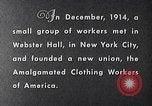
Empty buildings on Ellis Island, in 1954. Flashback to Immigrants arriving and being processed in 1901.
Start of a documentary production titled,"The Inheritance." Introductory slate tells how in December, 1914, the Amalgamated Clothing Workers of America (Union) was founded in a meeting at Webster Hall, New York City. It also describes how far and wide that union had grown in the ensuing 50 years. An ocean liner is seen in the mist in New York Harbor. Fog horn sounds. The statue of Liberty is seen dimly through the fog. A commercial ship and a tug boat pass in front of Ellis Island. Views of building interior, Sign in boiler room reads: "U.S. Immigrant Station. Ellis Island. N.Y.H." Furnace door and thermometer and pressure gauges are seen. Large hall is seen. Camera pans through the empty corridors and rooms of the facility. The frame of an iron baby's crib sits in an empty room. View through window of Ellis Island proper, just outside, and of New York City buildings across the water. Montage of still photo images: Immigrants on the deck of a ship in 1901. Views of small children. A group of immigrants wearing the fez. Immigrants waving their hats as they see the Statue of Liberty. Broader view of the ship packed with immigrants. Interior of Ellis Island building with queue of new arrivals being processed. Immigration officers seated on high stools, checking documents of arrivals. Medical officer examines a boy with a stethoscope (screening for TB). View shifts to passengers arriving. They walk across the pier, carrying their belongings.
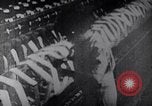
Early 20th Century images show tension between U.S. business and workers over child labor, low wages, and labor unions
Girls and boys engaged in child labor working on machinery in textile mills. Boys working in coal mines, A boy working at blacksmith's forge and one in a machine shop. Lady and gentleman in riding habit on horseback. All members of a family engaged in needlework, at home. Closeups of miners and a woman worker. Workers including children, parade with American flags and a sign reading: "Give us A Living Wage, Not Charity." New York City Garment workers from various unions, such as Pants makers, marching with placards. Workers jammed in a Chicago city square to hear Hannah Shapiro, initiator of the garment workers strike against clothing firm, Hart, Schaffner, & Marx. Some carry signs. One reads: "Do you belong to a Union. If not, why not." Closeup of Hannah Shapiro, standing on a ladder, with a Union banner beside her. Large group of marching workers with many children in the front rank. They carry American flags. Mine owners' spokesman assuring workers about their rights and interests. Closeups of a decorated senior uniformed policeman on horseback and another policeman in uniform. Group of uniformed policemen armed with Browning shotguns. Contingent of policemen mounting their horses in formation, and several riding along a cobblestone city street containing trolley tracks. An early vintage car is following them. Policeman walking ahead of women marching with a banner about Union Contracts for New Yorkers. Mounted police dispersing an unruly crowd. Policeman taking a young man into custody. A 1910 Auburn automobile, with right-hand drive. Policemen taking protesting workers into custody.
Garment workers demonstrating, for improved working conditions, encounter resistance in Eastern U.S. cities
Clothing workers in a factory in the United States. Street scene in garment district of Midtown Manhattan, New York City, in 1912. Garment workers, and supporters of their labor rights quest for better pay and shorter hours, pose for a photograph. Workers display many signs expressing their needs, in English, Italian, Russian, Hebrew and other languages. Garment workers, of various specialties, gather in demonstration for better treatment. Employees of the Alfred Benjamins Company refute management's claim that they are satisfied with working conditions. They display a large sign on the sidewalk. Four-sided box signs are also seen (written in Italian and Hebrew). Mounted police move along a street as a foot patrolman arrests a protester. Photograph of lawyer, Fiorello LaGuardia. Garment workers at work in a sweat shop. A large group of young women garment workers marching in a labor rally or demonstration during a strike. Two signs are seen, one reading: "Why are we prohibited from picketing?" and the other, partly hidden, explains why they are striking. A contingent of uniformed policemen with night sticks, stand in front of a building in Baltimore. Smiling women stand carrying signs. One reads: "Our employers are powerful (because) they are organized.We shall be more powerful." Another reads,"We shall fight until we win." Many other signs express similar sentiments. Portrait photograph of 17 year old Ida Brayman, with caption reading: "Who was shot & killed by an Employer Feb. 5th 1913 during the great struggle of the Garment Workers of Rochester (New York)."
CRITICALPAST.COM: About Us | Contact Us | FAQs - How to Order | License Agreement | My Account | My Lightboxes | Shopping Cart | Advanced Search | Featured Collections | Website Terms & Conditions | Privacy Policy ©2026 CriticalPast LLC.
License Agreement |
Terms & Conditions |
Privacy Policy
©2026 CriticalPast LLC.