


 Francais
 Deutsch
 Italiano
Refine Your Search
Miami Beach Florida USA 1963 stock footage and images
- Showing 10027 to 10032 of 26838 results more
more Hide
Hide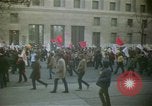
A moratorium march outside an official building in Washington D.C. as people protest against the Vietnam War.
Anti-war protestors in moratorium march in Washington D.C., United States. A large number of peace activists and pacifist demonstrators walk past Department of Justice building as they carry North Vietnamese flags of National Front for the Liberation of the South, to protest against American involvement in the Vietnam War. People gather at the entrance of the building. People protest outside the building as they carry flags and banners. Crowd is becoming unruly. One man seizes large ring on door of building and slams it as a knocker against door. Others beat on steel door with american flags. Smoke rises from area in background. Cameramen record the event.
The uses and the importance of colored grenades in a combat (WWII)
'Colored smoke grenades: their use in combat' shows the types, uses and importance of colored smoke grenades during combat in WW2. Colored smoke grenades burst. An orange smoke grenade burns. Grenades piled up in a crate. A soldier picks up a grenade from the crate and removes the outer can. He throws it on the ground and orange smoke rises from it. An aerial views of an area along a coast. Units advance in a field. An aircraft in flight. Different units burst different colored smoke grenades to pass on the information about their position to their Commander. The aircraft drops a colored grenade to get some information from the unit on advance. The unit sets off a purple grenade as an answer. (World War II period).
The use of colored grenades by a unit cut off from its headquarters during combat in WW2.
The types, uses and importance of colored smoke grenades during combat in WWII. An enactment shows a unit in a forest which has been cut off from its headquarters. The leader of the unit sights a friendly reconnaissance plane and throws a green smoke grenade to signal their position. Another grenade burns indicating their immediate need. The pilot of the aircraft throws a sign grenade. He signals them the way to be followed by throwing a red smoke grenade along the road to be followed.
Use of colored grenades by a unit to know the direction of the enemy fire during WW2.
The types, uses and importance of colored smoke grenades during WWII. An enactment shows units during an advance. Laying out a cloth in an arrow sign indicating the direction of an enemy fire and burning a smoke grenade near it. The smoke signal indicates the help required by the unit in knowing the direction of the enemy fire. A reconnaissance plane surveys the combat area and enemy installations. A pillbox being located and smoke grenades being burst. Soldiers fire 4.2 mortars at the pillbox and smoke rises. Smoke engulfs the pillbox. Ground units attack the area. A soldier sets off a colored smoke grenade to indicate cease fire. Soldiers advance and smoke from colored grenades rises.
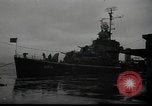
The education and professional journey of naval officer Chester W Nimitz, with views of early U.S. Navy ships and submarines.
Army film 'The Big Picture' . View of U.S. Navy Destroyer USS Buchanan (DD-484), at rain-soaked pier. Admiral Chester W. Nimitz, wearing rain coat, steps to shore. Naval ships in convoy. Battleship fires 16 inch guns. Heavy nighttime U.S. Navy ship gun barrages light up the dark in an unidentified battle. Landing craft race toward shore carrying U.S. Marines. Animation of earth with satellite circling it. U.S. Army narrator talks about the naval officer, Fleet Admiral Chester W Nimitz. Setting stage for Nimitz' upbringing, view of cowboys or cattle men herding cattle on great western plains of the United States with distant views of mountains behind. Narrator refers to Admiral Nimitz' birthplace, Fredericksburg, Texas. Still image of Chester W. Nimitz as a young boy. View of the old U.S. Navy ship USS Constitution -- a tall masted sailing vessel in full sail during the era of the Spanish American war. View of a U.S. Navy armored steam cruiser or battleship firing guns in battle. Theodore Roosevelt giving a speech, then seen close up talking and smiling, and then again Theodore Roosevelt seen on a flag draped podium giving an speech with animated hand gestures. Late childhood picture of young Chester W Nimitz around the time he entered the U.S. Naval Academy. Nimitz in a sailor uniform. U.S. Navy sailors participate in a boxing match during training, as their classmates look on and cheer the bout. Procession of U.S. Navy officers and cadets march on grounds of U.S. Navy Academy circa 1905, during a commencement exercise or other ceremony. View of one of the U.S. Navy's first submarines being loaded at a port. U.S. Navy sailors atop a small submarine as it cruises in a waterway. View of the small submarine as it dives under water. View circa 1918 of four U.S. Navy submarines at port, side-by-side. View of U.S. Navy sailors at work inside submarine. Fleet of warships and submarines underway during World War 1 era. View of USS Zeilin (DD-313) underway at sea. Navy biplane aircraft lands on U.S. Navy aircraft carrier.
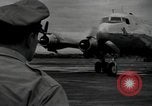
Events in career of Chester W Nimitz. The end of World War II and postwar years.
Fleet Admiral Chester W. Nimitz is met by General of the Army, Douglas MacArthur, as he arrives by airplane in Manila, Philippines. Japanese diplomats and military officers board the U.S. Battleship, Missouri, to sign surrender documents. Admiral Nimitz is one of the signatories. Nimitz is given a hero's welcome, in Washington, DC, replete with a military parade. He addresses a joint session of the U.S. Congress. Admiral Richard Byrd briefs Admiral Nimitz (now Chief of Naval Operations) about the 1947 expedition to Antarctica. Admiral Nimitz receiving an honorary degree from Columbia University, in New York. (Others present during this event include General Dwight Eisenhower and General George Marshall.) Nimitz, appointed as UN Plebiscite Administrator for Kashmir. He is visited by members of the Japanese Diet and signs autographs for them. Nimitz standing with President Truman, who appoints him to a special commission on internal security. Retired Admiral Nimitz at home in his garden at Berkeley Hills, California. Weather vane at his house contains 5 stars and replica of a submarine.
CRITICALPAST.COM: About Us | Contact Us | FAQs - How to Order | License Agreement | My Account | My Lightboxes | Shopping Cart | Advanced Search | Featured Collections | Website Terms & Conditions | Privacy Policy ©2026 CriticalPast LLC.
License Agreement |
Terms & Conditions |
Privacy Policy
©2026 CriticalPast LLC.