


 Francais
 Deutsch
 Italiano
Refine Your Search
Miami Beach Florida USA 1963 stock footage and images
- Showing 10669 to 10674 of 26838 results more
more Hide
Hide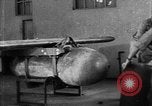
Dropping of a heat seeker missile, GB-6 from a B-17 flying fortress in the United States.
A review of research and development in guided missiles by the United States Air Force from 1919 to 1948. GB-6, a heat seeker missile, is assembled in a work laboratory. Men attach the homing device to the heat seeker unit then attach the same to the nose section of the GB-6 airframe. They test the heat seeker missile by holding a match flame in front of the same. Activating section of the heat seeker missile. A B-17 flying fortress in flight launches the GB-6 missile. The missile descends.
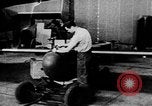
Dropping of an Azon bomb from a B-14 Liberator aircraft in the United States.
A review of research and development in guided missiles by the United States Air Force from 1919 to 1948. A GB-7 missile crashes in a scrubby wooded area. A GB-7 missile is assembled in a work laboratory. Men remove the protective cover from the nose section of the radar unit. A technician starts operating the radar unit in the nose section of the missile. The radar unit in operation. A radio control unit is mounted on the tail assembly of the bomb. Demonstration of the small stick control radio unit and control sections of the Azon bomb. A B -24 Liberator in flight drops a single Azon bomb. The bomb hits a bridge across a river. Multi drop of Azon bombs shows many smoke trails left by flares attached to the tail section of the bomb. The bombs drop on parallel course with a road leading through a wooden area. Razon bomb suspended from a chain hoist. Inserting a flare unit into the tail section of the Razon bomb. Two bombs are dropped at the same time. A technician works on the heat seeker section of a GB-6 free falling missile. A British Tall Boy bomb. The Tall Boy is the VB-13 bomb. (World War II period).
A drawing of a JB-1, surface to surface missile in the United States.
From a review of research and development in guided missiles by the United States Air Force from 1919 to 1948. A JB-1, (Jet Bomb 1) surface-to-surface missile. A drawing of the JB-1 missile by Nothrop, with General Electric B1 turbojets. (World War II period).
A JB-3, air-to-air missile attached to the wing of a B-26 Invader in the United States.
A review of research and development in guided missiles by the United States Air Force from 1919 to 1948. A JB-3, air-to-air missile. The missile is attached to the wing of a B-26 Invader. A still photograph of a partially assembled JB-3 missile in an assembly building.
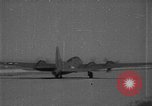
Test of a B-17 Flying Fortress drone, converted into BQ-7 missile, at Wendover Army Air Field, Utah
Test at Wendover Army Air Field, New Mexico, of a drone B-17 Flying Fortress converted into a remote-controlled bomb (designated BQ-7 missile). The B-17 drone sits with engines running. Interior of the aircraft shows technicians of the "Weary Willie Project" checking over radio controls. The B-17 drone takes off followed by a B-17 controller (mother ship). The two aircraft in flight. A ground tracking and control crew on the ground, follows the two B-17s in flight. Ten miles from the target, the drone BQ-7 missile is released from the mother ship B-17. Tracking and controlling the BQ-7 missile, using ascania camera. A hand controlled unit as an operator tracks it through the camera. A finger tip control box is used to control the B-17 (BQ-7 missile). It flies towards the target area along slope of a mountain. The target is approximately 30 feet square white area on the side of mountain slope. The BQ-7 missile crashes into the area, a large column of flame and smoke rises. (World War II period).
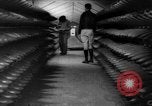
Men work on gun barrels and other ammunition inside an ammunition factory in the United States.
Men work in an ammunition factory in the United States. Ammunition stacked inside a building. Men write down information about the shells. Interior of the factory. Men work on a gun barrel inside the factory. Other men watch. An officer discusses with a man. Artillery lined up on the battlefield. Soldiers stand near the artillery. (World War II period).
CRITICALPAST.COM: About Us | Contact Us | FAQs - How to Order | License Agreement | My Account | My Lightboxes | Shopping Cart | Advanced Search | Featured Collections | Website Terms & Conditions | Privacy Policy ©2026 CriticalPast LLC.
License Agreement |
Terms & Conditions |
Privacy Policy
©2026 CriticalPast LLC.