


 Francais
 Deutsch
 Italiano
Refine Your Search
Miami Beach Florida USA 1963 stock footage and images
- Showing 10801 to 10806 of 26838 results more
more Hide
Hide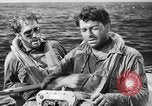
Different communication equipment used by units of the United States Army Signal Corps.
Communication means and equipment maintained and used by the U.S. Army Signal Corps during World War 2. Soldiers in a life boat use a hand cranked radio and an aircraft comes to rescue them. They wave at the aircraft. View of machines used for processing and printing V-Mail letters that are typed by machines and then delivered to soldiers. View of a soldier opening a small V-mail envelope and reading the note inside. Men and women work at various jobs in America in support of war production and war materiel. Men and women war production workers assembling various pieces of electronic equipment and radio devices. Men and women in large, busy clerical and administrative offices supporting typing and communications for the U.S. Army and military. Engineers work in a laboratory. A man loads a tube into a pneumatic message delivery system. Close up views of woman's hands on typewriter typing telegrams, letters, and messages. Women file clerks sort files. Technicians work on a telegraph machine. U.S. Army soldiers on a pole stringing communication wires. A soldier ties a wire on a tree. (World War II period).
The procedure of decontamination after a gas attack - a U.S. Army training film (WW2)
A U.S. Army Training film about Decontamination Procedures during World War II. The film is tilted 'Decontamination Procedures', 'equipment'. An aircraft attack with poison gas on trucks. The trucks go from the gas contaminated area to a safer place. The driver and the assistant driver of the truck, wearing gas masks, open the door and clean the steps and the door of the truck. Members of decontamination team arrive wearing protective clothes. They wash the truck with a solution of kerosene or gasoline. They remove the canvas cover from the truck and spread it on the ground. They put a warning sign board there. They spray the decontamination liquid all over the truck. Cans are refilled with non corrosive powder and chloride mixture, it is mixed well till it is transparent. It is then poured into cans and sprayed on the truck. Then truck is tested with a detector crayon. A 400 gallon apparatus is used to clean the truck. Then truck is washed with a mix of lime and water. It is mixed well and lumps are dissolved. It is then filled in cans. Then pressure pump is used to build pressure in the cans.
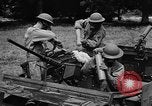
The procedure of decontamination after a gas attack on open vehicles and tanks in the United States (WW2)
A U.S. Army training film about decontamination procedures during World War II. Soldiers decontaminate an open vehicle like a half truck. They hand spray on the vehicle and rub it with a swab. They clean it on up wind side then turn it around and clean. Tanks are brought to a safer area and are turned facing the wind. A soldier opens a hatch and rubs the entrance with decontamination saturated rag. He then uses one o one half quarter sprayer. Then the soldiers clean the surface of the tank. They clean all the other parts of the tank especially openings air ways. A three gallon apparatus filled with non coronation and chlorinated lime is applied on the tank.
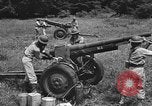
The procedure of decontaminating vehicles and persons in the United States (WW2)
A U.S. Army training film about decontamination procedures during World War II. A thick coat of contaminated solution is swabbed off with kerosene or gasoline. Then a solution of a non corrosive substance is applied. After it evaporates, the vehicle is washed with soap and water and is left to dry. The vehicle is then covered with a layer of oil. Machine guns and artillery are cleaned in the same way. Clothes and rags used for cleaning are then burned or buried. The land is covered with chlorinate lime. Men shuffle their shoes in the lime mixture. They then remove their shoes and clothes with the help of each other. The clothes are spread in air. They remove their socks and underwear and wash themselves in a stream. Then they wear fresh uniforms.
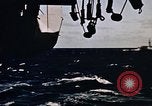
An LCVP, APs and transporters underway in the United States.
Activities aboard the USS Bayfield (APA 33) prior to the invasion of Iwo Jima. Sea as seen from the USS Bayfield. Rigging on a life raft. A Landing Craft Vehicle Personnel (LCVP) is rigged out over the side in the foreground. A convoy of APs underway. An LCVP in right foreground. Three transporters underway. A 5 inch open gun mount 38 in the foreground.
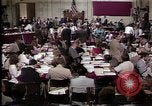
U.S. Marine Corps Lieutenant Colonel Oliver North arrives to testify before a Joint Congressional hearing on Iran-Contra affair
U.S. Marine Corps Lieutenant Colonel Oliver North arrives to testify before a Joint Congressional Committee formed to investigate the Iran-Contra affair. People in the hearing room. Lieutenant Colonel North arrives and is surrounded by media and press photographers taking pictures. Committee members slowly arrive in the room and take their seats. The hearing is called to order by Senator Daniel K. Inouye, Chairman ot the Senate Select Committee On Secret Military Assistance to Iran And the Nicaraguan Opposition.
CRITICALPAST.COM: About Us | Contact Us | FAQs - How to Order | License Agreement | My Account | My Lightboxes | Shopping Cart | Advanced Search | Featured Collections | Website Terms & Conditions | Privacy Policy ©2026 CriticalPast LLC.
License Agreement |
Terms & Conditions |
Privacy Policy
©2026 CriticalPast LLC.