


 Francais
 Deutsch
 Italiano
Refine Your Search
Miami Beach Florida USA 1963 stock footage and images
- Showing 11359 to 11364 of 26838 results more
more Hide
Hide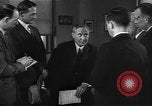
President of Southern States Industrial Council, Fitzgerald Hall, speaks about the NEC report on the economy of the south
Fitzgerald Hall, President of Southern States Industrial Council at his office at Nashville, Tennessee. He speaks to reporters as they take down notes. He speaks out against a report that he says is inadequate, exaggerated and misleading. He says that the south is not Nation's number one economic problem, but rather it is the Nation's economic hope. He is reacting to a 1938 "Report on the Economic Conditions of the South" by the National Economic Council (NEC), that had been echoed in statements by President Roosevelt.
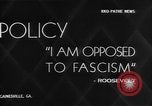
President Franklin D Roosevelt advocates for higher wages and compares feudalism with fascism during a speech in Gainesville, Georgia.
President Franklin D Roosevelt addresses a large gathering in Gainesville, Georgia. He expresses concern regarding the poor economic condition of southern states during the Great Depression and advocates for higher wages and against a system like feudalism. He says the problems are caused by selfishness on the part of a few, leaving one third of the nation ill fed, ill clad, and ill housed. He says "Georgia and the lower south may just as well face facts." He says most wage earners get wages that are far too low, and that "there is little difference between the feudal system and the fascist system" and that he is opposed to both.A large number of people gathered outside a building as they listen to the President.
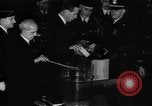
President Franklin D Roosevelt delivers a speech about the Selective Service System in Washington DC, United States.
Official and officers draw draft under Selective Service System at the Department of Labor auditorium in Washington DC, United States. President Franklin D Roosevelt delivers a speech on the occasion, during the lead up to America's involvement in World War 2. He reveals that 95 percent of the people registered under the Selective Service System are not required by the nation and will not be called to military service. He also encourages those new recruits selected for military service to answer the call for duty and defend the independence of the nation. He declares peace keeping as the main task of the United States Armed Forces, and speaks of the those called as members of a peace time army.
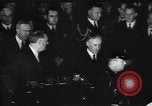
President Franklin D Roosevelt announces results of numbers drawn under the Selective Service System in Washington DC.
Officials draw drafts under Selective Service System at the Department of Labor auditorium in Washington DC, United States. Attorney General Robert H Jackson and Secretary of Navy, William Franklin Knox draw numbers and President Franklin D Roosevelt announces them, during United States initial build-up of military forces prior to the country's involvement in World War 2. A man writes down the numbers drawn on a draft board.
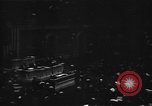
President Franklin D Roosevelt gives a message to the Congress about rearmament during World War II in Washington DC.
A session of the Congress in Washington DC, United States. President Franklin D Roosevelt in his message to the Congress emphasizes about the need for rearmament to avert the danger of an attack during the World War II. In his speech he talks about the need to protect the American hemisphere against an invasion. He also enumerates the possible threats to the independence of United States. He lays emphasis on the need to increase the production of war materiel and ammunition to get ready for the war in case of an attack.
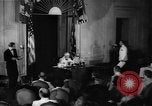
President Franklin D Roosevelt delivers fireside speech about the threat of war in Europe becoming a World War
President Franklin D Roosevelt delivers a fireside speech from inside the White House in Washington DC, United States. During the speech he expresses concern over the national emergency and the need to defend the freedom of American republics. He expresses concern over the European War turning into a World War (World War II) and the increasing threat to countries in the American hemisphere. He condemns Adolf Hitler's policies and stresses upon the need to check Nazi German expansion to the west. He says that the only way to stop Adolf Hitler is to prevent him from gaining control of the seas. Toward this end he stresses the need to speed up the ship building program.
CRITICALPAST.COM: About Us | Contact Us | FAQs - How to Order | License Agreement | My Account | My Lightboxes | Shopping Cart | Advanced Search | Featured Collections | Website Terms & Conditions | Privacy Policy ©2026 CriticalPast LLC.
License Agreement |
Terms & Conditions |
Privacy Policy
©2026 CriticalPast LLC.