


 Francais
 Deutsch
 Italiano
Refine Your Search
Miami Beach Florida USA 1963 stock footage and images
- Showing 14275 to 14280 of 26838 results more
more Hide
Hide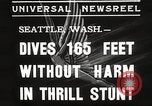
Ray Woods performs a stunt by jumping 165 feet from the George Washington Memorial Bridge in Seattle, Washington.
Ray Woods jumps from the George Washington Memorial Bridge in Seattle, Washington. Ray woods on the bridge as he prepares to perform the stunt. Rescue boats at the Lake Union section of the Lake Washington Ship Canal. Ray Woods jumps from the bridge into the water.

U.S. President Lyndon B. Johnson and the First Lady welcome King and Queen of Thailand in Washington D.C.
United States President Lyndon B. Johnson and First Lady Mrs. Lady Bird Johnson in Washington D.C., United States. King Bhumibol Adulyadej and Queen Sirikit of Thailand visit Washington D.C on their state visit to the United States. The president and his wife welcome the dignitaries. The King and Queen of Thailand arrive at the Executive Mansion with military Honor. Lady Bird Johnson speaks to Queen Sirikit.

U.S. President Johnson's daughter Luci Baines Johnson departs from the hospital after giving birth to a son in Austin, Texas.
Birth of United States President Lyndon B. Johnson's grandson Patrick Lyndon at a hospital in Austin, Texas. President Johnson's daughter Luci Baines Johnson stands holding her son outside Seton Hospital in Austin. Nursing sisters in the hospital. The couple departs from the hospital in their car. People wait outside the hospital to greet the couple.
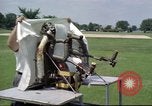
Demonstration of rocket belt flight by pilot Harold Graham at the Pentagon in Arlington, Virginia
Bell Aerosystems Test Pilot Harold Graham demonstrates Rocket Belt Flight backpack (Small Rocket Lifting Device, SRLD) on grounds of the Pentagon in Arlington, Virginia, United States. Man removes cover from the device kept on a table. Military personnel, Pentagon workers, and civilians gathered to watch the flight. Fire brigade along the flight area. Men, women and children stand behind barricaded area. Assistants strap Bell Aerosystems test pilot Harold Graham to the rocket belt flight device. He wears the rocket pack (some might call it a jet pack) on his back like a backpack and grips control handles that extend around to the front from the sides. He takes off from the ground. Two men dressed in traditional American colonial military costumes stand beside the pilot. Photographers take pictures.

U.S. Army Air Forces officers confer with General Electric executives about producing America's first turbojet airplane engine
Documentary film 'The Jet Engines' about the develpment of an American jet airplane, with help of the British who provide General Electric Company with a prototype engine developed by British RAF Group Captain Frank Whittle. A B-17 aircraft taxis and takes off from the runway. Vehicles carry U.S. Air Forces officers and civilian engineers to an airfield where a man stands with a gun next to a U.S. Army Air Forces B-17 Flying Fortress aircraft. The visitors look at cargo containers being offloaded from the aircraft. They contain a prototype British Whittle turbojet engine. Scene shifts to meeting of executives of the General Electric Company with U.S. Army Air Forces officers. They look at schematic of the Whittle engine. GE officials commit to building an American turbojet engine to power U.S. Air Forces airplanes.
Reenactment shows early 20th century U.S. research in gas turbines that contributed to development of turbojet airplane engine
Views of Cornell University where mechanical engineer, Stanford Moss, conducted research into gas turbines as part of his doctoral thesis work in 1903. Dr. Moss later joined the staff of General Electric Company. During World War I Dr. Moss is called to Washington DC to discuss, with the National Advisory Committee on Aeronautics (NACA), development of a turbo supercharger for airplane engines. View of a biplane with turbo supercharger mounted on top of radial engine. Animated diagram illustrating workings of a turbo supercharger. Using a supercharged engine, the U.S. Army Air Services established an altitude record of 36 thousand feet. (The pilot, flying without supplemental oxygen, passes out and doesn't regain consciousness until the airplane has fallen about 30 thousand feet.)
CRITICALPAST.COM: About Us | Contact Us | FAQs - How to Order | License Agreement | My Account | My Lightboxes | Shopping Cart | Advanced Search | Featured Collections | Website Terms & Conditions | Privacy Policy ©2026 CriticalPast LLC.
License Agreement |
Terms & Conditions |
Privacy Policy
©2026 CriticalPast LLC.