


 Francais
 Deutsch
 Italiano
Refine Your Search
Miami Beach Florida USA 1963 stock footage and images
- Showing 15043 to 15048 of 26838 results more
more Hide
Hide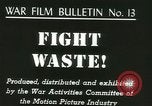
U.S. Government tells citizenry how they can help the war effort by living conservatively and avoiding waste, early in World War II
A public service informational campaign during World War 2 in the United States. A uniformed nurse tends to a U.S. Army Sergeant, Vincent Booth, who lost a leg during the African campaign of World War 2. He is in a wheel chair. The Sergeant speaks about the things that can be done on the home front to ration and help the war effort. As he narrates, a typical American family of three, father, mother, and youth in Boy Scout uniform, are seen sitting down at their dining room table. Missing is their daughter, serving as a WAC overseas (shown briefly in uniform) and their son, in the Navy (also shown briefly, in uniform). Scene shifts to the father at his work place. Narrator says he uses 10 percent of his weekly income to buy war bonds. The mother is seen at home with her Boy Scout son. She is writing letters to her son and daughter in the service. Change of scene shows her in a hospital, volunteering as a Red Cross Nurses aid. Next, the family members are seen in their home, characterized by the narrator as "an arsenal for victory," where they are being careful not to waste resources like electricity, home heating fuel, and cooking oils. They contribute their old metal objects to the war drive collections, and their son in the Boy Scouts participates in the local paper salvage drives. He is seen in Boy Scout uniform tying up a bundle of newspapers (with pictures of Hitler and Tojo on top which he dramatically stands on when tying the papers). They repair and use their old clothes, or contribute them to charities. The propaganda film ends summarizing ways that ordinary civilians can help the war effort, by rationing and avoiding waste at home, with on screen instructions: "Fight Waste! 1. Don't waste anything; 2. Buy only what is necessary; 3. Salvage what you don't need; 4. Share what you have."

Wendell Willkie salutes and people carry hot air balloons of various shapes during a parade in Milwaukee, Wisconsin.
A parade in Milwaukee, Wisconsin. U.S. soldiers march. The Republican Party nominee of the 1940 Presidential elections Wendell Lewis Willkie salutes. People on bicycles and cars in the parade. People dressed in different costumes. They carry hot air balloons shaped as different animals. A hot air balloon shaped in the form of a train. (World War II period).

Women pick daffodils in a large outdoor garden and a military couple exchanges rings during a wedding in Orting, Washington.
A military wedding in Orting, Washington, United States. Women in costumes pick daffodils in a large daffodil flower field. Soldiers and officers gathered during the spring time wedding. Staff Sergeant William Melnick and Private Clara Owens, from Fort Lewis, exchange rings. Soldiers hold guns as they stand near. The newly married couple kisses. (World War II period).
Parents of Japanese-American soldiers who died serving in the U.S. army are awarded Purple Heart medals.
Parents of American soldiers of Japanese ancestry receiving awards in the United States, during World War 2. Parents of the Japanese-American soldiers seated at the ceremony. They are receiving Purple Heart medals for the soldiers who died while serving in the U.S. army. Narrator mentions "60 from Hawaii alone gave their lives." (The soldiers were likely from the 100th Infantry or 442nd Regimental Combat Team).

The American students on an exchange trip to Africa as John Kennedy outlines the peace corps program in Washington D.C.
The U.S. president John Fitzgerald Kennedy outlines the peace corps program in Washington D.C., United States. The American students construct houses in Africa during an exchange program. A student puts cement on wall under construction using a shovel. Students stand on a bamboo scaffold and other work with shovels. Students pass bricks. A student washes his face. The students lined up for food. They sit and eat food using mess kit. Exteriors of the White House. The president John Fitzgerald Kennedy in the White house outlines the peace corps program. He speaks that the American peace corps will go abroad to work with the citizens of the newly developed countries. The peace corps will work in three major sectors : teaching,agriculture and health. The aim of the peace corps is to make a peaceful world.
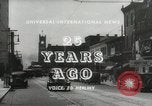
Damaged bridges, houses and property due to the floods in the various rivers of the United States in 1936.
Flood damage in the United States in 1936. The Kennebec River, Maine: men stand on blocks of ice and view a broken bridge due to flooding. Ice jams loosened on the Penobscot River threaten towns near Bangor, Maine. View of giant ice flows and downed utility poles The Housatonic River, Connecticut: Broken electrical towers on the blocks of ice. Men walk on the ice blocks. Men clear the ice from road. Passaic River, New Jersey: the water of the river flows above limits over a bridge. Lake Conemaugh, Pennsylvania: View of submerged houses from flooding. The destoyed houses due to flood. The people stand on a bridge and heavy flow of water under the bridge. Ohio River: the submerged buildings from flooding are seen. Men on boats in front of the submerged shops. People on bridge run. The damaged cars,trains and trams lie on the streets. The streets filled with water. From a 1961 newsreel recounting events 25 years earlier.
CRITICALPAST.COM: About Us | Contact Us | FAQs - How to Order | License Agreement | My Account | My Lightboxes | Shopping Cart | Advanced Search | Featured Collections | Website Terms & Conditions | Privacy Policy ©2026 CriticalPast LLC.
License Agreement |
Terms & Conditions |
Privacy Policy
©2026 CriticalPast LLC.