


 Francais
 Deutsch
 Italiano
Refine Your Search
Miami Beach Florida USA 1963 stock footage and images
- Showing 1597 to 1602 of 26838 results more
more Hide
Hide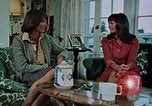
Jennie, a rape victim recounts how she was raped and underwent medical examination and CID inquiry.
U.S. Army training film about victims of rape in the United States. Victim works with police and CID special agents in the United States. Emmie, a victim of rape, talks to a lady named 'Monica', who helps women (Victims). Other women seated in a room. Jennie, one of them describes every thing about her and what she went through. Past events show Jennie as a soldier. She marches at a parade with other military personnel. Views of Jennie after her rape. She walks on a street in night. Police car arrives there and police men get her into the car and rape her. Nurse talks on phone about Dr. Marshall in hospital. Dr. Marshall talks to Jennie and asks her about undergoing physical examination. Nurse, Jennie and Dr. Marshall in a room at the hospital. Dr. Marshall tells Jennie to take samples for examinations. She signs on papers for undergoing an examination. Hospital staff members testify the samples in a laboratory. Jennie meets CID special agents and gives them information about the rapist. Jennie comes outside from church with officer and talks with him to apprehend and punish the rapist'. Emmie at a beach. A man flies kite at beach. Emmie keeps looking at the strange man. She walks on the beach.
CIA and other U.S. sponsored experiments dealing with control of animals and people using various techniques during the 1960s and 70s.
In 1964, Professor Jose M.R. Delgado, of Yale University's School of Medicine, invented a device he called a stimoceiver. It was a chip that could alter the brain’s electrical impulses via radio signal. In tests sponsored by the U.S. Office of Naval Research, he implanted the device in the brain of a bull. This film opens shows that experiment and its results. A man in Cordova, Spain, opens a bull ring door to allow a fighting bull to enter. It charges a man holding a cape. Another man fires a dart to sedate the bull. Several men plant electrodes for a stimoceiver in the bull's brain. Next, the bull charges a man holding a cape, but pulls up short before hurting him. The bull chases the cape but never attacks the man as the man uses remote control to influence the animal's behavior. The bull charges around in a circle. Scene shifts to Dolley Madison Parkway (Route 123 in Mclean, Virginia, where sign points toward the CIA headquarters at Langley, Virginia. Narrator lists various techniques examined in the 60s and 70s, including brain surgery; psychosurgery; creation of amnesia; parapsychology; and manipulation of genes. Glimpse of some facilities at CIA headquarters. Change of scene to hearing of the Senate Subcommittee on Health and Scientific Research on September 20, 1977. Chaired by Senator Edward M. Kennedy, the Committee sought information about these activities by the CIA. Narrator says witnesses had agreed to limit information they would provide the Subcommittee. Former narcotics officer Charles Siragusa is seen on camera admitting that the man he reported to at the CIA wanted him not to say anything. Former CIA chemist Robert V. Lashbrook is seen testifying that he has no knowledge about the CIA running safe houses. (Narrator states he ran one of them and that a "surprise LSD experiment" was conducted there.) Scene shifts to a California tennis court, where Dr. Sidney Gottlieb is playing doubles tennis, Narrator says he oversaw those activities at the CIA but destroyed all his records when he retired in 1973. View of a letter he wrote at that time, in which he states he and his colleagues had been able to maintain contact with the leading edge of chemical and biological developments in the field of biological and chemical control of human behavior. View of Dr. Gottlieb entering an ante room where he testified before the Senate Subcommittee on Health and Scientific Research without being filmed because of what his lawyer claimed were health and cardiac problems. View of him on the tennis courts as Narrator states he declined ABC News requests for an interview. Change of scene to George White who retired from the CIA and lives in Stinson Beach, California. View of Stinson Beach from high overlooking vantage point. People jogging on the beach. Narrator states that White wrote to Dr. Gottlieb summing up his career saying, "it was fun fun fun, and where else could a red-blooded American boy lie, kill, and cheat, steal, deceive, rape, and pillage, with the sanction and blessing of the All Highest." Narrator strolls on lawn near the U.S. Capitol building and says it appears doubtful that mind control has been achieved. But work, that we don't know very much about, is continuing in this field. He asks how deeply are the Russians and other dictatorships into this. He notes that the CIA is reluctant to give information about it (such as Project MKUltra) and he questions where such a program fits in a democracy. He notes that one person working on these projects told him there are capable, conscientious, and very capable scientists working for our country, and "their work speaks for itself."
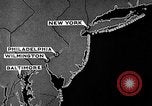
Coast Guard Stations along coasts of Long Island and New Jersey in the United States
Film begins showing map of Coast Guard Stations along the coasts of Long Island, and New Jersey to deal with storms that affect the ports of New York, Philadelphia, Wilmington, and Baltimore. Narrator notes that, accordingly, the number of Stations in this region are increased. View of Long Island South coast from low flying airplane, showing sand bars. Aerial view of Jersey shores showing a ship run aground and listing. Aerial view of the resort towns and recreational beaches on the Jersey coast. Closeup of a beach filled with people enjoying the sand and water. Aerial views of beaches teeming with visitors. Aerial view of harbor filled with small pleasure boats. A sailing regatta.
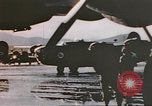
U.S. Air operations from Adak, and views of.the island's defenses during the Aleutians campaign of World War II.
As film begins, two U.S. B-24 bombers are seen taxiing across the Adak airfield to takeoff on a bombing run against the Japanese airfield at Kiska Island. Closeup of B-24 with engines running. About an inch of water covers the ramp. The two bombers take off (followed by others unseen). Airmen on the ground watch them depart. Scene shifts to the port of Adak. A cargo ship and a tugboat moving a barge are seen in the water. Trucks drive along the beachfront. Mountains loom in the background. Military supplies, including munitions are seen piled along the beach. Soldiers carry some goods over their shoulders. Closeup of items piled on the beach. A dog trots along with soldiers walking the beach. Change of scene highlights guns installed as coastal defense on the island, including fixed heavy guns, anti-aircraft guns and machine guns. A sailor viewed through a life safer buoy, paints part of a warship. A Navy PBY Catalina on patrol is seen overhead. U.S. gunboats patrol the harbor. Crew members are seen aboard a U.S. destroyer patrolling deep waters off Adak. They exchange blinker light messages with a Bancroft-class (four-stacker) destroyer. Glimpse of the Bancroft-class destroyer flashing blinkers lights. Sailors on a destroyer respond to alarm of sonar sound contacts and man battle stations. Closeup of a Bancroft-class destroyer, followed by views of depth charges being launched from a destroyer underway. Exchanges of blinker light messages between camera destroyer and a Bancroft-class destroyer.
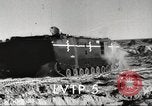
U.S. LVTP-5 (Landing Vehicle Tracked Personnel-5) and LVTA-5 (Landing Vehicle Tracked Armored-5) in United States.
Capabilities of U.S. amphibious vehicles carried by landing ships, United States. LVTP-5 (Landing Vehicle Tracked Personnel-5) moves up a beach. LVTP-5 leaves beach and goes in surf. LVTA-5 (Landing Vehicle Tracked Armored-5) moves up on a beach. LVTA-5 equipped with a howitzer.
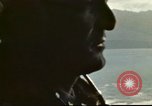
U.S. Navy PBY Catalina seaplane lands in water at Naval Air Station Kanoehe Bay, Oahu, Hawaii.
View from cockpit of a U.S. Navy PBY airplane circling to land at the Naval Air Station Kanoehe Bay, Oahu, Hawaii. View from the land, as PBY taxis in toward beach after landing. A man stands by a white flag at beach front to guide the seaplane. A crewman seated on the wing of the seaplane. A man swims out to the PBY, as it approaches the beach. Several flights of Curtiss P-36 Hawk aircraft fly overhead in formation.
CRITICALPAST.COM: About Us | Contact Us | FAQs - How to Order | License Agreement | My Account | My Lightboxes | Shopping Cart | Advanced Search | Featured Collections | Website Terms & Conditions | Privacy Policy ©2026 CriticalPast LLC.
License Agreement |
Terms & Conditions |
Privacy Policy
©2026 CriticalPast LLC.