


 Francais
 Deutsch
 Italiano
Refine Your Search
Miami Beach Florida USA 1963 stock footage and images
- Showing 16291 to 16296 of 26838 results more
more Hide
Hide
An electrical specialist checks wires,harness connections,battery during the inspection of B-24 aircraft in the United States.
The 50-hours inspection of the ignition and electrical system of USAAF B-24 Liberator heavy bomber aircraft at an airfield in the United States. Men exercise on the field. An animated diagram of human skeleton and United States Army Air Forces B-24 Liberator heavy bomber aircraft. The B-24 heavy bomber aircraft takes off. The aircraft in flight over grasslands. The B-24 parked at the airfield. The crew members start the 50-hours inspection of ignition and electrical system of the aircraft. An electrical specialist tightens the elbow terminals and nuts of the hammering engines. The specialist checks the chamber and slides wires and makes sure they are not worn. He checks the cable for security of mounting. After inspecting all the wires and harness, the specialist checks other attachments. He examines the switch lead and removes cover from booster coil. The signals for operation test on cover plate switch board flow smoothly, so the specialist gives an 'OK' signal. During the electrical inspection: the specialist notes the operation of the battery disconnect relay. A man in the cockpit operates the battery switches. The specialist signals in the cockpit and replaces canvas covering. He checks battery insulation for proper security of connections. The specialist makes the hydrometer test with electrolytes and removes the sump and cleans it with soda water bath and neutralize acids. He checks the proper connection of accessible electrical leads and also checks the landing lights and examines the inter cooler shutters in the cockpit. The specilaist checks the generator for security of mounting and makes sure that the brushes are in good condition. He tests the oiling and cooling blast connection.
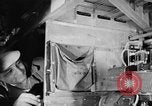
An electrical specialist checks regulators,igniter,alarm bell,motor during the B-24 aircraft inspection in the United States.
The 50-hours inspection of the ignition and electrical system of the USAAF B-24 Liberator heavy bomber aircraft at an airfield in the United States. The electrical specialist checks the regulators in the aircraft nose compartment. The specilaist checks starters and removes window strap for proper inspection. The specialist checks brush condition and inspects the heaters. He takes out screws and pulls out back casting and inspects the back plate for deformation of metals. The electrical specialist uses air hose to clean the oven. He checks and cleans the igniter using a brush. The specialist makes a similar inspection with the side heaters and cleans solenoid belt. He runs the motor and checks its functioning. He inspects the battery plug connection on the outside of the aircraft. He checks the A/C inverter. O perational check of alarm bell is done. He opens the fuse box to repair it, and with the help of a diagram he replaces the bad fuse with the new fuse. The aircraft in flight after completion of inspection.

Honor girl presents colors to the midshipman during the final dress parade at the U.S. Naval Academy in Annapolis,Maryland.
Final dress parade at the U.S. Naval Academy in Annapolis, Maryland. United States Naval Academy students lined up on a field during the Graduation Week. Honor girl of the year presents colors and a traditional kiss to the midshipman of the outgoing class. The students march in the Final Dress parade

Farmers plow undergrowing crops with tractors due to strikes by cannery labors in Racine,Wisconsin.
Cannery labors' strike in Racine,Wisconsin. Cannery labors protest holding placards through the streets in Racine. Farmers plow undergrowing crops with tractors due to the strike by the cannery labors. Children celebrate a Roman holiday and play on a farm.

Aircraft fly in formation,soldiers fire artillery and advance on field during war rehearsal in Chicago, Illinois.
The U.S. Army rehearses for war in Chicago, Illinois. An aircraft in flight. Soldiers fire artillery and advance on a field. Antiaircraft guns fire at diving aircraft. Soldiers fire machine guns. Tanks advance on a field.

A man secures stabilizer to ring tail,covers with drag ring,adjusts valve before the release of torpedo in United States.
New techniques in aerial torpedo attack, United States. An aircraft in flight over a sea. The aircraft releases torpedo in water. Torpedo moves. Men haul trolley loaded with the torpedo. The shroud ring or ring tail is in conjunction with the drag ring on nose of the torpedo. Using ring tail and drag ring with wooden stabilizer results in successful test drops. A man secures the stabilizer to ring tail with wooden dowels. The man covers the torpedo with a drag ring which helps to stabilize the torpedo during air travel, and seals the ring. The man adjusts the water trip delay valve which prevents the torpedo from burning up during long travels. Depth setting is done. (World War II period).
CRITICALPAST.COM: About Us | Contact Us | FAQs - How to Order | License Agreement | My Account | My Lightboxes | Shopping Cart | Advanced Search | Featured Collections | Website Terms & Conditions | Privacy Policy ©2026 CriticalPast LLC.
License Agreement |
Terms & Conditions |
Privacy Policy
©2026 CriticalPast LLC.