


 Francais
 Deutsch
 Italiano
Refine Your Search
Miami Beach Florida USA 1963 stock footage and images
- Showing 16489 to 16494 of 26838 results more
more Hide
Hide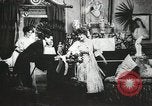
Dramatization :Fantasy of courtship attended by visions, magic, and fairies
Paper print. Early motion picture made in the United States. Dramatization : man presents a bouquet to a woman. He is visited by an angel with a wand, who magically brings him to the woman he seeks. The woman appears magically in miniature above a vase. A full size woman appears in magical costume. Tiny fairies watch as a scallop shell opens and a fairy queen appears. A fairy carries a valentine heart. The couple appears bedecked by heart-shaped valentine collars.

Comical vignette. engineer seeks help to design bridge, uses books, telephone and public library. Marries librarian
Series of pictures in slide show style with piano accompanyment. Engineer designs bridges in the United States. He thinks about the designs. Engineer picks up a book from a book rack. He talks over telephone. He go to a library. The librarian hands him a book on great bridges. Picture of upper jaws. Engineer scolds the librarian. Board placed on wall reads 'Quiet'. Engineer and librarian get married.

Woman engineering worker argues with boss and urges that employees make use of a new information center.
Early information retrieval practices in a corporate engineering office in the United States during the 1960s. Dramatization depicts a woman in the work force in the 1960s: Female worker with vintage 1960s beehive hair style appears to be performing work as a secretary, but, it turns out she is engineer Julie Stone. Julie takes printouts from a printer in information center. She opens a drawer and takes out document files. She leaves her office. She arrives at office of her Chief named George A Price. Chief scolds an engineer called Harry for committing mistakes in his designs. Chief asks Harry to be responsible in his work. Another engineer named Pete Newton draws designs. View of the cabins. Harry meets Newton and discuss about his conversation with Chief. Julie on telephone calls Harry. They go to a restaurant for lunch. They talk about the sources of information and Julie encourages Harry to use the information center that she runs, rather than relying on antiquated and incomplete methods of obtaining information. Julie gets up and leaves the restaurant. Harry and Pete talk in the office. Pete asks him about his meeting with Julie. Harry takes his seat and opens a drawer. He looks over the documents and publications, including a Playboy magazine, to get information about transistors. Julie meets with Chief and complains about Pete and other engineers failure to use the information center and to lookup answers to questions in a more comprehensive way. Chief attends a telephone call. Pete enters Chief's office. Depicts woman worker arguing with boss. Clip also shows examples of common work place interpretation of women worker roles in the 1960s, including opening introduction of clip that objectifies the woman worker as a sexual object (before broad awareness of sexual harassment in the workplace), and a restaurant scene that opens with the man assuming that the woman has asked him out to lunch as a love interest rather than for work purposes.
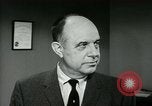
Engineers planning computer information center for processing data in the United States; 1960s attitudes toward woman workers.
Engineer's problem of retrieving information in the United States. Dramatization depicts: actress portrayed as engineer named Julie Stone leaves Chief George A Price's office. Chief interacts with engineer Pete Newton about the information center. Book rack in the background. View of a information center building. Men enter a Univac data center computer room. They confer while over a terminal labeled "UNIVAC Thin Film Memory" . Close up view of reel to reel computer and punch tapes running. Chief and Pete walk out from the information center. Men enter elevator while boss points to his watch. They meet Mr Cook. Cook discusses the sources of information for engineers. Pete asks about the transistors to solve designing problems. Cook calls his assistant and hands her a message. Assistant arrives and hands documents to Cook. Pete looks at the documents about the designing problems and references of design manuals. They return to their office. Pete enters Julie's office and hands her the reference documents. Engineer Harry seated at her cabin. Julie opens drawer and hands him documents about transistors for design problems. Julie and Pete subtly express romantic interest in one another. Chief enters Julie's office and hands her a reference paper about construction problems. Men interact. Julie searches for documents to help Chief solve his problem. She finds and hands him the documents. The men refer to woman worker Julie as "My girl" (consistent with era of inequality, sexism, and sexual harassment in workplace).
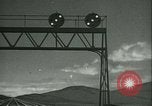
Development of the railroad transportation network and wide use of trains as a means of transportation in the United States.
Development of the railroad transportation in the United States. Trains parked on railroads. Mountains in the background. Train moves on railroads. Passengers seated in train read and interact. Crew serve them meals. Dramatization depicts: A family move in a horse drawn cart through field. Boy interacts with his father about railroad development. Woman reads magazine. Trees in the background. They watch a moving train. Animation depicts: the developing transportation system. Civilians gathered at marketplace. Animated map of America.
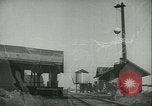
Development of railroad operating navigation and wide use of railroad transportation by the industries in the United States.
Development of the railroad transportation in the United States. Development of the railroad operating navigation from Highball signal to Semaphore signal to the automatic precession light signal. Iron railroads replaced by the steel railroads. Train moves under tunnel. Large crowd of passengers gathered at the Pennsylvania Station (Penn Station New York City). Exterior and interior views of Penn Station in Manhattan. Train moves across arch rail bridge known as the Hell Gate Bridge in New York. Raw materials and finished products are loaded in railroad trains at steel plants, foundries, oil towers, and mills. Farmers load their agriculture products in wagons.
CRITICALPAST.COM: About Us | Contact Us | FAQs - How to Order | License Agreement | My Account | My Lightboxes | Shopping Cart | Advanced Search | Featured Collections | Website Terms & Conditions | Privacy Policy ©2026 CriticalPast LLC.
License Agreement |
Terms & Conditions |
Privacy Policy
©2026 CriticalPast LLC.