


 Francais
 Deutsch
 Italiano
Refine Your Search
Miami Beach Florida USA 1963 stock footage and images
- Showing 16915 to 16920 of 26838 results more
more Hide
Hide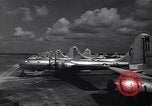
Civilian painters paint U.S. Army Air Force B-29 Superfortress bomber aircraft at an airfield in the U.S. during World War II.
U.S. Army Air Force B-29 Superfortress bombers at an airfield in the United States during World War II. A B-29 that is being protectively sealed in preparation for painting. Fuselage and number 3 engine are sealed. Moveable scaffolding is in place and drums of liquid are on the ground. Painter begins process of sealing an engine nacelle, by taping opening. He then sprays a synthetic "spider web" of material over the opening. Similar material is sprayed into various openings of the aircraft, until a fabric is formed over them. Finally, preformed sheets of fabric are used to seal other sensitive seams on the airframe and trailing edges of wings..
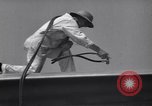
Painting and mothballing B29s and B-17s in the United States
U.S. Army Air Force B-29 Superfortress bomber aircraft at an airfield in United States during World War II. A civilian spray paints the wing of a B-29. A painter uses a roller around the wing insignia. Several civilians using ladders, paint a B-29 Superfortress. Man on forklift empties 55 gallon drum of mastic liquid into power sprayer. Sprayer nozzles are shown. Operator sprays mastic material on fuselage of mothballed B-29, to seal it. B-17 with mastic sprayed on tail section of fuselage. A Wright 3350 radial engine from a B-29, on a stand and series of views as it is gradually mothballed. View of sealed B-29 airframe, with engines removed, and hosing connected to various openings.

Aircraft workers on an assembly line during the construction of U.S. Lockheed bomber airplanes in Burbank, California.
U.S. Lockheed bomber airplanes under construction in Burbank, California during World War II. The airplanes are to be transported to England. Aircraft workers on an assembly line in a factory. The workers move out of the factory. Cars parked outside the factory.

USS Bear with members of a South Pole expedition gets underway from Boston, Massachusetts.
The U.S. Navy survey ship USS Bear (AG-29) departing Boston, Massachusetts. Dogs and men aboard the ship at a dock in Boston. As well-wishers wave from the pier, the USS Bear gets underway with members of the United States Antarctic Service Expedition (AKA Admiral Byrd’s third Antarctic Expedition) aboard.
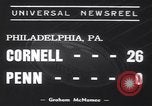
Cornell University beats the University of Pennsylvania with a score of 26-0 in a match in Philadelphia, Pennsylvania.
A football match between Cornell University and the University of Pennsylvania in Philadelphia, Pennsylvania. The match in progress. A cheering crowd in the stands. Cornell University beats the University of Pennsylvania with a score of 26-0.
U.S. Navy Dr. Walt Miner gives historical background of LSD (Lysergic acid diethylamide) drug in the United States.
The film gives an introduction and briefs the history of illegal drug LSD (Lysergic acid diethylamide). U.S. Navy Doctor Walt Miner speaks about revealing the facts about LSD which can be documented. He speaks about the historical background of LSD. He says that LSD is synthesized from lysergic acid derived from ergot, a grain fungus that typically grows on rye. He says that ergot is a fungus that grows on grains and other cereals. He speaks about Swiss chemists Albert Hofmann and Stahl who tried to make modifications in LSD molecule in 1938. He mentions the event of 1943 when Dr. Hofmann intentionally ingested 250 micrograms of LSD in his laboratory and how he felt uncomfortable. Dr. Walt Miner further explains how unique and powerful LSD drug is and says that the most unique thing about LSD is effective dose of the material. Miner states that effective dose for LSD can range from 0.5 micrcograms to 1.5 micrograms per kilogram of body weight.To explain the effective dosage of LSD, he displays a piece of wax paper where a mark is made with a pen. A penny is placed beside that mark to compare the two sizes. Dr. Miner informs that the ink mark weighs some micrograms. Dr. Miner takes one drop of human blood from a tube and says that this one drop contains 330 million cells and in comparison to that the weight of LSD to produce its effect is equal to the weight of two blood cells.
CRITICALPAST.COM: About Us | Contact Us | FAQs - How to Order | License Agreement | My Account | My Lightboxes | Shopping Cart | Advanced Search | Featured Collections | Website Terms & Conditions | Privacy Policy ©2026 CriticalPast LLC.
License Agreement |
Terms & Conditions |
Privacy Policy
©2026 CriticalPast LLC.