


 Francais
 Deutsch
 Italiano
Refine Your Search
Miami Beach Florida USA 1963 stock footage and images
- Showing 17209 to 17214 of 26838 results more
more Hide
Hide
Animation depicts characteristics of U.S. soldiers and their superiority over other people in the United States.
Animated film on characteristics of U.S. Army soldiers during World War 2. Propaganda film depicts positive characteristics of the soldiers. They are compared to other people. They are taller and weigh more than other people. They know more about maps and compasses. They shoot more accurately with rifles. They have more fire power than others. They also know more about arrangement of beds than the average housewife.
Animation depicts the supply of guns and ammunition after being produced in a factory in the U.S. to a battlefield.
A film on problems of military supply. Animation shows a shell being fired at a target board. Production of shells and guns in a factory in the United States. They are loaded in a train and the train moving on a railway track. Then they are carried by ships. They are loaded in an airplane and the airplane in flight overhead. They are then carried by trucks and finally by mules to a battlefield. The soldiers then are able to use the ammunition. (World War II period).
Animated cartoon in the U.S. depicts how Private Snafu, who refuses to wash his mess gear, contracts diarrhea.
A film about sanitation and hygiene directed at American soldiers and military personnel during World War 2 shows how diseases like diarrhea and dysentery are contracted by soldiers. Animation shows a medical aid station on a field. A dirty plate in a dining or mess area. A Private Snafu refuses to wash his mess gear eating utensils. He takes food on a dirty plate. He contracts diarrhea. He rushes towards a washroom several times.
Wrong methods of instruction chosen by instructors during a training of the soldiers in the United States.
Training of U.S. soldiers in the United States. An instructor should consider several points before instructing the soldiers. A group of soldiers seated in a field. An instructor instructing them. Traffic moving past on a road nearby. The soldiers are not able to understand due to noise. Another instructor speaking to the soldiers lined up. A unit working nearby. A smoke screen is laid for the training of the soldiers. The other unit gets disturbed. One more instructor instructing the soldiers. The soldiers seated on the ground. The instructor instructing the soldiers about M-1 rifles by reading from a manual. Some of the soldiers sleeping. (World War II period).
An instructor prepares before giving a lecture to students in a class in the United States.
Training methodology for U.S. soldiers in the United States. Soldiers seated in chairs in a class room. An instructor speaking to them. He talks about types of gases and their identification. A diagram on a chart. The instructor has not prepared for the lecture. He arrives near a table to get a gas identification set. The set is not there. Another officer talking to the soldiers and speaking about the well preparedness for any action before it is being undertaken. The instructor preparing for the next lecture. He reads a book and makes notes. He assembles equipment and rehearses lesson. The instructor speaking to the students in a class. He speaks about a rifle and its working. He gives step by step demonstration of each phase. The students holding rifles. The instructor asks them questions. They discuss at the end of the lecture to sum up the important points and to clarify the doubts. (World War II period).
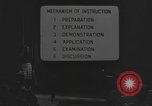
Correct mechanism and methods of instruction are explained to soldiers in the United States.
Training methodology for U.S. soldiers in the United States. An instructor instructs soldiers seated in a class room. He speaks about the correct methodology of teaching. A chart on a board reads 'Mechanism of instruction'. There are six steps in the mechanism of instruction. They are 'Preparation, Explanation, Demonstration, Application, Examination and Discussion'. The methods of instructions are also explained. These things should be considered while instructing 'The Lecture, the Conference, the Demonstration, the Group Performance Method and the Coach and Pupil method'. The lecture should be brief and interesting. Training films, slides, maps, models and other devices should be used. An instructor instructing a class. He takes a long lecture. The soldiers sleep in the class. (World War II period).
CRITICALPAST.COM: About Us | Contact Us | FAQs - How to Order | License Agreement | My Account | My Lightboxes | Shopping Cart | Advanced Search | Featured Collections | Website Terms & Conditions | Privacy Policy ©2026 CriticalPast LLC.
License Agreement |
Terms & Conditions |
Privacy Policy
©2026 CriticalPast LLC.