


 Francais
 Deutsch
 Italiano
Refine Your Search
Miami Beach Florida USA 1963 stock footage and images
- Showing 17371 to 17376 of 26838 results more
more Hide
Hide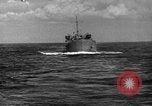
Information about the officers who handle different parts of Landing Ship Tanks in the United States. (WW2)
A World War II training film on design of Landing Ship Tanks (LSTs). An LST underway at sea in the United States. Valves to a tank line. A man working inside the LST. A storage tank consisting of fresh water and fuel oil. Other landing crafts underway at sea. Officers who control the Landing Ship Tank. The conning tower. The Commanding Officer on the conning tower. The officer looks through binoculars. The Communication Officer handles the signal bridge. Below the conning tower, in the wheel house, is the Executive Officer who is the navigator of the ship. The officer looks through binoculars. The Gunnery Officer. The ship's Supply Officer on the stern. An engineer controls the engine. The officer in charge of loading and unloading of important cargo. Tanks are loaded on the ship. Troops seated aboard.
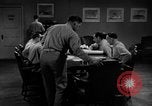
The TQM with other officers formulate plans for loading and employment of an LST in the United States.
A training film on loading and employment of LSTs (Landing Ship Tanks) in the United States. Officers seated at a desk. They make strategies and plans for the loading and the employment of the ship. The office of the Transport Quartermaster Officer (TQM). A TQM seated at a desk. He confers with commanding officers of each unit to be transported. They ensure correct loading of every equipment. They fill a form. Plans for handling of special items and protection of cargo from different weather conditions are made. The TQM makes a personal inspection of a ship. He finds out possible minor conversions which should be made. A man standing with him. He gives information about changes which are required. The TQM discussing with other officers and personnel. The TQM standing near a table with officers in his office. He designs plans for the ship. He lays out the ship's blueprints and corrects any peculiarities. Cargo loading and other plans are formulated. They prepare the profile storage plan. Then they compile the loading summary. The ship's Cargo Officer and the TQM present the loading plan to the ship's Captain for his approval. The Captain must agree with him in every detail. After the final agreement, the ship prepares to receive the cargo. The cargo is being loaded. Men working on the ship.
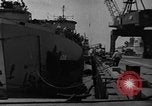
A Captain briefs officers aboard an LST underway at sea in the United States (WW2)
A World War II training film on loading and employment of LSTs (Landing Ship Tanks) in the United States. LSTs get ready at a harbor to get underway. The LSTs underway proceeding in a convoy. Cargo and troops aboard the LSTs. Careful loading is very essential. Tanks and half tracks are loaded below in the LST. Trucks, jeeps and LVTs ( Landing Vehicle Tracked) and other vehicles are loaded on the main deck. Officers gather in the wardroom and get seated at a desk. The Captain briefs them. Data gathered in the meeting is passed on to crew aboard. Men seated on the deck.

Landing boats underway at sea head towards a rendezvous area in the United States.
A film titled: 'Amphibious Warfare Landing Boat Tactics Attack' on movement and tactics of landing boats. Landing boats underway at sea in the United States. Crewmen seated inside a room. An officer briefs them. A model of an Amphibious Transport (APA). Boats operating from this APA make up a boat group. The APA underway at sea. Men aboard a boat. Animation depicts an assembly area for personnel. Information about speed and distance of the boats in a circle. LCMs ( Landing Craft Mechanized) on a side of the APA. If the APA does not complete the group, the boat group is completed by boats from other ships. Design of an APA. Debarkation centers of the APA. Numeral and color designations are given to stations. Flags atop flag poles on the APA. Troops come aboard the ship by climbing up a landing net. The landing diagram should be studied carefully. The boats head towards the rendezvous area. (World War II period).
Landing boats underway at sea move in a group to form wave near a rendezvous area in the United States.
A training film on movement and tactics of landing boats in the United States. The rendezvous area. Aerial view of the boats underway at sea. Flags atop flag poles on the boats. The flags are used to give signals. The rendezvous area is protected by support boats. Animation depicts the boats moving in the area. Waves are formed by the boats to complete the boat group. The boats underway at sea circling in the area. They get a signal from the control vessel to move. The boats move in a sequence. Signals to change the formations are given by the Wave Commander. Animation depicts the positions of the Wave Commander and the boats. A landing diagram distance reads 100 yards.

A U.S. Navy F9F Panther pilot undergoes training for photo reconnaissance at Naval Air Station Miramar during Korean War
A film titled: 'Fighter Photo-Eyes of the Fleet' on the importance of photographic reconnaissance. A board reads: "Composite Squadron Sixty One - VC-61" outside a building of Naval Air Station Miramar in San Diego, California, United States. F9F Panther aircraft in formation fly by. A jeep arrives. A pilot gets off the jeep. The pilot arrives near the building. Men load cameras in an airplane. Interior of an office. Officers seated at a desk in the office. The pilot shakes hands with the officers. They look at a model of an aircraft. The pilot walks with his luggage. A jeep arrives near him. He shakes hands with the man driving the jeep and talks to him. He sits in the jeep. The jeep drive away. Buildings along the sides of a street. The jeep comes to a halt and the man gets off. Man enters building with sign "BOQ Office". Inside a man loads film into a camera. The man seated with other crew members inside a building. An officer instructs them on aerial reconnaissance photography techniques in the classroom. View of three Republic F9F Panther aircraft in formation flight overhead. The man looks at the aircraft. He writes a formula and explains to the crew.
CRITICALPAST.COM: About Us | Contact Us | FAQs - How to Order | License Agreement | My Account | My Lightboxes | Shopping Cart | Advanced Search | Featured Collections | Website Terms & Conditions | Privacy Policy ©2026 CriticalPast LLC.
License Agreement |
Terms & Conditions |
Privacy Policy
©2026 CriticalPast LLC.