


 Francais
 Deutsch
 Italiano
Refine Your Search
Miami Beach Florida USA 1963 stock footage and images
- Showing 1759 to 1764 of 26838 results more
more Hide
Hide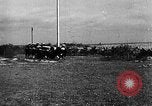
Coast Guardsmen conduct a breeches buoy drill
Coast Guardsmen in uniform wheel a beach cart containing a lyle gun and other equipment for firing a shot line to a vessel in distress. They are conducting a breeches buoy drill. They remove a lyle gun and flaking box from the cart and uncover the shot line which they place in the gun. Using a long lanyard, one guardsman fires the gun. Closeup of the shot line smoothly paying out from the flaking box. It is fired to a simulated mast (tower) on the beach. Closeup of large spools of whip line with instructions to the distressed crew about their use. After the whip line and block are set on the distressed ship's mast, the Coast Guardsmen now prepare the whip line to move large hawser line to the mast. Large spools of hawser line are seen in background. Closeup of Guardsmen pulling hawser from the spools. Guardsmen tie the hawser to the whip line for hauling aboard the distressed vessel. Closeup of the whip line pulling the hawser across the sand to the tower. Guardsmen working rapidly to accomplish this. A breeches buoy being attached to the hawser which is then propped up for elevation. View of the Breeches Buoy traveling up to the tower. A guardsmen riding the breeches buoy down from the tower. He is helped by others when he reaches the ground. Closeup of a clamp placed on the hawser to retrieve it from the vessel. The hawser being retrieved.
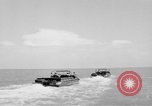
Men clean and check the lubrication of a DUKW in the United States.
A film on workings and general features of DUKWs. Men aboard DUKWs underway at sea in the United States. They learn about navigation. Men discuss the course undertaken by the DUKWs. They don life preserver jackets. They head in for a landing. Traffic rules should be followed while driving a DUKW. The DUKWs move along a beach. They move in water. An officer addresses men at a beach. The men at work. They clean the DUKW. Lubrication is checked and rechecked.
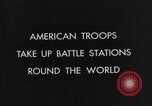
As the United States enters World War II, U.S. military forces are seen, deployed in various places throughout the world.
American troops are seen in arctic gear moving on skis through blustery snowy weather in Iceland, during World War 2. They were sent in 1941 to relieve British troops occupying Iceland since 1940, during World War II. A guard post at the American camp, with Quonset Hut in background. Closeup of U.S. sentry in arctic gear holding rifle with bayonet affixed. View from above, of numerous tents partially covered with snow in the American camp. Change of scene shows U.S. troops disembarking from transport ships at the British Isles. They march with their combat gear onto a square where Army trucks wait to transport them inland. Another scene shows the American troops, viewed from behind, parading in London. Other scenes show them marching in various areas of London. Saint Paul’s cathedral is seen in the background of one scene. A large number of American M3 Stuart Light tanks move on a railroad train in Britain. Scene shifts to the Middle East, where railroad cars and various military supplies for Russia are be offloaded from American ships. A Russian officer is seen signing receipts for war materiel, from a U.S. Army Technical Sergeant. A row of American Army trucks are lined up behind them. The Russian and American exchange salutes, and shake hands. Next, a troop ship carrying American troops is seen arriving at a port in India, where they disembark with their gear. An American Army Sergeant in a pith helmet pays attention to a little Indian girl. Scene shifts to China, in 1942, where Brigadier General Claire Lee Chennault, Commander of the China Air Task Force, of the Tenth Air Force, that replaced the American Volunteer Group (Flying Tigers), is seen with Brigadier General Caleb V. Haynes, Commander of the India Air Task Force. A colonel joins their discussions. A Consolidated B-24 Liberator bomber is parked behind them. View of Curtiss P-40 Warhawk fighter planes, with Flying Tiger markings, parked on a flight line. A B-24 bomber landing on a runway, between hills, deep in China. Closeup of Nationalist China Generalissimo Chiang Kai-Shek, saluting. Huge numbers of Chinese troops assembling in a formation. Next, an expeditionary force of American troops is seen arriving on a troop ship in Australia. They line the ship’s deck and wave. General Douglas MacArthur arriving in Australia to assume the office of Supreme Commander, South West Pacific Area (SWPA). .Glimpses of U.S. Navy activities in Australia: setting up defenses of islands; unpacking a Kingfisher float plane and making it ready for use on a desert island. The final segments of the film show American forces in August ,1942 sailing to Adak in the Aleutian Islands, to strengthen American defenses there. Troops seen descending by rope ladder from the American transport ship USS J Franklin Bell (PA-34), into her landing craft for deployment on Adak Island. Scenes of landing craft reaching the beach and offloading troops, vehicles, and supplies. View of beach filled with supplies. One landing craft is clearly marked with ""P34" showing that it belongs to the USS J Franklin Bell ( later reclassified as APA-16).

The "China Clipper", a huge new Martin M-130 Flying Boat, takes off from Alameda, California.
United States flying boat China Clipper (a Martin M-130 Flying Boat of Pan American Airways) at the beach in Alameda, California. Ceremonies precede the China Clipper passenger airplane take off from Alameda to Honolulu. The huge craft leaves for the first mail and passenger flight. Captain Musick and his crew. Mail to be loaded in packets. The U.S. flag on the flying boat. Huge crowd at the beach. Plane taxis in water. Aerial view of the land. Pilot seated at the controls in the cockpit. Interior and exterior view of the China Clipper while in flight.
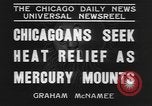
People find ways to escape the heat in Chicago, Illinois
'Chicagoans seek heat relief as mercury mounts '. People in swimsuits on the beach at Lake Michigan in Chicago. Men and women crowd the beach. Skyscrapers of Chicago are seen from the background. Children enjoy a shower as a fireman sprays them with a hose. Children holding each other while dancing in the shower.

U.S. LCU (Landing Craft Utility) loaded with equipment heads for the shore, United States.
Capabilities of U.S. Landing Crafts, carried by various amphibious ships, United States. LCU (Landing Craft Utility) underway at sea. Another landing craft in the background. LCU loaded with cranes and other equipment as it heads for a beach. Ramp of LCU lowered at beach.
CRITICALPAST.COM: About Us | Contact Us | FAQs - How to Order | License Agreement | My Account | My Lightboxes | Shopping Cart | Advanced Search | Featured Collections | Website Terms & Conditions | Privacy Policy ©2026 CriticalPast LLC.
License Agreement |
Terms & Conditions |
Privacy Policy
©2026 CriticalPast LLC.