


 Francais
 Deutsch
 Italiano
Refine Your Search
Miami Beach Florida USA 1963 stock footage and images
- Showing 1825 to 1830 of 26839 results more
more Hide
Hide
U.S. Army troops make amphibious landing at Nasugbu, Batangas, Philippines, in World War II
On January 31, 1945, during World War 2, elements of the 11th Airborne Division attached to the U.S. Eighth Army, are seen in landing craft approaching the shore of Nasugbu, Batangas. They hit the beach in an unopposed landing, but one of their vehicles stalls near the shoreline. A DUKW Military Amphibious Vehicle moves along the shore as soldiers board the stalled vehicle and head toward the beach pulled by a bulldozer using a towline. Another vehicle is also seen, being pulled by a bulldozer.
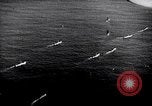
Preliminary U.S. Naval bombardment of Iwo Jima before invasion in World War II
February 17, 1945, Minesweepers move across the beaches of Iwo Jima, where U.S. amphibious landings are to be made. Diagram shows their positions and paths. Minesweepers are seen running parallel to the shore and then with Mount Suribachi behind them. Diagram illustrates Japanese shore batteries pattern of fire at U.S. gunboats. Actual scenes of the gunboats being destroyed and damaged by Japanese fire. At the same time, American reconnaissance swimmers jump from fast patrol boats. U.S. Navy ships begin firing white phosphorus shells to set up smoke screens. U.S. swimmers are recovered, after reconnoitering the beach areas. Gunboat 474 (USS LCI(G)-474) is seen severely damaged. Stretcher bearers seen on deck of a U.S. ship. Diagram shows the plan to employ naval gunfire from the battleships, Idaho, Nevada, New York, and Tennessee, at close range, against Japanese shore batteries. Numerous views of gunfire from those battleships.
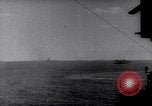
U.S. warships fire moving barrage of naval gunfire to support amphibious assault on Iwo Jima in World War II
World War 2 invasion of Iwo Jima by U.S. amphibious forces. U.S. warships continue bombardment of Japanese fortifications on Iwo Jima, but cease temorarily, allowing U.S. air strikes. U.S. dive bombers attacking Japanese positions.The Cruiser USS Indianapolis (CA-35) is seen maneuvering close to shore. U.S. gunboats firing barrages of rockets that saturate the beach with explosions. Diagram illustrates the way heavy naval gunfire overhead is coordinated with advancing amphibious craft. Views of landing craft and battleships firing overhead in a moving barrage. Landing craft arriving at the beach.

Secretary Henry Stimson, Generals Bradley and Patton visit a field hospital in Cherbourg Peninsula, France (WW2)
U.S. Secretary of War Stimson, General Omar Bradley, and U.S. General George S. Patton tour a field hospital in Normandy, France during World War II. Bradley poses outside a hospital tent with Secretary Stimson and an army doctor. Wounded soldiers in the tent. Signs on boards outside the tent. The United States Army generals visit a battlefield graveyard above Omaha Beach after D-Day. They drive down to Omaha Beach, still littered with equipment.. They look around. A flag on the beachhead. Soldiers stand on the field. Tents on the field. Soldiers work on the field.
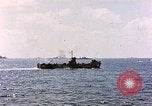
U.S. Naval Forces at Iwo Jima in Japan.
A Landing Ship Medium (LSM) underway off the coast in Iwo Jima, Japan. Battleship, probably BB-38 USS Pennsylvania fires. Smoke rises from bow. A heavy cruiser and destroyer can be seen on horizon in background. Formation of planes in flight above the sea. View of the Iwo Jima beach as some tracked landing vehicles (LVTs) make their way towards the beach. Smoke from gun fire seen. Destroyer from port quarter, a second destroyer in the background. An Amphibious Force Command Ship (AGC) with a landing craft alongside. U.S. Navy officers use perolis on bridge of a ship. (World War II period).
Eisenhower, Hewitt, Clark, and Gruenther gather for campaign strategy discussion (WW2)
U.S. General Dwight D. Eisenhower disembarks from a beach landing craft and gets into a Jeep on the beach with Admiral Hewitt during World War II. The Jeep is driven away. They arrive at the 5th Army headquarters area and meet with Lieutenant General Mark W. Clark and Major General Alfred M. Gruenther for strategy discussions. Military photographers and other troops are gathered around the commanders as they greet.
CRITICALPAST.COM: About Us | Contact Us | FAQs - How to Order | License Agreement | My Account | My Lightboxes | Shopping Cart | Advanced Search | Featured Collections | Website Terms & Conditions | Privacy Policy ©2026 CriticalPast LLC.
License Agreement |
Terms & Conditions |
Privacy Policy
©2026 CriticalPast LLC.