


 Francais
 Deutsch
 Italiano
Refine Your Search
Miami Beach Florida USA 1963 stock footage and images
- Showing 18565 to 18570 of 26838 results more
more Hide
Hide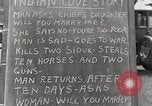
American "Indian Love Story" translated into Indian sign language by Richard Sanderville
A story called,"Indian Love Story," is written out in chalk, on a blackboard. Scene shifts to Richard "Dick" Benedict Sanderville, interpreter at the Blackfeet Agency in Browning, Montana,seated on a chair,outdoors. He translates the story into Native American Indian sign language, as follows, while the camera records his movements: Man asks chief 's Daughter Will You Marry Me? She Says No. You're too Poor. Man Is Sad. Goes To War. Kills Two Sioux. Steals Ten Horses And Two Guns. Man Returns After Ten Days. Asks Woman Will You Marry Me? She Says-Yes! Man Says-No!! You Don't Love Me-You Love My Horses'. The signs: 1. MAN ASK CHIEF HIGH (head-chief) CHILD WOMAN , YOU ME MARRY; which translates to: A man asks the head-chief's daughter: "Will you marry me?" 2. WOMAN SAY , NO YOU POOR; which translates to her saying: "No, you are too poor." 3. MAN SAD (heart heavy), GO-TO-WAR; which translates to: The man is sad (his heart is heavy, falls on the ground). He goes to war. 4. KILL TWO SIOUX (3 missing sign), STEAL TEN HORSE, TWO BOW; which translates to: He kills two Sioux, steals ten horses and two bows. 5. GO-TO-WAR COME TEN NIGHT; which means: The man returns (from war) after ten days. 6. SEE WOMAN, SAY YOU ME MARRY; which means: He (visits and) asks the woman: "Will you marry me?" 7. WOMAN YES, MAN SAY NO; which translates to her saying: "Yes!" The man says: "No!" 8. YOU FOND HORSE , YOU HEART FOND (love) FINISHED. Translation: You love (my) horses, ( I ) don't love you anymore. Editor Commentary: The second GO-TO-WAR sign is much shorter because it is part of a compound sign, and the emphasis is now on COME. The actual going to war has already happened. Also, in the last sentence the first YOU is the subject, but the second YOU is the object, and the subject is missing. Finally, in the first sentence the HIGH sign (index finger pointing up above head) is almost unnoticeable, and means "standing high above all others" or "above all, superior, high above the others".
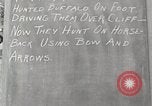
Native American Indian man narrates the text in sign language
A blackboard contains the following text written in chalk: "Formerly Indians Hunted Buffalo On Foot Driving Them Over Cliff. Now They Hunt On Horse-Back Using Bow And Arrows." Next, Richard "Dick" Benedict Sanderville, Native American Indian interpreter at the Blackfeet Agency in Browning, Montana, is seen seated outdoors, while the camera records his translation of the text into sign language.
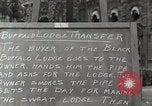
Buffalo Lodge Transfer is narrated in Indian sign language
A story called,"Indian Love Story," is written out in chalk, on a blackboard. It describes a barter system in which Native American Indian tribal people exchange goods with one and another. According to the story relatives of purchaser help him to pay for the lodge in horses, weapons, robes or war bonnets. The owner and his wife and the purchaser and his wife exchange clothes. A sketch of an Indian and a bull. Scene shifts to Richard "Dick" Benedict Sanderville, interpreter at the Blackfeet Agency in Browning, Montana. He is seated on a chair,outdoors. He translates the story into Indian sign language while the camera captures his motions.
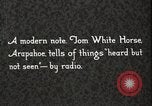
Native American Indian Tom White Horse uses sign language to narrate a modern note
A modern note. Tom white Horse, tribe Arapahoe of Native American Indian tells of things 'Heard but not seen'- by radio. Tom White Horse uses sign language to narrate. Assinniboine Boy, tribe Upper Gros Ventre from Atsena, sitting to the left, and Rides Black Horse, tribe Assinniboine, sitting to the right, read Tom White Horse's narration by sign language.
Strange Owl contributes a anecdote in sign language
Strange Owl, tribe Cheyenne of Native American Indians, contributes a anecdote in a group meeting. Strange Owl uses sign language. Foolish Woman, tribe Mandan, sitting left and Bird Rattler, tribe Blood, sitting right read the hand signals that Strange Owl makes.
Bitter Root Jim uses sign language to tell his renowned bear story
Native American Indian Bitter Root Jim presents a classic,his renowned bear story. He has a pouch strung to side of his waist on which a horse is printed. He uses sign language to tell his story. Sitting from left to right are other Native American Indians: Drags Wolf, Arickaree; Iron Whip,Sioux; Deer Nose,Crow; James Eagle, Arickaree; Foolish Woman,Mandan; and Strange Owl,Cheyenne, read Bitter Root Jim's hand signals.
CRITICALPAST.COM: About Us | Contact Us | FAQs - How to Order | License Agreement | My Account | My Lightboxes | Shopping Cart | Advanced Search | Featured Collections | Website Terms & Conditions | Privacy Policy ©2026 CriticalPast LLC.
License Agreement |
Terms & Conditions |
Privacy Policy
©2026 CriticalPast LLC.