


 Francais
 Deutsch
 Italiano
Refine Your Search
Miami Beach Florida USA 1963 stock footage and images
- Showing 2149 to 2154 of 26839 results more
more Hide
Hide
Fishing boats anchored at harbor and Fisherman's Memorial in Gloucester, Massachusetts.
Landscapes and monuments in Gloucester, Massachusetts. Views of beach and landscape. A large tower and a man stands on the tower. Official shed at harbor. A fishing boat is anchored. Sign: 'Jean and Patricia' and 'Mary and Julia' on fishing boats. Boats underway. Views of city and traffic on Main Street in Gloucester Massachusetts. A man walks down on road. Employees walking out of Harbor Cove Fisheries packaging plant. People walking outside of stores and shops in town. Pedestrians walking. Cars and trucks moving on South Stacy Boulevard. View of the Man at the Wheel, Fisherman's Memorial Cenotaph. View of memorials and grave stones in a town cemetery of Gloucester.

An amphibious landing and bombers on a mission and troops battle on a Pacific Island.
Dramatization shows how one defective walkie-talkie can impair battle plans, United States. U.S. transporters including cruisers, destroyers and crew carrying ships underway in South Pacific on a mission to attack on Japanese installation and Island no. 6. A personnel plays whistle from the bridge of cruiser. Interior of manned radio operations room:Task Force officers sitting around table and discuss over battle plans. A personnel talks on radio device. American bombers in formation flight. Pilot and copilot in cockpit. American aircraft drop bombs on Japanese installation. Explosion and large column of smoke rise. Task Force officers look at map of Japanese island no. 6 in the radio room. Animated map shows Japanese Island no. 6 showing an amphibious landing and bombers on a mission. U.S. soldiers on landing crafts with walkie-talkies. Artillery fire on the Pacific island. Troops disembark from the landing craft and heads towards beach area. Soldiers move into action and fire artillery. (World War II period).
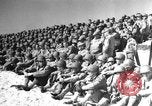
U.S. soldiers train for amphibious assaults in World War II.
American soldiers are assembled on outdoor stands on a sand beach in World War 2. Next, soldiers are seen climbing down rope nets on a stand designed to simulate leaving a troop ship. Brief closeup of some of the soldiers descending the nets. Change of scene to a sandy area shows soldiers in a simulated landing craft rushing out of it in a practice drill. Soldiers in wheeled vehicles simulating landing craft armed with machine guns. Troops, in live fire training, crawl over water-filled ditches as a trainer fires a Browning M1917 30cal machine gun across the area. Shells bursting in the area. A soldier stretches himself in prone position across a barbed wire fence. Other soldiers climb over him to cross the fence. Several combat soldiers holding rifles which are used as a ladder for climbing a barbed entanglement.
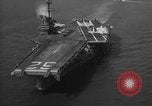
NATO's Atlantic Alliance ships and aircraft associated with anti-submarine preparedness
Film opens with aerial view from overflying aircraft, of the aircraft carrier, U.S. Navy ship USS Independence (CVA-62) underway. Scene shifts to Naval Air Station Oceana, Virginia Beach, Virginia, where a ramp is filled with a variety of aircraft. A pair of Douglas A-4 Skyhawk aircraft are taxiing. View of men in the Control Tower with large radar array in background. Two A-4 Skyhawks approach and one lands as the other goes around. Complete change of scene, to Halifax Nova Scotia, where warships of the Royal Canadian Navy are berthed. In waters off the Grand Banks, the Canadian Navy Aircraft carrier, HMCS Bonaventure (CVL 22) is seen making way at high speed during anti-submarine exercises.
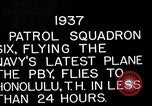
American flying boat Consolidated PBY Catalina taxis down the ramp into the water and takes off for Pearl Harbor, Honolulu.
United States Navy flying boat PBY Catalina of Patrol Squadron Six (V-P-6) in flight to Honolulu. American flying boat Consolidated PBY Catalina in water with monoplane construction and retractable wing floats. Mountains in the background. The PBY takes off. A boat in the water in the background. The PBY taxis down the ramp into the water. The aircraft handlers go over to take off the beaching gear. The PBY taxis. PBY fly in formation and heads for Pearl Harbor.
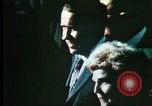
Republican nominee Richard Nixon express his views about the presidential race before U.S. Presidential Election of 1968.
Self-portrait of Richard Nixon aired during his 1968 presidential run against Hubert Humphrey and George Wallace in the United States. An interviewer asks Richard Nixon what did he think when he made a decision to run for the President of the United States in 1968. A picture showing Richard Nixon and his wife Pat Nixon. The interviewer asks if he felt any strain on the family. Nixon says he thought of his family first. A picture showing his wife Pat Nixon and daughters Julie Nixon and Tricia Nixon. Nixon calls this presidency more of a challenge in terms of America being involved in the Vietnam War and in the Cold War with the Soviet Union. A photograph shows Richard Nixon with his wife Pat Nixon, daughters Julie and Tricia and Julie's husband David Eisenhower at a beach. He says that present time is different from World Wars I and II because now America is a great power and there should be a best possible leader to lead the nation. Nixon states that America needs a kind of leadership that would obtain peace and avoid war and surrender. A picture of Mr. and Mrs. Richard Nixon.
CRITICALPAST.COM: About Us | Contact Us | FAQs - How to Order | License Agreement | My Account | My Lightboxes | Shopping Cart | Advanced Search | Featured Collections | Website Terms & Conditions | Privacy Policy ©2026 CriticalPast LLC.
License Agreement |
Terms & Conditions |
Privacy Policy
©2026 CriticalPast LLC.