


 Francais
 Deutsch
 Italiano
Refine Your Search
Miami Beach Florida USA 1963 stock footage and images
- Showing 2251 to 2256 of 26839 results more
more Hide
Hide
Soviet troops and T-62 tanks unloaded from modern hovercraft as they come ashore during an amphibious landing.
United States Air Force Soviet Awareness Program depicts Soviet military equipment and its use in terms of purpose and jurisdiction. Portrayal of amphibious landings by the Soviet Navy. The task force advances at sea. Sailors at controls aboard the ship. An armored hovercraft travels over water and then on shore to support troops. Soviet Army main battle tank T-62s unloaded from the hovercraft in enemy territory. Another hovercraft comes ashore. Troops disembark from the craft, advance across the beach and inland. Tanks and soldiers advance amidst heavy fire. Rockets and other weapons fired. Soldiers in tanks. A soldier takes cover under an enemy tank and then launches a grenade at the tank. Tanks fire guns. Smoke from explosions in the field. Soldiers take cover and run out of burning buildings.
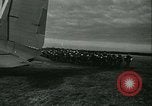
U.S. Signal Corps employ the Eureka/Rebecca transponder system during the American airborne landings in Normandy, France.
The role and contribution of the U.S. Army Signal Corps in combat and war. Parachute drop-markers with radio signals guide an airborne operation in the European Theater. U.S. airborne troops board a U.S. Army Air Forces Douglas C-47 Skytrain or Dakota transport aircraft. A woman soldier greets the paratroopers as they prepare to board the aircraft. The paratroopers jump out and descend towards the ground. The paratroopers are furnished with markers for every dropping point. A paratrooper with a radio beacon hooked onto his belt. The beacon is the ground section of the Eureka/Rebecca transponder system. The paratrooper fixes the Eureka extension including the cable and the receiver transmitter. Animation depicts the working of the Eureka-Rebeca system. An aircraft unloads paratroopers over Normandy in France during World War II. Allied troops, landing crafts, landing ships arrive at Normandy on D-Day (6 June 1944). Soldiers wade through the water towards the shore and advance inland across the beach during Allied invasion of France.
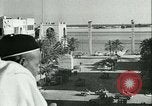
The North African Campaign, Allied invasion of Sicily, and Allied bombings of Nazi Germany during World War II.
Pictures taken by military and news cameramen during World War II. North African Campaign: The British Eighth Army enters Tripoli in Libya. Allied soldiers on tanks. Civilians and children watch as the troops move into the city. A British flag. British Army Field Marshal Harold Alexander (1st Earl Alexander of Tunis) stands in a car and greets the troops and civilians as it moves along. Allied invasion of Sicily, 1943: Field Marshal Alexander's British Dominion and U.S. forces advance. The task force underway off the Sicily coast. Soldiers get off landing ships and crafts. They wade through shallow water and advance inward on the beach. Germany: Allied aircraft in flight. The airplanes bomb Nazi industries. The aircraft bay doors open, bombs away as bombs are released, and they descend towards the target area. Smoke due to the explosions.
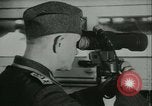
German troops move through a village and interrogate Canadian and British prisoners of war in France during WWII.
Allied invasion of northern France during World War II. Allied bombers attack the coast during invasion of France. German coastal fortifications of the Atlantic Wall are shown. A German officer looks through binoculars. He surveys Allied ships and crafts approaching the coast. German coastal guns fired at the Allied fleet in the English Channel. Smoke due to explosions in the water. Soldiers fire artillery. They load shells. Ships hit by the artillery fire. German pillboxes and fortifications. German soldiers inspect damaged and wrecked crafts washed ashore. Soldiers look out to the sea. Camouflaged German tanks and infantry move through a French village. Explosions in fields. Machine guns fired. Soldiers take cover, fire in prone positions. They advance past wrecked and damaged Allied tanks. Allied prisoners marched in the forest. Seated prisoners. German officers discuss strategy and review a map, possibly a captured one. German fortifications on a French beach. Germans pass downed Allied and British planes. Invasion stripes on an aircraft. German officers arrive to inspect the wrecked aircraft. Captured British and Canadian prisoners of war (POWs). Soldiers of The Nova Scotia Highlanders, The 1st Canadian Parachute Battalion held prisoners. Wounded POW prisoners. A soldier with an eye patch. A German officer talks to the prisoners and checks their papers.
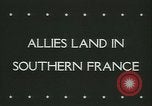
U.S. General Patch, U.S. Admiral Hewitt, and French Admiral Lemonnier lead the Allied fleet invasion of southern France.
Amphibious and airborne Allied forces land in southern France during World War II. (Operation Dragoon in August 1944). Map of France depicts Allied landings at Normandy on D-Day. Naples: An Allied naval force assembles, poised for landing in Southern France, 10 weeks after the Normandy D-Day invasion. Thousands of landing crafts, trucks, tanks, mobile cannons, military vehicles and equipment in the embarkation area. Barrages in flight overhead. Allied officers supervise as the vehicles are loaded into ships. US, French, British, Greek and Polish troops move up to their ships. The ships underway in the Mediterranean. U.S. Secretary of Navy James Forrestal, U.S. Army General Alexander Patch, French Admiral Andre Lemonnier and U.S. Navy Admiral Henry Hewitt (Chief of the Atlantic Invasion Fleet) aboard the flagship. Allied soldiers stitch sleeve patches. An animated map depicts the Allied invasion of southern France near Toulon in a combined amphibious and airborne assault. Hundreds of transport aircraft carry paratroop forces. The paratroopers get ready, jump, and descend to the ground. The amphibious forces near the French coast. German shore batteries fire at the approaching naval vessels. Explosions on ships and in water. Allied troops crouched in landing crafts. They hit the beach under shell fire and advance in land.
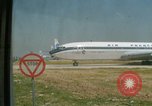
A Pan American Airways Boeing 707 aircraft takes off from Orly Airport outside Paris
A Pan American Airways 4-engine Boeing 707 (N893PA) passenger aircraft at Orly Airport outside Paris, France. Air France and Finnair passenger planes taxi along a runway. A sign on an aircraft reads 'Pan American'. A woman boards the flight. Several of the terminal buildings are seen. Large cranes and construction are underway in parts of the airport. A Boeing 707 aircraft taxis down a runway and past other aircraft on the airfield. Aerial views of Paris near Orly Airport. The aircraft in flight. The aircraft flies over a beach and comes in for landing. The aircraft lands and taxis. A sign reads 'Jet Clipper Whirlwind' on the side of the Pan American Boeing 707. Aircraft at an airfield.
CRITICALPAST.COM: About Us | Contact Us | FAQs - How to Order | License Agreement | My Account | My Lightboxes | Shopping Cart | Advanced Search | Featured Collections | Website Terms & Conditions | Privacy Policy ©2026 CriticalPast LLC.
License Agreement |
Terms & Conditions |
Privacy Policy
©2026 CriticalPast LLC.