


 Francais
 Deutsch
 Italiano
Refine Your Search
Miami Beach Florida USA 1963 stock footage and images
- Showing 23365 to 23370 of 26838 results more
more Hide
Hide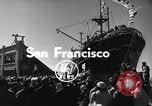
A crane loads cargo and barrels aboard a merchant vessel docked at a harbor in San Francisco, California.
Cargo loaded aboard a merchant vessel in San Francisco, California. Merchant vessel 'Korea' docked at a harbor. A large crowd of civilians gathered at the harbor. Men haul a trolley loaded with barrels and bags. A crane loads cargo aboard the vessel. A flag flutters in wind atop the vessel mast.
Atomic bomb scenes WWII; atomic testing at U.S. Army atomic experiment station 'Camp Desert Rock' in Nevada, United States
Episode of "The Big Picture", a U.S. Army series of news release programs. U.S. Army cameraman recording Nike missile launch. Atomic cannon fires shell creating atomic explosion and classic mushroom cloud.. Army troops spill out of Sikorsky YH-19 helicopters. U.S. Army infantry soldiers ascend hill firing their rifles. Atomic experiments at Camp Desert Rock in Nevada, United States. U.S. Army Master Sergeant Stuart Queen seated at a desk in his office. He speaks about a series of atomic experiments ("Desert Rock 6") held in barren lands of Nevada at Camp Desert Rock. Celebrating victory in Europe, during World War 2, American troops parade down the Champs Elysees in Paris, France, with the Arc de Triomphe behind them. Happy Parisians watch the parade. War scenes in Japan: footage of explosion and mushroom cloud rising after atomic bomb blast over Nagasaki on August 9, 1945. Barren land on the ground in Hiroshima after the August 6, 1945 atomic blast there . B-29 bombers in flight. Atomic bomb test detonation. Atomic artillery gun M65, also called the Atomic Cannon or Atomic Annie, fires and creates nuclear explosion on distant target.Viking missile launch. U.S. soldiers on parade. Headquarters sign at U.S. Army atomic experiment station at Camp Desert Rock, Nevada, displaying 6-pointed star with "A" in center.. Several atomic test explosions. Soldiers on hillside witness a non-nuclear explosion. Buses carry troops along a road past a sign warning of radiation hazard. Army captain, instructor, briefing troops before the start of atomic maneuvers.. Maps of planned maneuvers. Engineer surveyors lay out ground zero target. View of the ground zero area which is the target area for testing. Signal men lay communication lines to receive and transmit teletype messages. Men operate machinery and dig trenches in which troops will take cover. Other men cover them with sand. [Note: According to the U.S. Department of State, Office of the Historian, from February 18 to May 15, 1955, the United States conducted Operation Teapot, a nuclear test series at Yucca Flat and Frenchman Flat on the Nevada Test Site in the continental United States. During the test period 14 nuclear shots and 1 non-nuclear shot were detonated. Several thousand scientific, military (army, air force, navy, marines), and civilian contract personnel participated in the organization, planning, and execution of the test series. Military exercises undertaken during and following the shots took place under the name Desert Rock 6.]
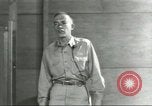
Instructor at Camp Desert Rock, in Nevada, briefs U.S soldiers about atomic explosions
A U.S. Army Captain, instructor at Camp Desert Rock, in Nevada, briefs U.S soldiers about atomic maneuvers. He notes that the first indication of an atomic explosion is the brilliant light created. After that, a fireball will be visible. Animated images accompany his descriptions of changes in the fireball and formation of the characteristic mushroom cloud. Troops being briefed are seated in a large outdoor area at the camp. Using chalk and blackboard, the Captain explains that danger comes from blast, heat, and radiation. Animated images illustrate the effects of atomic blast, as the Captain narrates.

U.S. Army Captain lectures troops about protection against blast from atomic explosion
Animated images accompany views of a U.S. Army Captain briefing soldiers about effects of atomic explosions, at Camp Desert Rock, in Nevada. He emphasises importance of getting down, below ground level, if possible, to avoid blast and flying objects. Troops are seen seated in a large outdoor area for the briefing. Soldiers are told to get down, to protect against blast, as soon as they perceive the flash of an atomic explosion.
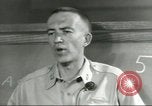
A U.S. Army Captain lectures troops at Camp Desert Rock, about protection against heat from an atomic explosion
An Army Captain stands at a blackboard in Camp Desert Rock, Nevada, as he lectures U.S. Army troops about protection against heat from an atomic explosion. The troops are seated in a large outdoor assembly area. Closeups of the soldiers in the audience. He notes that burns from the heat can occur in a half second from the time of the flash. He notes that burning can occur within 3 miles of the explosion, but ordinary clothing can protect as close as 1 mile away. And, the shade of a foxhole will protect from the heat. The Captain also mentions the blinding flash of an atomic explosion. The troops all look up momentarily at the sun, as he compares it to the flash of an atomic explosion.
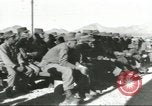
A U.S. Army Captain lectures troops at Camp Desert Rock, about protection against radiation from an atomic explosion
U.S. Army troops seated in an outdoor theater in Camp Desert Rock, Nevada, are briefed by a Captain, about radiation from an airburst atomic explosion. Closeups of some of the soldiers. The Captain standing in front of a blackboard. He writes, "1 mile" on the blackboard, while noting that beyond that, a lethal dose of radiation is unlikely. He writes and describes Alpha, Beta, Gamma, and Neutron emmissions from an atomic explosion, noting that gamma radiation and neutrons are the emissions of most concern to humans, but they can be stopped by shielding, He mentions steel, concrete, and earthen shielding. Animated images illustrate blast effects and narrator states that protection from blast will protect from half of any radiation. He holds up a film badge and explains that a badge or dosimeter will allow radiation protection specialist to determine the amount of any radiation received by its wearer. Closing view of the outdoor theater.
CRITICALPAST.COM: About Us | Contact Us | FAQs - How to Order | License Agreement | My Account | My Lightboxes | Shopping Cart | Advanced Search | Featured Collections | Website Terms & Conditions | Privacy Policy ©2026 CriticalPast LLC.
License Agreement |
Terms & Conditions |
Privacy Policy
©2026 CriticalPast LLC.