


 Francais
 Deutsch
 Italiano
Refine Your Search
Miami Beach Florida USA 1963 stock footage and images
- Showing 2737 to 2742 of 26889 results more
more Hide
Hide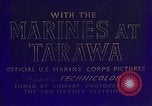
U.S. Marines launch the Battle of Tarawa, in the Pacific, during World War II.
U.S. marines engage Japanese during the Battle of Tarawa in World War II. Members of United States 2nd Marine Division walk up gangplanks, in full battle gear, and board ships. Convoy of ships underway in the Pacific Ocean, with weapons on deck visible. Fighter escort aircraft from U.S. aircraft carriers fly in formation over the convoy. A U.S. destroyer pulls alongside to deliver sealed orders on a line stretched between the two vessels. Officer briefs the Marines with a relief map on deck of ship. Marines load ammunition in belts for machine guns. They check and fire weapons. They exercise to relieve tension. Navy and coast guard assault boat coxwains receive last minute instructions from an officer. Chaplain conducts religious services for the Marines before the invasion day. Boats loaded with marines proceed toward the shore. Explosions occur. Aircraft in flight as they strafe and drop bombs on Japanese shore installations. American assault boats approach the beach. Heavy Japanese firing destroys several U.S. assault boats. Marines find some shelter behind a pier extending into the water. Marines are held down by heavy Japanese fire. They suffer heavy casualties and administer aid to wounded.
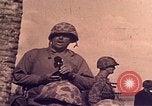
U.S. Marines fight against fanatical Japanese defenders in the Battle of Tarawa during World War II.
U.S. Marine Corps struggle during Battle of Tarawa, in the Pacific, during World War II. Marines of the United States 2nd Marine Division Corps move carefully and stay low as they advance on the island and fire at Japanese well-entrenched in bunkers and hiding in trees.Marines employ grenades, flame throwers and mortars against the Japanese and occupy some Japanese bunkers. Marine casualties being carried on stretchers. Several Japanese soldiers break out of their fortification and run for safety as marines fire at them. Marines check for snipers and throw grenades, as they advance very cautiously toward abandoned Japanese positions on the Tarawa beach.
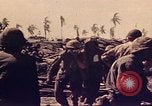
U.S. Marines fight Japanese in Battle for Tarawa, in the Pacific, during World War II.
A wounded marine holding a bandage to his head moves toward the rear. Sunken U.S. assault boat seen in water in which Japanese had set up machine gun nest. Marine artillery fire destroys the boat. Marines of United States 2nd Marine Division occupy defensive positons behind bunkers and fire mortars. An American sherman tank on the sand has the name "Colorado" on it with a painted symbol. Tank commander hunkers down as he walks toward a marine with walkie talkie. Marines fire mortar continuously. Marine runs from wood frame of destroyed Japanese building. Marines fire at Japanese snipers who have tied themselves in trees. Marines run toward abandoned and destroyed Japanese buildings. The sherman tank moves along the abandoned airfield with U.S. marines running behind. A jeep drives through debris of battle, with a wounded marine huddled down in back. At the beach, amphibious vehicles tow floating supplies behind them.
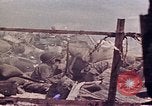
U.S. marines mopping up after battle for Tarawa, in Pacific. Generals Holland and Julian Smith. Admiral Harry Hill. Marine dead.
U.S. Marine Corps during Battle of Tarawa of World War II in November 1943. United States 2nd Marine Division Corps fire artillery. On the beach,Chaplains Assistants remove one dog tag from each of many dead marines. General of the United States Marine Corps Generals Holland McTyerie Smith and Julian Constable Smith U.S. Navy admiral Harry Wilbur Hill, commander of the task force. Bulldozers dig the ground in search of Japanese in bunkers as deep as 20 feet. They destroy the Japanese bunkers. Japanese prisoners are marched by the Marines.
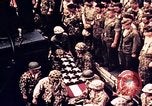
Priest conducts funeral services aboard a ship and dead U.S. marines are buried at sea during following Battle of Tarawa.
U.S. Marine Corps following Battle of Tarawa in World War II. Chaplains conduct funeral services aboard a ship. Dead of the United States 2nd Marine Division, covered with United States flag, are buried at sea. Marines fire guns and pay honor to the dead. They salute. Marines cut away clothing and search Japanese prisoners on the Tarawa beach. Prisoners carry their wounded comrade. U.S. marines drink and fill water from containers of captured Japanese water supplies..
Glider rockets designed by German rocket pioneer, Reinhold Tilling
Workshop of German rocket pioneer, Reinhold Tilling, in Ahrenshorst or at Osnabruck, Germany. Various models of his postal rockets (recoverable rocket for mail delivery) are seen in the shop. A sketch and stringed models show how the wings fold about the rocket for launching and unfold for gliding descent after the rocket has finished firing. Next, a number of similar-looking rockets or gliders are seen on the ground in a field. Their wings appear to fixed open. The closest one appears to have a radio antenna attached at its wing root. Several young men are occupied with one of the gliders on the ground. Another holds a kite. What is possibly a rocket launching tube sits on a tripod in the background. Closeup of one of the gliders on the ground. Change of scene shows a cylindrical solid fuel rocket on a tripod launcher. The rocket nose is shown without the lower portion. Next, the rocket is seen set up on a beach next to a body of water, where is is ignited and launches at a low angle, in a cloud of white smoke.
CRITICALPAST.COM: About Us | Contact Us | FAQs - How to Order | License Agreement | My Account | My Lightboxes | Shopping Cart | Advanced Search | Featured Collections | Website Terms & Conditions | Privacy Policy ©2026 CriticalPast LLC.
License Agreement |
Terms & Conditions |
Privacy Policy
©2026 CriticalPast LLC.