


 Francais
 Deutsch
 Italiano

Refine Your Search
Miami Beach Florida USA 1963 stock footage and images
- Showing 307 to 312 of 26873 results more
 Hide
Color Sound

Montage of scenes showing Americans in various pursuits during 1950s and 1960s
A U.S. Department of Commerce film entitled "Voyage to America." Opening scenes depict ordinary life during rush hour in major city in the United States in 1963. People walking in what appears to be a large railroad station and then riding escalators to lower floors. People stepping from a subway door to a platform and others leaving a crowded train station. An official cutting a ribbon to open some place or event. Young women cheer leading for a political candidate. People attending a concert and others at an outdoor sports event. Crowds filling sidewalks to watch foreign dignitaries in two white cars. Republicans fill the Cow Palace near San Francisco in the 1956 political convention where President Dwight D. Eisenhower is supported for a 2nd term as President. Some "Stick with Ike" banners are seen in the crowd. Scene transitions to views of clouds and beautiful coastal images of America.
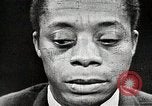
Views of Martin Luther King Jr. and Kenneth Clarke on the position of African Americans in the US; Civil Rights protest scenes
James Baldwin speaks in United States. Scenes of strife and struggle during civil rights movement. Policemen beat a African American man. Doctor Kenneth Clark, Professor of Psychology at the City College of New York; Director of Fallen Youth Opportunities Unlimited and Research Director, North Pride Center for Interpretation, sits in a chair during an interview. He speaks on the position of African Americans and America's Promise. Other scenes: Martin Luther King Jr. addresses a small gathering of African Americans. They are standing at the scene of a bombed out or destroyed church. He speaks about what happened there alluding that they know the truth of the racist hate crime. He speaks about remaining strong in striving for freedom for African American citizens. People around him sing and clap. Martin Luther King Jr. looks into a bible. Ebenezer Baptist Church and its interiors are seen, where Martin Luther King Jr. preaches. Exterior view of a Woolworths store where African Americans in protest sit at a segregated lunch counter at Woolworth store and wait to be served, in a non-violent demonstration. People pass through doors. Men moving on a road are stopped by a policeman. He stands with other policemen. The civil rights demonstrators stop and pray together. They are then directed to a waiting police paddy wagon van for arrest. Policeman hits a African American man. African Americans are put in police paddy wagons. Policemen detain African American demonstrators during a march and use dogs in rounding up demonstrators. Fire truck arrives during a protest and firemen spray fire hoses at African American demonstrators on May 7, 1963 in Birmingham Alabama during the Birmingham Campaign or movement. High powered fire hoses spraying water at demonstrators. Police chasing and detaining demonstrators in a crowd during a black civil rights demonstration. Martin Luther King Jr. leaving a courthouse, his wife by his side. He walks down the steps where a reporter asks him, "Dr. King how long do you expect to stay in jail". King replies "I'm under orders to keep walking."

Director of U.S. Information Agency, Carl Rowan speaks about the Civil Rights Great March on Washington
Director of United States Information Agency, Carl Rowan addresses people in United States. He introduces a documentary program about the Civil Rights March in Washington DC known as the March On Washington For Jobs And Freedom, that occurred on August 28, 1963.

U.S. President John F Kennedy delivers American University Commencement Address in Washington DC.
U.S. President John F Kennedy delivers American University Commencement Address in Washington DC. The speech addresses issues of university education, peace, war, nuclear arms and disarmament. The President highlights the need to examine American attitude towards peace as well as the Soviet Union. 10 June 1963.
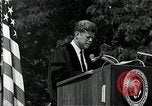
U.S. President Kennedy's American University Commencement Address in Washington DC about America and Soviet Union relationships.
U.S. President John F Kennedy delivers American University Commencement Address in Washington DC speaking about America and Soviet Union relationships. He raises questions about Nuclear war its consequences. Communist drive to impose their political and economic system on others is the primary cause of world tension. He points out that despite differences there are some common links between America and Soviet Union and they should conduct affairs in such a way that is acceptable to both. He emphasizes reexamining the American attitude towards the cold war. Also raises issues of strengthening the United Nations as an instrument of global security, direct line between Moscow and Washington DC, Geneva talks, outlawing of nuclear tests. He confirms that high level discussions will shortly begin in Moscow for Comprehensive Test ban treaty. 10 June 1963.

U.S. president John F Kennedy delivering speech about human rights at American university, Washington DC.
John F Kennedy delivering American University Commencement Address and raises issue of human rights over all the other issues. He is honored with Honorary Degree of Doctor of Civil Law. 10 June 1963.
CRITICALPAST.COM: About Us | Contact Us | FAQs - How to Order | License Agreement | My Account | My Lightboxes | Shopping Cart | Advanced Search | Featured Collections | Website Terms & Conditions | Privacy Policy ©2026 CriticalPast LLC.
License Agreement |
Terms & Conditions |
Privacy Policy
©2026 CriticalPast LLC.