


 Francais
 Deutsch
 Italiano
Refine Your Search
Miami Beach Florida USA 1963 stock footage and images
- Showing 3661 to 3666 of 26888 results more
more Hide
Hide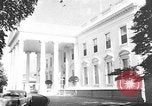
U.S. President Kennedy talks about respecting African American citizens and giving them equal rights during a speech on Alabama in Washington DC.
U.S. President John F. Kennedy's speech on Alabama in Washington DC. The White House. United States President John Kennedy seated at a desk and speaks over a microphone. The President speaks about the discrimination of blacks by whites in the United States. He talks about the University of Alabama not giving admission to two clearly qualified young Alabama residents (James Hood and Vivian Malone) who happened to have been born African Americans. President Kennedy says that the nation is founded on the principle that all men are created equal, and that the rights of every man are diminished when the rights of one man are threatened. The President says that it is possible for the American consumers of any color to receive equal service in places of public accommodation, to register and to vote in a free election without interference or fear of reprisal. President Kennedy talks about respecting African Americans and all Americans and urges people not to discriminate and to uphold civil rights. He says that no city or State or legislative body can prudently choose to ignore them.
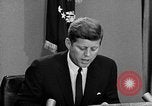
U.S. President Kennedy asks for support of the citizens for ending the discrimination against African Americans, in his speech in the U.S.
U.S. President John F. Kennedy's Civil Rights Address in Washington DC. United States President Kennedy seated at a desk and speaks over a microphone. Following events in Alabama, the President speaks about ending the discrimination of blacks by whites in the United States. He says that it's time for the Congress to act. President Kennedy says that he will ask the Congress of the United States to act, to make a commitment it has not fully made in this century to the proposition that race has no place in American life or law. He talks about the necessary measures that Congress can provide. The President, in his speech, asks the Congress to enact legislation giving all Americans the right to be served the facilities which are open to the public. He talks about his meeting with the business leaders and urges them to take voluntary action to end this discrimination. The President says that he has also asked the Congress to authorize the Federal Government to participate more fully in lawsuits designed to end segregation in public education. He also speaks about giving employment for African American citizens. President Kennedy, in his speech, pays tribute to those citizens of North and South who have been working in their communities to make life better for all. The President asks for support of all the citizens so that the discrimination can be removed and civil rights upheld.
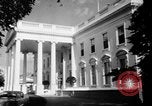
U.S. President Kennedy talks about equal rights for black and white citizens during a speech in Washington DC, United States.
United States President John F. Kennedy's speech regarding racism and racial tensions in Alabama, delivered from Washington DC, the White House. United States President Kennedy seated at a desk and speaks over a microphone. The President speaks about racial discrimination against blacks in the United States. He talks about the University of Alabama not giving admission to two clearly qualified young Alabama residents who happened to have been born African Americans, due to segregation and discrimination practices. View of people crowded outside the University of Alabama (Tuscaloosa, AL 35487, United States). Men take pictures as officials escort entering students Vivian Malone and James Hood into Foster Auditorium of the university. The President says that the nation is founded on the principle that all men are created equal, and that the rights of every man are diminished when the rights of one man are threatened. President Kennedy says that it is right for American consumers of any color to receive equal service in places of public accommodation, to register and to vote in a free election without interference or fear of reprisal. Additional views of Vivian Malone and James Hood walking with crowds and unaccompanied on the University of Alabama campus. A policeman rides a motorcycle on a road at the University. President Kennedy talks about respecting African American citizens and importance of civil rights and equality. The President says that no city or State or legislative body can prudently choose to ignore the rights of any of its citizens. The press record his speech and take pictures.
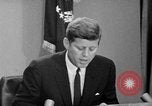
U.S. President Kennedy asks for support of citizens and business leaders to end racial discrimination in the United States
Second part of U.S. President John F. Kennedy's speech in Washington DC following events at the University of Alabama when two African American students, Vivian Malone and James Hood, attempted to enroll. United States President Kennedy seated at desk and speaks over a microphone. The President speaks about ending racial discrimination and importance of equality and civil rights in the United States. He says that it's time for the Congress to act. President Kennedy says that he will ask the Congress of the United States to act, to make a commitment it has not fully made in this century to the proposition that race has no place in the American life or law. The President talks about the necessary measures that Congress can provide. President Kennedy, in his speech, asks the Congress to enact legislation giving all Americans the right to be served the facilities which are open to the public. He talks about, and scenes are shown from his recent meeting with business leaders in the white house, together with Vice President Lyndon Johnson, as Kennedy urged them to take voluntary action to end workplace discrimination. The business leaders in a large room of the White House. The President says that he has also asked the Congress to authorize the Federal Government to participate more fully in lawsuits designed to end segregation in public education. He also speaks about giving employment to African Americans. President Kennedy, in his speech, pays tribute to those citizens of the North and South who have been working in their communities to make life better for all. The President asks for support of all the citizens so that discrimination can be removed. Many television cameras and cameramen. The President gets up from the desk and leaves.
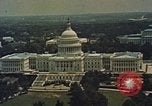
Excerpt from end of film about John Glenn, America's first Astronaut, extolling the nation's scenic diversity and beauty
Scenic views of landmarks and landscapes in the United States in the mid 1960s. A couple strolling among cherry blossom trees during Spring, at the Tidal Basin in Washington, DC. The Jefferson Memorial seen in the background. A university or college campus. Aerial view of skyscraper buildings in lower Manhattan, New York City. Street scenes in New York City with car traffic on street and pedestrians walking on sidewalks and crossing an intersection. Seven harvesters operating in parallel on a wheat field. Street scene in San Francisco, with cable car approaching passengers gathered at the Powell Street turnaround, near Ellis Street. Sign for Golden State Hotel is seen on Powell Street. Powell Street crowded with parked cars, shops and pedestrians. The Golden Gate Bridge. Waterfall and river in Yosemite National Park. Visitors watching Niagara Falls. "Maid of the Mist" tour boat moving along the base of the falls. View from car driving through forest in National Park. Cars driving on street in New Orleans, Louisiana. Cowboys herding cattle on a ranch in southwest or western United States. Beautiful scenes of America's natural outdoors including mountain ranges and a rushing river. A woman riding a horse on a rocky coastline with the ocean behind her, at sunset. Closeup of the American flag waving.
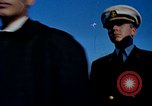
Vice President Lyndon B. Johnson becomes the 36th President of the United States after assassination of John F. Kennedy.
Features President Johnson assuming his new responsibilities as the President in an atmosphere of grief in the U.S. United States civilians walk in a long queue line and entering the U.S. Capitol Building to view the casket of President John F. Kennedy, days after his assassination death. The U.S. flag draped coffin of assassinated President John F. Kennedy (35th President of the United States) is seen in the center of the dome room. People cry and express grief, and comfort each other. Point of view shot of mourners exiting the U.S. Capitol building and looking out over the National Mall, with the Washington Monument visible in the distance. Night time exterior view of the White House. Scenes changes to show a man, possibly Indian, laying bricks at a construction site. A teacher in a college talking to a student in a courtyard. Women seated selling and buying goods at an outdoor market in Asia. A farmer driving a red tractor in the United States and tilling the soil of a farm field. A lit up room in the White House. Lyndon B. Johnson, former Vice President of the U.S. (now the 36th President of the United States) sits with documents at his desk and works in the White House. Close up side view of President Johnson as he works. Flashbacks: Views of President Johnson surrounded by large crowds, including a group of children, and being greeted during his trip to Asia, Europe, Africa and South Africa. LBJ signs promoting Lyndon Johnson at a Democratic Convention. Brief excerpts of Johnson speaking about Civil Rights and about space exploration, and about military readiness. President Johnson entering the House of Representatives chamber in the U.S Capitol five days after he became President of the United States to make his first speech to Congress as President. Lawmakers assembled give him a standing ovation as he enters.
CRITICALPAST.COM: About Us | Contact Us | FAQs - How to Order | License Agreement | My Account | My Lightboxes | Shopping Cart | Advanced Search | Featured Collections | Website Terms & Conditions | Privacy Policy ©2026 CriticalPast LLC.
License Agreement |
Terms & Conditions |
Privacy Policy
©2026 CriticalPast LLC.