


 Francais
 Deutsch
 Italiano

Refine Your Search
Mig-15 stock footage and images
- Showing 649 to 654 of 685 results more
 Hide

German civilian Matthias Gierens is hung until death for murdering a downed American flier in Germany in World War 2.
German civilian Matthias Gierens, a 37 year old railroad worker, is hanged in Rheinbach Germany for the August 15, 1944 murder of a downed American flyer, who was later identified as U.S. Army Air Forces 2nd Lieutenant Lester E. Reuss, from Forsythe, Montana. Reuss was the navigator on U.S. Army B-17 bomber #42-31183 which was downed by German aircraft after it attacked the Airdrome at Wiesbaden, Germany. Gierens and three other German civilian men, Peter Kohn, Peter Back, and Matthias Krein, were convicted on June 2, 1945 in Ahrweiler, Germany, for the murder of the American airman after his parachute landing near Priest, Germany. The trial was the first Allied trial in Germany of civilians charged with a war crime. Military police are seen escorting Gierens toward the gallows in a prison yard in Rheinbach. A German Catholic priest performs the rites. U.S military officer reads charges as Gierens is readied for execution (the officer is possibly Lt. Col J.V. Roddy, of San Francisco, who was in charge of the hanging). Trap door opens and Gierens is hung. The U.S. Army executioners were Master Sgt. John C. Woods, a former Texas State executioner, and Staff Sgt. Thomas Robinson, of Bronx, New York. Witnesses present included seven U.S. Lieutenant Colonels and one British officer, a number of Military Police, news correspondents, and photographers.
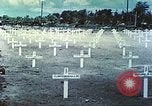
A U.S. Marine walks past 2nd Marine Division Cemetery in Saipan, Mariana Islands.
A U.S. Marine cemetery in Saipan, Mariana Islands during World War II. Crosses over graves. A marine armed with a carbine walks past a sign: '2nd Marine Division Cemetery'. Names of the marines who died on 15th June, 1944 engraved on the crosses.

Great flood of the Potomac River near Washington DC after heavy rains add to melting of ice and snow
The working of weather bureau in the United States. Snow covered shores of the Potomac River at Great Falls, west of Washington DC, following 15 inch snowfall in February 1936. Two people walking on a high snow covered bluff near the Great Falls. The frozen Potomac River, covered with ice. View of the Memorial Bridge spanning a totally frozen Potomac River, with the Lincoln Memorial and the Washington Monument in the background. Views of the river carrying chunk of snow and ice as a thaw begins the breakup. Man photographs a woman next to a guard rail at the Potomac River, covered in chunks of thawing ice and snow. Frozen ice chunks flowing under the Memorial Bridge. Narrator describes flood beginning with heavy rainwall in Shenandoah River valley on March 17 and March 18, 1936. Scenes of Western Union Telegrams detailing reports of rain in the west from various towns in the Shenandoah foothills. One from Romney , West Virginia notes rainfall of 5 inches.

Keio University rowing team competes in race on river in Japan prior to World War II
Opening scene shows Keio University (2 Chome-15-45 Mita, Minato City, Tokyo 108-8345, Japan) in Tokyo, Japan, before World War II. Six students walk side-by-side toward the camera. Next, they are seen in rowing attire, carrying their racing shell (a sculling boat) above their heads, and then placing it gently into a river. View from Coxwain's position, of rowers pulling on their oars. Scene shifts to view above the river as two sculling boats, each with eight rowers, compete in a race. A launch carrying an umpire follows the racing boats.
African American WACS of the 6888th Central Postal Directory Battalion march in formation after arrival in Birmingham England.
African American women soldiers of the 6888th Central Postal Directory Battalion, nicknamed “Six Triple Eight", Women's Army Corps (WACS), march in formation on February 15, 1945, during World War 2. Location is Birmingham, England, United Kingdom, at the time of the unit's arrival in Birmingham. A military band of male soldiers precedes the group of marching WACS. The long column of African American WACS, marching 4 deep, is led by commanding officer Major Charity Adams. Close up views of the women marching. WACS in front of the unit carry the American flag in the procession.
African-American WACS pass in review before Major Charity Adams and General John C H Lee during World War II.
During World War 2, African American women soldiers of the Women's Army Corps (WACS) stand in formation at a parade ground in Birmingham, England, United Kingdom, during a formal military review on February 15, 1945. The women are from the 6888th Central Postal Directory Battalion, nicknamed “Six Triple Eight, which had just arrived in Birmingham. The WACS' commanding officer, Major Charity Adams, stands beside General John C.H. Lee. The African-American female soldiers of the WACS march in a column, eight deep, passing by General John CH Lee and Major Charity Adams, who salute the soldiers. Other male officers stand on the review stand behind officers Lee and Adams. Note: Major Charity Adams (Charity Edna Adams; later Charity Adams Earley) was the first African-American woman officer in the WACS, and, at the end of the war, then Lieutenant Colonel Adams was the highest ranking African-American woman in the United States military.