


 Francais
 Deutsch
 Italiano
Refine Your Search
Mig-15 stock footage and images
- Showing 379 to 384 of 682 results more
more Hide
Hide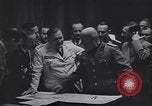
German troops planning and launching May 1940 attacks across Luxembourg, Belgium, and Holland; Rotterdam blitz scenes (WW2)
Hermann Goering, Benito Mussolini, Adolf Hitler and others as Italy joins Germany in declaring war against Britain and France June 10, 1940 (World War II). Animated map illustrates possible Axis war plans. Aerial view of Maginot line. Fire burning from German bombing in Scandinavia. Windmill turning in Holland. Map outlines Allied strategy for defense. Views of the Ardennes Forest. French Generals examining map. British Field Marshal John Vereker (Viscount Gort) studying map with two Generals. Narrator states they dismissed German attack through the Ardennes. May 9, 1940 - News headline reports German troops on move. Netherlands and French recruit troops mobilizing. French army soldiers standing at train station platform and loading into passenger railroad trains. Exterior of the Basilique du Sacre-Coeur (Basilica of the Sacred Heart) at Montmartre, Paris. People lighting candles. Statue of Madonna and Child. Views of several churches. A Catholic Bishop blessing people. People kneeling in prayer. Hitler and other Nazi leaders, including Heinrich Himmler, Goebbels, Bormann, Hess, and Rohm, haranguing crowds. Hermann Goering leading crowd in salutes. Ludwig Muller, Reichsbischof, Hitler supporter. Many views of Germans shouting Sieg Heil. German troops moving out on May 10, 1940. Hermann Goering, chief of Luftwaffe, in uniform. German pilots run to airplanes. Ju-87 Stukas take off. D0-17 bombers take off. German tanks, motorcycle troops, armor and infantry cross borders of Luxembourg, Belgium, and Holland. Map depicts action. German forces destroy obstacles at border crossings and move past windmill in Holland.He-111 bombers in flight. German paratroops jump from Ju-52 transport over Rotterdam. They capture key facilities. Troops riding on tanks. Dutch General Henri Gerard Winkelman walks with German officer over Maas-bridges in Rotterdam. He and delegation enter building at Rijsoord to sign surrender on May 15, 1940. German bombers destroy Rotterdam. View of German bomber bomb bay doors open and bombs away toward targets. The city in flames, with sound. Remains of the city. Numerous dead civilians.
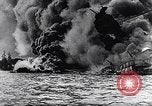
Japanese attack on Pearl Harbor in presaged by a decade of Japanese military aggression in China (WW2)
Opening scene shows the famous image of American battleship USS Arizona as attacked by Japanese forces in Pearl Harbor on December 7, 1941 in World War II. The ship is engulfed in black smoke, and listing. Change of scene to a waterfront in Japan during 1938, where numerous Japanese soldiers board troop ships bound for Manchuria, China. Next, are scenes of Japanese troops marching as they occupy Manchuria. Closeups of some Japanese soldiers. Scene shifts to a train moving on the South Manchurian railway, at a station showing a sign reading,"Chin Hsien." View of steam locomotive pulling a train away from the camera position. (Narrator states that a Japanese train, on the South Manchurian Railway, had been dynamited) This incident triggered a Japanese attack on Mukden, Manchuria. Japanese infantry are seen placing numerous bundles of reeds as a bridge across a wide, shallow, stream and proceeding to cross on their way to invade Mukden. Military supplies are carried on pack animals. In the air, overhead Japanese Mitsubishi G3M Type 96 land-based attack aircraft are seen flying in precision "V" formation. On the ground, Chinese civilians run for cover in the City of Mukden. (The date is September 18, 1931.) Glimpse of Chinese civilians looking at bombing victims on street of Mukden. Brief view of Geneva Switzerland, where League of Nations was housed. A memorial stone monument in that city to Woodrow Wilson, President of the United States and founder of the League of Nations. An entrance to the League of Nations headquarters in the Palais Wilson in Geneva, Switzerland. League delegates in session inside the Palais Wilson. A Japanese Naval Fleet, under command of Admiral Kichisaburō Nomura, is seen steaming toward the Chinese coast and begin a naval bombardment, firing their guns, 15 miles from Shanghai. Japanese Naval biplanes are seen in flight overhead. Japanese troops marching in the streets of Shanghai, as sidewalks of onlookers wave Japanese flags. Next, Japanese troops are seen marching out of Shanghai, at the insistence of the League of Nations. (Narrator states Japan signed a truce with China on May 4th, 1932.) View of Japanese troops entering further, into Mongolia. Japanese soldiers waving flag celebrating formation of the Puppet State of Manchuko in Northeast China and Inner Mongolia, in 1932. Japanese statesmen leaving the League of Nations headquarters, after Japan resigned from the League on February 24, 1933. Japanese infantry moving further into China supported by field artillery fire. Explosions from artillery and damaged buildings, as Japanese troops advance in China. Invaders using tall ladders to scale walls of a damaged fortress in China. Japanese pilots receiving briefing and boarding their Mitsubishi Ki-30 single engine light bomber aircraft at an airfield. View of them taking off and inflight, dropping bombs on Chinese targets. Aerial views of bombs exploding on ground below. Retreating Chinese army marching along the Great Wall of China. Chinese people and military forces moving their military and civilian resources deep into the Chinese interior.
Helicopters of the First Aviation Brigade operating in and around Camp Holloway, Pleiku, during the Vietnam War
A long line of UH-1 Helicopters, from the U.S. Army 1st Aviation Brigade, is seen parked beside the runway, with engines running, at Camp Holloway, Pleiku, Vietnam. One is moving slowly a few feet above the runway. Scene shifts to view from open door of an UH-1 Huey helicopter, flying overhead. View of the long runway with some red dust above it. View of misty mountains. View of narrow curving stream cutting through green brush below. Image stops from TC: 00:53 to 01:15, where another aircraft passes at a distance and a river and jungle are seen below. Next, numerous UH-1s are seen on the red earth fields of Camp Holloway, as the camera chopper settles over the camp runway and then air taxis along a ramp paved with PSP (pierced steel plank aka Marsden matting).
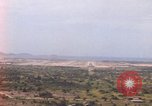
Aerial view from aircraft cockpit of approach for landing at U-Tapao Air Base runway number 18 in Thailand
Final approach cockpit view to runway 18 at U-Tapao Air Base in Thailand. View of air strip. Aircraft parked at the air base. Plane approaches air strip for landing. This is the final clip in a series of 9 in a row showing approach for landing at the following Thai Air Base locations: Don Muang AB runway No. 21; Korat AB runway No. 24; Udorn AB runway No. 30; Phitsanulok AB runway No. 33; Takhli AB runway No. 36; Ubon AB runway No. 05; Chiang Mai AB runway No. 36; Nakhon Phanom AB runway No. 15; U-Tapao AB runway No. 18.
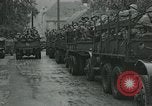
United States army troops advance through a village in France.
Soldiers of E Company, 15th Infantry Regiment, Seventh Army in military trucks pass through streets of a village in France. A soldier standing near an army jeep. A group of United States C Company soldiers marches through muddy street. (World War II period).
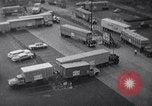
United States monitoring Cuba and enforcing Kennedy's shipment quarantine order during the Cuban Missle Crisis
Community fallout shelters being stocked. Lorries and trucks on road carry supplies. View of Red Ball trucking line truck. Aerial, exterior view of United Nations Building in New York City. View inside United Nations building. United Nation Ambassador Stevenson asks the USSR delegate whether there are missile bases on Cuba. President Kennedy signs Quarantine order on what materials may be shipped to Cuba, to begin 10am on October 24, 1962. B-52 bombers take off, taking 24 hour missions. Interceptors and fighters take off. Views on aircraft carriers with fueling and takeoff operations on flight deck. Radar dishes and radio communications. U.S. battleship at sea. U.S. intercepts Soviet tanker and allows her to proceed. Reconnaissance aircraft over Cuba. Views of White House. SAC bombers and anti aircraft missiles on 5 to 15 minute alert to handle any critical situation. Interiors of control room inside the Headquarters of American Air Defense Command.