


 Francais
 Deutsch
 Italiano
Refine Your Search
Mig-15 stock footage and images
- Showing 565 to 570 of 682 results more
more Hide
Hide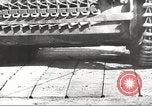
German invasion of Soviet Union (Operation Barbarossa) in Belarus during World War II.
Operation Barbarossa, the German invasion of the Soviet Union during World War II. Panzergruppe Guderian operating in Belarus (Each vehicle displays a white "G" on its fender.) . Closeups of tracks on German Panzerkampfwagen II (Sd.Kfz. 121) tanks rolling across a wooden bridge.Views flip back and forth between the full views of tanks and of their tracks and wheels. A German soldier rides on the tank gun in one view. The tanks including, Panzerkampfwagen (Sd/Lfz/141/1 Pz.Kpfw III Ausf.L), speeding along a dirt road, accompanied by half-tracks armed with antiaircraft guns (SdKfz Flakwagen). One also tows a field piece..One of the half-tracks is protected by logs and sandbags. The German column passes a knocked out smoking Soviet BT tank at the side of the road. Soldiers on motorcycles and a covered German 15cm Kanone are also seen. More views of the advancing armor column. View from a German invasion vehicle crossing an alternate bridge over a river, on their way to Grodno. (A destroyed bridge is in background.) Next, the city of Grodno (or Hrodna) is seen in a broad view from a bridge on the near bank of the Nieman (or Nyomen or Newman) River on June 23, 1941. Smoke rises from the city, across the river. German armor and vehicles move across the bridge German infantry enters the city past burning buildings.
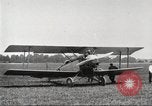
Various bi-planes parked at a field during a commercial aircraft reliability tour in the United States.
Commercial aircraft reliability tour for the Edsel B. Ford Trophy in the United States. A bi-plane on a field. A bi-plane numbered 15 on a field. A man stands near a bi-plane numbered 3. A bi-plane numbered 5 with a rear landing skid.
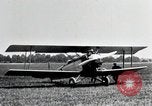
Few biplanes and a Ryan monoplane at Ford Airport, during the Airplane Reliability Tour in Dearborn, Michigan, United States.
Airplanes at the Airplane Reliability Tour at the Ford Airport, Dearborn, Michigan, United States. View of a biplane on the airfield at the Ford Airport at the Airplane Reliability Tour. Two men beside the biplane. Number '15' written on the fuselage of the aircraft. Another biplane with number '3' written on the fuselage. A biplane on the airfield with number '5' written on the rudder. Another biplane with number '22' written on the fuselage. A monoplane on the airfield. The motor of the monoplane and a lever beside the motor in view. 'Ryan M-1' written on the rudder of the monoplane. Number '23' written on the side of the monoplane. A man working on the stabilizer of the Ryan monoplane. A biplane beside a building on the airport, with number '20' written on the fuselage. The biplane on the runway and a few men beside the biplane.
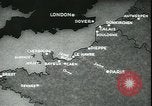
German forces fire at Allied vessels. Battle of Villers-Bocage in World War II
German soldiers in France during the Battle of Villers-Bocage of World War 2. A pictorial map showing cities along French coastline. A German soldier looking through binoculars. Allied ships at sea. German soldiers prepare artillery and fire. Smoke rising from explosions. German soldiers beside artillery. Smoke rising from Allied vessels at sea. Explosions on land and smoke rising. Two German soldiers talking. A wrecked landing craft at a beach. Debris of wreckage spread on the beach. A bomb wrecked U.S. LST (Landing Ship, Tank) on the beach and armored vehicles aboard the ship. Vehicles moving along a road. recked British Cromwell tanks and M3 Halftracks along the side of a road. A German soldier beside a damaged tank. Wide shot of a Stuart light tank. A damaged signboard which reads 'Villers Bocage'. Damaged buildings on the street of Villers-Bocage and a wrecked Tiger tank beside the buildings. Debris strewn on the ground and a damaged tank among the debris. A damaged tank with its front part into a building. A British helmet in the debris on a Cromwell tank. (Note: During this battle, On June 13th, 1944, German tank commander, Michael Wittmann, in a single Panzerkampfwagen VI Tiger tank reportedly destroyed up to 14 tanks and 15 personnel carriers along with 2 anti-tank guns. Many were of the British 22nd Armored Brigade of the 7th Armored Division, AKA the 'Desert Rats'.)
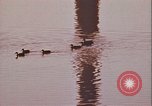
The Washington Monument and the U.S. Capitol in Washington DC, United States.
Monuments in Washington DC, United States. Several ducks swimming in the Lincoln Memorial reflecting pool (2 Lincoln Memorial Cir NW, Washington, DC 20024, United States) with the Washington Monument behind, and Capitol visible in distance. A street lighted in the night. View of the Potomac River, the Lincoln Memorial, the Washington Monument, and the U.S. Capitol, in single view, early morning. A street in downtown Washington DC. Cars moving on a road and buildings on either side of the road. The U.S. Capitol building (First St SE, Washington, DC 20004, United States) seen in the background. The Washington Monument (2 15th St NW, Washington, DC 20024, United States) in view. Equestrian statue at George Washington, at Washington Circle in Washington, D.C. The U.S. Capitol viewed at dawn, along an empty Pennsylvania Avenue. The Washington Monument, seen from space between buildings. Equestrian statue of Civil War hero, Major General John A. Logan (Washington, DC 20005, United States), at Logan Circle, Rhode Island Avenue and 13th St. NW. The U.S. Capitol dome. View from Memorial Bridge, of Lincoln Memorial and Washington monument (in distance).
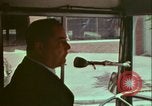
A city tour bus driver speaks about former U.S. President Abraham Lincoln's assassination in Washington DC, United States.
A city tour bus in Washington DC, United States. The driver of the city tour bus speaking in a microphone from the driver's seat. The bus driven in front of the Ford's Theater. The driver says that former U.S. President Abraham Lincoln was shot by John Wilkes Booth while attending a performance of 'Our American Cousin' at the Ford's Theater. The driver says that President Lincoln was taken to the Petersen House across the street and the President passed away at 7.15 AM the next morning. Part of the theater and a sidewalk in view. People walking into the theater.