


 Francais
 Deutsch
 Italiano
Refine Your Search
Mojave California 1955 stock footage and images
- Showing 2101 to 2106 of 3122 results more
more Hide
Hide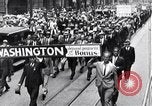
The 1930s Great Depression and the administrations of Presidents Herbert Hoover and Franklin Roosevelt, in the United States
Hard times in the Great Depression led to formation of The Bonus Army. American veterans of World War 1 march on streets of Washington DC, carrying a large poster demanding immediate cash redemption their "bonus" service certificates awarded by Congress in 1924 (but not lawfully payable until 1945). Army Chief of Staff, General Douglas MacArthur, ordered by President Hoover, to clear the Bonus Army encampments, is seen standing in a street surrounded by several U.S. Army troops. People watch from sidewalks as a contingent of U.S. Army cavalry rides down the street. U.S. Army M-1917 tanks roll down Pennsylvania Avenue in July 1932. Bonus marchers and others watch from Lafayette Park in background. Scene shifts to the 1932 Democratic Party Convention in Chicago Stadium, Chicago, where delegates cheer after nominating Franklin D. Roosevelt as their Presidential candidate. Roosevelt seen waving from the podium. Migrant farm workers seen at temporary, dilapidated dwellings in close quarters, and sitting at a campfire, some with sad and desperate faces. Migrant farm workers' cars on the road, piled high with family belongings during westward migration. Migrants riding atop an open railroad freight car. Two men share a copy of the "Epic News" newspaper (published by supporters of Upton Sinclair and the End Poverty Movement in Los Angeles and central California). Narrator describes programs of the Works Progress Administration (WPA) and the Civilian Conservation Corps (CCC). Construction workers ignite demolition charges during construction of Boulder Dam (aka Hoover Dam and officially so-named in 1947). Glimpse of President Roosevelt at the site in an open car, for its dedication on September 30, 1935. Construction workers engaged in building the dam. Another shot of President Roosevelt in his open car. Towers being erected to carry electric power from the dam's hydroelectric generators. President Franklin D. Roosevelt smiling broadly at the formal dedication ceremony, September 30, 1935. Controlled discharges of water through the dam. Views of the Boulder Dam hydroelectric generating station. Oil well rigs or oil derricks at work during construction at night. People at work in fabric mills or textile mills, and in a print shop
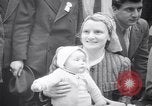
Displaced Persons, refugees, and former prisoners of Nazi concentration camps arrive by ship in New York City
Views of men, women, and children aboard the steamship "SS "Marine Flasher" docked at a pier in New York harbor after a voyage from Bremen, Germany. Her passengers include many refugees and former prisoners of Nazi concentration camps. Many benefited from U.S. Presidential Directive No. 29, issued on December 22, 1945, giving preference to Displaced Persons in obtaining visas. A woman with her child smiles. A boy waves at friends and relatives on shore. A young brother and sister in the ship. An older and younger woman, likely mother and daughter, show the prisoner number tattooed by Nazis on their arms. The tattoos are sequentially numbered, A-26587 and A-26588. Reuniting people hold each other with warmth and weep. A family of 7 children spanning a range of ages, with no parents evident. (Note: this is the Weber family ranging in age from 4-18. In order of age from oldest to youngest they are Alfons, Senta, Ruth, Gertrude, Renee, Judith, and Virginia (Ginger) nee Bela. The family settled in Chicago. All married and had 24 children and now numerous grandchildren. The children and grandchildren live in across the U.S. in Chicago, Maryland, Texas, Alabama, California, Virginia, Minnesota and in London, England. This Information provided in 2014, by Lynn Chapman daughter of Gertrude.) (World War II period).

Profile of Harvard professor of Economics Thomas Schelling at home in Lexington and at work at Harvard and Washington, D.C.
Thomas Schelling, a Professor of Economics with specialization in arms control at Harvard University in Cambridge, Massachusetts. Close up of clock tower at Harvard. View of Harvard Yard and statue of John Harvard with students nearby. Tom Schelling smokes a pipe while walking through Harvard Yard. Professor Tom Schelling teaching a class at Harvard. View of outside of the Center for International Affairs at Harvard. Tom Schelling compiles newspaper cuttings and goes through papers at the Center for International Affairs. Tom Schelling on a flight. View of airplane wing and propeller through passenger window. Wide shot of Rand Corporation in California. View of Capitol Building in Washington D.C. from a moving car. Wide shots of Pentagon Building in Arlington Virginia as Tom Schelling arrives at the Pentagon parking lot via taxi and climbs the steps to enter the Department of Defense at the Pentagon. As an adviser to the United States, Schelling participates in a meeting with military officers to discuss issues of national defense and arms control. Professor Schelling at his home with his family in Lexington, Massachusetts near the town green where the American Revolutionary War began. Thomas Schelling walks with his wife, Corinne Tigay Saposs, and their four sons, Robert Schelling, Daniel Schelling, Tom Schelling Jr., and Andrew Schelling. At night he is seen recording lectures and articles with the help of a tape recorder.

People offer prayers on 1966 Easter all over the world.
A film titled 'Holiday Highlights: World marks Easter with prayer and fete’. Interdenominational Christian group offering prayers in California. Yosemite falls also seen. Large crowds gather at Hollywood Bowl (2301 N Highland Ave, Los Angeles, CA 90068, United States) to offer prayers on Easter. Pope Paul VI addresses the people at St. Peter’s Square in Vatican City. People enter St. Thomas Church (1 W 53rd St, New York, NY 10019, United States) and St. Patrick's Cathedral (5th Ave, New York, NY 10022, United States) in New York to offer prayers.
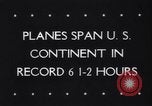
United States Army Air Force pilots fly across the continent in 6 ½ hours in Mustang aircrafts in New York in United States
A film titled 'Planes span U.S. Continent in record 6 ½ hours', shows two Mustang also known as P-51 aircrafts take off from Los Angels in California. Planes land at New York after crossing the continent in just 6 ½ hours. Colonel Peterson gets out from the plane and is greeted by his wife. Colonel Carter gets out from the second P-51 as photographers take pictures.
Doreen Garwick, wife of a United States Navy officer, taken as prisoner by Japanese being interviewed in Manila, Philippines (WW2)
Interview with Doreen Garwick, wife of United States Navy officer Warren Garwick from Los Angeles, California. Garwick recounts her experience taken as a prisoner by Japanese forces during World War II in Manila, Philippines. During the interview she hopes of meeting her husband soon after the liberation of Manila.