


 Francais
 Deutsch
 Italiano
Refine Your Search
Mojave California 1955 stock footage and images
- Showing 37 to 42 of 3122 results more
more Hide
Hide
Men remove dead bodies from a plane crashed into a mountain killing 66 people in United States.
1955 air disasters in the United States. Wreckage of United Air Lines Flight 629, a Douglas DC-6B aircraft (N37559, Mainliner Denver) that was blown up over Longmont, Colorado on November 1, 1955, by a dynamite bomb placed in the checked luggage. The crash site of United Air Lines Flight, a Douglas DC-4 propline (N30062), in Medicine Bow Peak, near Laramie, Wyoming. Dead bodies carried out from wrecked plane. Crowd watches.
Preparations for the "Apple Two" atomic test shot and associated U.S. Army's "Desert Rock VI" exercise, at the Nevada Test site
The U.S. Army prepares for its "Desert Rock 6" atomic maneuvers and tests , as part of Operation Teapot atomic tests in 1955. U.S. Army troops in trucks, pass through entry gates, headed for ground zero of atomic test shot "Apple 2" , the 13th in this series, scheduled for May 5, 1955, at the Nevada test site. A soldier with clipboard notes their passing. Next, the Control Center Building is shown. It displays several types of antennas. View from inside the building. Vehicles moving in area near the control center. Low-level aerial view of the "ground zero" area. Men walking into a bunkered shelter housing instruments for measuring atomic explosion data. View upward from ground, of instrumentation being setup on a steel tower outdoors. Glimpse of a soldier who will be participating in the exercise. A technician adjusting instruments atop the steel tower. Soldiers walking into ground zero and inspecting an artillery piece there to determine the planned explosion's effects on it. Other things placed in the area to determine effects atomic explosive effects on them include: sand-bagged emplacement; a jeep (labeled, Test Equip. off limits); a 155mm howitzer; A Browning heavy machine gun; portable field radio; trench mortar; simulated soldiers, including steel helmet and rifle; trees; an unsheltered North American B-45 tornado aircraft; and Republic P-47 aircraft in both sheltered and dug-in positions. Workmen are seen erecting buildings in a model village (including mannequins representing occupants and food to be tested). M-48 Patton tanks and their crews, part of "Task Force Razor" are seen raising dust as they travel across deserts to the Nevada test site. Army soldiers performing maintenance on their tanks and equipment prior to entering the test site. More trucks and equipment approaching the test site.
Atoms for Peace. UN approves formation of IAEA. Nuclear scientists gather in Geneva Switzerland
UN General Assembly seen meeting in 1954 as it approves an International Atomic Energy Agency (IAEA). U.S. Ambassador Henry Cabot Lodge II, and French ambassador, Henri Hoppenot, speaking. Finn Moe, of Norway, speaking. View of the city of Kjeller, Norway. Flags of Norway and the Netherlands at joint atomic laboratory. Scientists with various pieces of scientific equipment inside the facility. Indian ambassador, Krishna Menon, speaking at the United Nations. Atomic laboratory and a Government Teachers' Training College, in India. Indian scientists in a laboratory. Indian lecturer speaks to students. Brazil's Professor Ernesto Leme speaks at the UN. The city of Sao Paulo, Brazil. The University of Sao Paulo. Rio de Janeiro, Brazil. The Center for Physical Research. Clock tower of Brazil Central Station in Rio. Sutan Sjahrir,of Indonesia at the United Nations. An animated map shows nations interested in atomic energy. The UN Headquarters building on the East River in New York. A person looking through a microscope. Foreign scientists attending indoctrination courses at the U.S. Argonne National Laboratory. Diplomats sign agreement between the U.S. and Philippines on July 27, 1955, for the Philippines to lease uranium for a research nuclear reactor, and to receive technical assistance. Views of Geneva Switzerland in August 1955, including street views with pedestrians, and tram or streetcar on city streets. Exterior of Palace of Nations, then interior view with atomic science conference in progress. Indian nuclear physicist, Homi Jehangir Bhabha, presiding over conference of scientists and university representatives from 73 nations, including, inter alia, John Cockcroft, of Great Britain; Otto Hahn, of Germany; Willard Libby, of the U.S.A.; Vladimir Vexler of the Soviet Union; and Niels Bohr of Denmark. Views of exhibit hall at the conference, and displayed models of nuclear reactors, uranium ore refining exhibits, and accelerators. U.S. President Dwight Eisenhower views swimming pool reactor, while visiting the exhibit hall. Site work and construction underway in Meyrin, Geneva, Switzerland for a research laboratory for the European Organization for Nuclear Research (CERN - Conseil Européen pour la Recherche Nucléaire). Sitework seen for a facility of Euratom in Europe (European Atomic Energy Community). View of early sitework in Manila for an Asian nuclear center in the Philippines under the Colombo plan, for training personnel in nuclear science and technology.
Vice President Nixon and Senator Kennedy debate over Quemoy and Matsu issue prior to presidential elections in the U.S.
The fourth presidential election debate held between Democratic nominee Senator John F. Kennedy and Republican nominee U.S. Vice President Richard Nixon in New York, United States on 21st October 1960. ABC News correspondent Quincy Howe speaks during the debate and allows NBC correspondent John Chancellor to pose a question to Richard Nixon a . Correspondent Chancellor asks a question about Quemoy and Matsu issue. Vice President Nixon points out inconsistency of Senator Kennedy. He further explains it by saying that Senator Kennedy signed a resolution in 1955 which gave the president the power to use United States forces to defend Formosa (Taiwan) and offshore islands. But he also voted for an amendment which was lost, an amendment which would have drawn a line and left out those islands. Vice President Nixon supports President Eisenhower's position. Correspondent Howe asks Senator Kennedy to comment on the topic. He speaks about President Eisenhower sending a mission to persuade Chiang Kai-shek in the spring of 1955 to withdraw from Quemoy and Matsu because they were exposed. The President was unsuccessful. He refers to the fact that in 1958, as a member of the Senate Foreign Relations Committee, he was very familiar with the position that the United States took in negotiating with Communist China (PRC) on these two islands. He further that the U.S. was unable to persuade China's Chiang Kai-Shek to withdraw and thus it was decided by the U.S. to defend the islands.
Judge Louis E. Goodman dismisses Justice Department's civil action to denaturalize ILWU President, Harry Bridgers.
Opening scene shows dimly lit hallway of Federal District Court building in San Francisco. Camera focuses on a courtroom door inscribed as " U.S. District Court, 258, Louis E. Goodman." Officials are seen escorting International Longshoreman's Union (ILWU) President, Harry Bridgers, along a hallway, accompanied by many photographers. Bridger's lawyer, Carol Weiss King and her co-counsel, wearing dark rimmed glasses, are seen standing in the hallway. Closeup of them. He holds up a copy of legal papers. View from further down the hall as Bridgers stops briefly to converse with them. Another closeup of Bridger's lawyers. (Note: Harry Bridgers was prosecuted for his labor organizing and supposed subversive status by the Justice Department in the 1930s, 1940s, and 1950s, with the goal of deportation. This was never achieved. Bridges became a naturalized citizen in 1945. A final effort by the Justice Dept. to deport Bridges ended in 1955 when Judge Louis E. Goodman dismissed the department's civil action to denaturalize him)
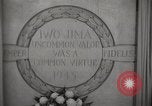
Dedication of Marine Corps War Memorial at Quantico Virginia, and sculptor Felix de Weldon working on sculpture for Arlington location.
The U.S. Marine Corps War Memorial original statue during its unveiling ceremony at the Marine Corps base in Quantico, Virginia on November 10, 1951 (This is after the statue had been moved from its original Constitution Avenue location in Washington DC in 1947, and subsequently renovated under sculptor de Weldon's supervision while it was in Quantico.). A sign on the memorial reads "Uncommon valor was a common virtue, 1945." Next scenes show sculptor Felix de Weldon as he works to build the larger Marine Corps War Memorial in Arlington, Virginia, which was dedicated in November 1954. Felix de Weldon measuring a model of the flag raising on Iwo Jima made by him. de Weldon and others on his team work to carve the large war memorial in plaster before it is cast in bronze. Views of the sculpted faces of the six Marines who raised the flag on Iwo Jima: Faces of John Bradley, Rene Gagnon, Ira Hayes, Franklin Sousley, Harlon Block and Michael Strank. Brief glimpse of the original flag raising scene on Mount Suribachi in February 1945. Next scene, circa 1954 or 1955, shows the completed Marine Corps War Memorial in bronze, in Arlington Virginia, with Washington Monument and Lincoln Memorial landmarks of Washington DC in the background. Close-up views of faces of a young boy, an elderly woman, and a middle aged man who removes his hat. American flag fluttering in the breeze atop the war memorial.