


 Francais
 Deutsch
 Italiano
Refine Your Search
Moosburg Germany 1945 stock footage and images
- Showing 4213 to 4218 of 10461 results more
more Hide
Hide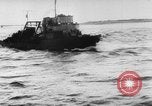
Allied bombing campaign against Germany and Luftwaffe defenses during World War II
German M-Class mine sweeper in waters off France in World War 2. It is armed with quad-mounted 2 cm Flak 38 AA guns (2 cm Flakvierling 38). German Navy sailors look up at contrails from high flying Allied aircraft. Officer sights aircraft overhead and hurries to report it. He records his observation in a log. German radio operator transmits information over wireless telephone by morse code telegraph key. A mass of contrails from Allied aircraft is seen in the sky. Scene shifts to a German airfield in France, where Focke-Wulf FW-190 fighters are lined up. Ground crewman shows motion picture gun camera for an airplane. Men push a Messerschmitt Bf 104 out of a hangar. Closeup of German pilots strapping into Me-104s and taxiing for takeoff. FW-190s and Me-109s taking off from airfield. German civilians entering a Flak tower for refuge as a bomb shelter. View from inside as doors close. Trams stopped on street. Hospital staff moving patients to bunkers (bomb shelters). Massive contrails from Allied bombers. View inside a German command post, where women workers and German officers with headphones plot positions of attacking planes on large maps. Flight of German Me-109 aircraft in formation. Gun camera showing A U.S. B-17 bomber being shot from rear with its wing on fire and explosion in its tail. Glimpse of head-on attack against B-17. Two Messerschmitt Bf 110 aircraft in flight. A lone U.S. B-24 Liberator bomber under attack. B-17 with piece of windshield missing and horizontal stabilizer shot away. B-17 bomber formation under attack from the rear. View of pilot and instruments inside German fighter plane. B-17 being shot to pieces in frontal attack. More attacks on formations of B-17s. German women in command post recording combat information on displays. Parachutes of American B-17 crew in sky. Captured U.S. fliers being escorted under guard, and one, with head bandaged, being questioned by German officers (English conversation is heard.) The flier says he is fine They ask another flier if he is wounded. He says only a twisted ankle. Temporary graves of dead American fliers, with wooden crosses and names on them, including one with name George J.Parker.
Germany launches V-1 flying bombs against England during World War II
Initial scene shows German soldiers setting up a camera, in a camouflaged location, during World War 2. . Views from the water, of the White Cliffs of Dover, on the English Channel coast. Suddenly, a jet-propelled V-1 flying bomb is seen racing past the camera and disappearing in the distance. Next the camera focuses on another V-1 and tracks it. Its body, wings, and jet engine affixed to its top, are clearly seen. as are pulses of flame from its engine. Another V-1 launches from near the camera and flashes past, disappearing in the distance. The final scene shows a V-1 in flight, even clearer than the earlier views. (Note: The V-1 was also known as a buzz bomb or doodle bug was the first cruise missile used in wartime.)

Eva Braun, Hitler's companion, with sister Gretl and friends on a snowy street in Germany.
Gretl Braun, sister of Eva Braun (Hitler's companion) on a snowy street with friends.One friend has a muzzled dog with him. One of the friends puts a leash on her dachshund dog. Later, Eva Braun is seen picking up the Dachshund dog and singing to it.

Girls of Hitler Madchen do calisthenics in a field and perform hooping in Germany.
Hitler Madchen, the female branch of the Hitler Youth, attends various classes in a field. Women doing calisthenics. They perform hooping. The Nazi flag flies from a pole. German Chancellor Adolf Hitler poses.
German soldiers being trained in infantry drills, goose step, and parachute jumping techniques in Germany during World War II.
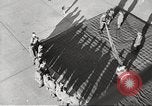
Paratroop training in the German army early during World War II. German Army paratroopers in training seen on a large field with parachutes, learning to stand and control an open parachute after landing. German Army troops marching and in drills for infantry training in addition to paratrooper duties. A column of German soldiers marching in formation. A view of several German soldiers goosestep march with very high steps in front of a parked Junkers Ju 52 aircraft on an airfield. Parachute trainers use different training methods and drills to prepare soldiers for jumping out of aircraft, descending on parachute, and landing safely on the ground.
Men and women working to manufacture parachutes in a factory in Germany during World War II.
Parachute manufacture for the German army early in World War II. Soldiers stand on the ground rolling parachutes. German women work inside a parachute factory. They stitch the parachutes with the help of a Dürkopp sewing machine. Men, including older or elderly men, inspect the parachutes to test that they are properly stitched. Workers also manufacture the other parts to be attached to the parachute. A Singer sewing machine is seen in use. A stamp of acceptance is given for the parachute after a rigorous inspection (stamp bears date 20 September 1938). A man selects a parachute backpack from a large stock of completed parachutes. A German airplane in flight. For testing purposes, a 400 pound mannequin dummy is attached to one of the parachutes and pushed out of the airplane. View of the mannequin descending to ground, attached to the test parachute.
CRITICALPAST.COM: About Us | Contact Us | FAQs - How to Order | License Agreement | My Account | My Lightboxes | Shopping Cart | Advanced Search | Featured Collections | Website Terms & Conditions | Privacy Policy ©2026 CriticalPast LLC.
License Agreement |
Terms & Conditions |
Privacy Policy
©2026 CriticalPast LLC.