


 Francais
 Deutsch
 Italiano
Refine Your Search
Moosburg Germany 1945 stock footage and images
- Showing 4909 to 4914 of 10461 results more
more Hide
Hide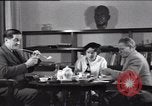
Ernst Hanfstaengl shows a sculpture of German Chancellor Adolf Hitler to a man and woman in Berlin.
Ernst Hanfstaengl (known as "Putzi"; an early friend of Adolf Hitler) sitting in an apartment in Berlin, Germany, smoking a long tobacco pipe as he shares lunch and conversation with Wolf-Heinrich Graf von Helldorf and a woman (possibly Ingeborg von Wedel Helldorf?). He shows them a sculpture of German Chancellor Adolf Hitler by German sculptor Josef Thorak, whom he says the couple will meet later that morning. Close-up view of the bust of Hitler. Hanfstaengl plays the piano for the couple, introducing the song as one he wrote called "The Heart of Song." Behind him, on a book shelf, is a bust of Paul von Hindenburg and a photograph of Adolf Hitler.
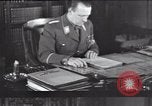
Wolf-Heinrich Graf von Helldorf ,Chief of Police in Berlin, signs a document and talks into a phone at a desk in his office.
Berlin chief of police, Wolf-Heinrich Graf von Helldorf, in Berlin,Germany. Heinrich von Helldorf at his desk. He receives and signs a documen, and talks into a telephone.

Captain Prien and crew of German submarine U-47 greeted on return to Kiel, after sinking the British battleship, Royal Oak
Views of the British battleship Royal Oak, in Scapa Flow, Scotland, and underway at sea. . The German submarine, U-47, commanded by Captain Gunter Prien, underway and saluting as they are greeted as they return to base at Kiel, Germany, on October 23, 1939, after successfully penetrating Scapa Flow and torpedoing the British battleship, Royal Oak (and also, the British battle cruiser, Repulse, they believed), on October 14, 1939.

U.S. Brigadier General Frank L. Howley speaks about Berlin blockade before a map after end of Berlin blockade.
A film titled 'Berlin Blockade Ends' depicts the conditions which existed during blockade, the Berlin Airlift operation, and final lifting of blockade in Berlin, Germany. Rooftops of Berlin. A damaged building. A plane flies high over damaged buildings. Pedestrians crowding streets. A group around newsstand. U.S. Brigadier General Frank L. Howley stands before a map of Berlin as he speaks about Berlin blockade. Interiors of Air Safety Center with French, British, and U.S. representatives working side by side. Brandenburg Gate in Berlin. Crowd on a street. Two Soviet officers walk along a deserted railroad track. Deserted Charlottenburg railroad station.
Defendants answer as their names are called at Doctors' Trial of War Criminals before the U.S. Military Tribunals in Nuremberg.
The Doctors' Trial of War Criminals before the Nuremberg Military Tribunals held at the Palace of Justice in Nuremberg, Germany after World War II. The judges file in and take their seats. Defendants, one by one, answer when their names are called. Defendants include Karl Brandt, Siegfried Handloser, Paul Rostock, Oskar Schröder, Karl Gebhardt, Kurt Blome, Rudolf Brandt, Joachim Mrugowsky, Helmut Poppendick, Wolfram Sievers, Gerhard Rose, Siegfried Ruff, Hans Wolfgang Romberg, Viktor Brack, Hermann Becker-Freyseng, Georg August Weltz, Konrad Schäfer, Waldemar Hoven, Wilhelm Beiglböck, Adolf Pokorny, Herta Oberheuser, Fritz Fischer.
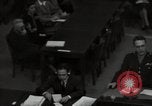
U.S. General Telford Taylor addresses the court session at the Doctors' Trial of War Criminals before the U.S. Military Tribunals.
The Doctors' Trial of War Criminals before the Nuremberg Military Tribunals held at the Palace of Justice in Nuremberg, Germany after World War II. U.S. General Telford Taylor speaks before microphone about Jewish and Gypsy victims dying under torture and experimentation after being cruelly mistreated and murdered by Nazi German doctors. General Taylor further says these savage crimes by medical physicians and scientists cannot go unpunished.
CRITICALPAST.COM: About Us | Contact Us | FAQs - How to Order | License Agreement | My Account | My Lightboxes | Shopping Cart | Advanced Search | Featured Collections | Website Terms & Conditions | Privacy Policy ©2026 CriticalPast LLC.
License Agreement |
Terms & Conditions |
Privacy Policy
©2026 CriticalPast LLC.