


 Francais
 Deutsch
 Italiano
Refine Your Search
Naha Okinawa Ryukyu Islands 1945 stock footage and images
- Showing 901 to 906 of 9403 results more
more Hide
Hide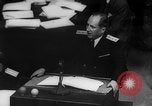
View of the Nazi Concentration Camps and its victims, and other atrocities committed by Nazi forces in World War 2.
Images and testimony related to the Nuremberg Trials held at the Palace of Justice in Nuremberg, Germany in October 1946. Flashbacks of a variety of Nazi crimes against humanity during the years of World War II. Reference to testimony of Kenaris and Hans Frank in describing Nazi policies and methods for exterminating Poles and others. Pictures recording the implementation and results of Nazi policies; atrocities and murder of victims in Ouradour Sur Glane in France, in Bande in Belgium, in the Catacombe of San Callisto in Italy and in Czechoslovakia. Nazi German soldiers seen leveling and destroying the town of Lidice in Czechoslovakia in 1942, after massacre of many residents, in retaliation for the assassination of SS Reich Protector Reinhard Heydrich. Corpses of the victims of the Nazi concentration camps, including Auschwitz, in 1945. Bones of humans in crematory ovens. Cramped starved women camp victims inside barracks. Stacks of luggage and suitcases of victims at a concentration camp, along with locks of hair, stacks of toothbrushes. Shaving cream brushes, shoes, clothing, and finally, piles of bones of camp victims. Testimony of Rudolf Franz Ferdinand Höss (sometimes spelled Höß or Hoess or Hess) describes concentration camps at Auschwitz in Poland. As scenes of victims in hospitals are shown, testimony of Rudolf Hoess is read, describing medical experiments include lowering the body temperature, injecting the body with poisons and infectious diseases and subjecting the body to high altitude pressure chambers. Shows pile of mutilated corpses.The "Arbeit Macht Frei" sign over the camp entrance of Auschwitz. Scenes of dead victims of Nazi brutality in the concentration camps.
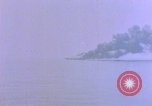
Thick smoke rises from USS Bunker Hill after it suffered a Japanese air attack in the Pacific Ocean during World War II.
Japanese air attack on U.S. ships underway in the Pacific Ocean during World War II. USS Bunker Hill (CV-17) underway burning after an air attack on 11th May, 1945. Thick smoke rises from the burning ship. U.S. Navy sailors aboard a destroyer which is counter sailing.
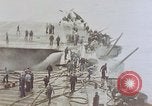
Crew of USS Enterprise suppressing fire after being struck by a Japanese kamikaze in World War II
U.S. Navy warships under attack by Japanese aircraft during World War 2. Fire fighting detail working on the deck of USS Enterprise (CV-6). They play hoses into elevator shaft where forward elevator was blown out of its well by Japanese kamikaze on 14 May 1945. Another ship in the far background, as battle with Japanese aircraft continues. Bomb splash in water near distant ship.
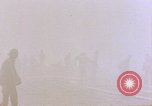
Damage on USS Enterprise after it was attacked by a Japanese suicide aircraft while underway in the Pacific Ocean
Japanese air attack on U.S. ships underway in the Pacific Ocean during World War 2. Men running on the deck of USS Enterprise (CV-6) after it suffered a Japanese air attack on 14th May, 1945. It was hit by a kamikaze Zero, piloted by Lt. J.G. Shunsuke Tomiyasu, destroying her forward elevator, killing 14 and wounding 34. View of damage to number one elevator from the suicide airplane attack Fire fighters try to douse the fire. Burned aircraft on the deck. On hangar deck, fire fighters plays hoses on bulkheads. Ammunition and damaged airplanes are jettisoned over the side. An aircraft on its nose on the deck. Debris strewn all around.
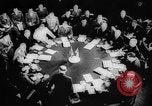
V-J Day: New Yorkers celebrate as President Harry Truman announces Japanese surrender during World War II.
Events surrounding the surrender of Japan during World War II. Scene from the Potsdam Conference meeting. Group of dignitaries together including Clement Attlee, Harry Truman, and Joseph Stalin. U.S. President Harry S. Truman and the General Secretary of the Communist Party of the Soviet Union, Joseph Stalin, in discussion. A parade in Moscow showing Soviet military might (these scenes are from the May 1, 1945 May Day parade just before Germany's surrender). Scene changes to Japanese Emperor Hirohito riding on a white horse in a procession. Next scene shows dignitaries arriving for meeting at the White House in Washington D.C. U.S. Secretary of War Henry Stimson, Secretary of State James Byrnes and Secretary of Navy James Forrestal meet at the White House. Close up view of Secretary Forrestal. View of President Truman with his cabinet in a meeting. Scenes from prior months showing dignitaries involved in the war: Close up of the late President Franklin Roosevelt. A scene of President Roosevelt shaking hands with several Soviet military officers. General Douglas MacArthur seated and talking to President Roosevelt. Close up view of Chairman of Nationalist Government of China, Chiang Kai Shek. View of U.S. Navy Admiral Chester Nimitz shaking hands with a sailor. Views of President Truman meeting in emergency session with his cabinet, and his announcement of the Japanese surrender. View of former Secretary Hull at that meeting. President Truman standing as he reads from a bulletin confirming the Japanese acceptance of the terms of the Potsdam Agreement and their agreement to unconditional surrender. View of media, press, and newsmen running from the White House to file the happy news story. New Yorkers rejoice at the end of war. Daytime scenes of happy, jubilant celebrations on Victory over Japan day, or V-J Day, in the Times Square area of New York City. Crowds cheering, people dancing, soldiers, sailors, and citizens waving hands and American flags. A neon sign with message "Japs Surrender". View of night time celebrations at Times Square as the crowd continues to celebrate VJ Day.
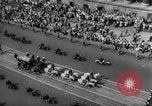
Funeral services for Franklin D. Roosevelt in Washington DC and at Hyde Park, New York (WW2)
Funeral procession of President Franklin D. Roosevelt on the streets of Washington DC. Horse drawn carriage with casket escorted by men on motorcycles. Crowd lined up on sidewalks. Various U.S. military units march. Funeral procession arrives at White House. Casket is carried into building. Casket is placed in East Room, lying in state. Scene change to funeral services for FDR at Hyde Park, New York. President Truman and Franklin D Roosevelt's wife among the mourners. A volley is fired over the president's grave. Symphonic music track in background is interspersed with audio quotations from Roosevelt, including, from his State of the Union on January 7, 1943: "Therefore, let us all have confidence, let us redouble our efforts. A tremendous, costly, long-enduring task in peace as well as in war is still ahead of us. But, as we face that continuing task, we may know that the state of this Nation is good--the heart of this Nation is sound--the spirit of this Nation is strong--the faith of this Nation is eternal." Also heard at the beginning of the clip is Roosevelt saying, "American fighting men looked to the statesmen of the world to finish the work of peace for which they fought and suffered. We failed them then. We cannot fail them again, and expect the world again to survive," from his address to Congress on Yalta, March 1, 1945 (World War II).
CRITICALPAST.COM: About Us | Contact Us | FAQs - How to Order | License Agreement | My Account | My Lightboxes | Shopping Cart | Advanced Search | Featured Collections | Website Terms & Conditions | Privacy Policy ©2026 CriticalPast LLC.
License Agreement |
Terms & Conditions |
Privacy Policy
©2026 CriticalPast LLC.