


 Francais
 Deutsch
 Italiano
Refine Your Search
Naha Okinawa Ryukyu Islands 1945 stock footage and images
- Showing 9289 to 9294 of 9403 results more
more Hide
Hide
General Omar Bradley meets General George S. Patton at 3rd Army Command in snowy Luxembourg (WW2)
United States General Bradley and Lieutenant General George S. Patton Jr. exit 3rd Army Corps Command in Luxembourg during World War II. (Today the Jean-Pierre Pescatore Foundation, 13 Av. Jean-Pierre Pescatore, 2324 Luxembourg City) General Bradley sits on the passenger seat of a Jeep. It is winter, and snow is on the ground. General Patton stands beside the Jeep, talking to General Bradley. Military Police personnel board Bradley’s Jeep before it departs. The Jeep drives away. Omar Bradley arrives at the headquarters building of the U.S. 12th Army Group Tactical Air Command in Luxembourg (today Spuerkeess Financial Center at Place de Metz 2 Pl. de Metz, 2954 Luxembourg City) Bradley jumps out of Jeep, salutes guard, and walks quickly inside. Staff car drives in the snow and stops at 3rd Army Corps Command checkpoint. A Military Police uses a telephone at ‘Dismount Point’. Soldiers exiting a building at 3rd Army Corps Command as snow falls.
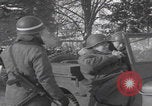
General Omar Bradley travels in Luxembourg City in winter (WW2)
United States General Omar N. Bradley in Luxembourg City during World War II, sitting in the passenger seat of a Jeep at a checkpoint. Military Police officer inspects General Bradley’s identification card before letting the Jeep pass. General Bradley’s Jeep drives on snow covered Pont Adolphe towards U.S. 12th Army Group Command in Luxembourg before signaling right to drive into the headquarters (today Spuerkeess Financial Center at Place de Metz 2 Pl. de Metz, 2954 Luxembourg City). General Omar Bradley's Jeep exits the rear gate at 3rd Army Corps Command in Luxembourg during World War II. (Today the Jean-Pierre Pescatore Foundation, 13 Av. Jean-Pierre Pescatore, 2324 Luxembourg City). General George S. Patton Jr. speaks to General Bradley, the latter sitting in the passenger seat of Jeep. Major General John Milliken sits on the back of the Jeep. General Bradley’s Jeep drives away into snow covered landscape of Luxembourg.

General Frank L. Culin and his son at 87th Infantry Division headquarters in Libramont, Belgium (WW2)
United States Army Brigadier General Frank L. Culin Jr. and his son, Lieutenant Frank L. Culin III outside 87th Infantry Division headquarters in Libramont, Belgium during World War II. The two men exit a headquarters. A cameraman stands nearby with a camera. Jeeps are parked in the snow near trees. General Culin and his son board a Jeep. The Jeep leaves through a gate. Military Police salutes as they drive away.
General Harry Twaddle awards two commissioned soldiers during a battlefield commission in Saarlautern, Germany (WWII)
Battlefield commissions in Saarlautern (present-day Saarlouis), Germany during World War II. Major General Harry L. Twaddle pins bars on two newly commissioned soldiers of the 37th Infantry, 95th Infantry Division. General Twaddle pinning bars on a soldier’s shoulder. The soldiers shake hands with General Twaddle. Infantry troops stand in formation during a snowy day. Soldiers lower their flags in front of General Twaddle. Damaged buildings are seen in the background.

United States Secretary of State James Byrnes requests increased production for the war effort (WWII)
United States Secretary of State James Byrnes addresses Americans to participate in the war effort during World War II. Byrnes calls for Americans to divert work from non-essential, civilian production to increase war production of necessary supplies to the front. “Our boys are suffering and dying abroad while we are living in safety and comfort at home. If they are willing to die for their country surely we should be willing to work for that country.” Byrnes said.

Artillery crews fire anti-aircraft guns at V-1 rockets directed at Antwerp, V-1 rocket explodes (WW2)
A German V-1 rocket in flight heading towards Antwerp. United States anti-aircraft guns fire at incoming V-1 rockets Belgium during World War II. Gunners load more shells into the howitzer. Smoke rises from anti-aircraft gun fire. Dark puffs of smoke and explosion from anti-V-1 rocket defense is scattered over the sky. A V-1 rocket explodes mid-air after being shot by anti-aircraft gun. Diagram shows the effectiveness of anti-aircraft guns in preventing V-1 rockets from hitting their targets. A soldier neatly arranges empty spent anti-aircraft shells on the ground.
CRITICALPAST.COM: About Us | Contact Us | FAQs - How to Order | License Agreement | My Account | My Lightboxes | Shopping Cart | Advanced Search | Featured Collections | Website Terms & Conditions | Privacy Policy ©2026 CriticalPast LLC.
License Agreement |
Terms & Conditions |
Privacy Policy
©2026 CriticalPast LLC.