


 Francais
 Deutsch
 Italiano
Refine Your Search
Naha Okinawa Ryukyu Islands 1945 stock footage and images
- Showing 937 to 942 of 9403 results more
more Hide
Hide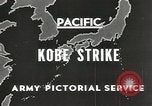
United States B-29 bombers drop incendiary bombs over Kobe, Japan
"Kobe strike" shows United States B-29 bomber aicraft dropping 3200 tons of incendiary bombs over industrial targets in Kobe, Japan during World War 2. Firebombing causes pillars of smoke to rise up. Narrator speaks of strikes on other Japanese cities also and relates statement by General Arnold that beginning July 1945, industrial Japan will be hit by bombs at the rate of 2 million tons per year, or 5480 tons per day, adding that "by the end of 1946, Japan will have ceased to exist as a bombing target."
USS Franklin heads towards the United States after facing a Japanese attack during World War II.
United States aircraft carrier USS Franklin after being attacked by a Japanese bomber in the Pacific Ocean on March 19, 1945, during World War II. The U.S. flag flies from USS Franklin while on its way to the United States. A chaplain conducts a religious service on the deck of the aircraft carrier. The ship enters the Panama Canal. The men who faced the Japanese attack on USS Franklin being decorated. Men lined up with medals on their uniforms. Crew members smile after being decorated. The ship enters New York Harbor with the Statue of Liberty in the background.

Field Marshal Keitel signs the unconditional surrender act as Allies take over a ruined Germany during World War II.
The Germans sign unconditional surrender in Berlin, Germany on May 8, 1945 during World War II, signing a document similar to the one signed at Reims the day before. People gathered outside a German Army Engineering School. Soviet General Georgi Zhukov and British Air Chief Marshal Arthur Tedder at a desk as they represent the Allies. Field Marshal Wilhelm Keitel and other officers representing Germany arrive. Keitel puts his signature on the document of unconditional surrender. Zhukov and Tedder also put their signatures as they take over Germany. The two officers shake hands. Allied officers tour the city of Berlin. Damaged buildings in the city due to Allied bombings. The Brandenburg Gate in Berlin. The heavilly damaged Hotel Adlon. Aerial views of the damage caused due to Allied bombings in Hamburg. Damaged buildings and shipyards in Hamburg.

Eminent prisoners including Baroness Schuschnigg, Lord Lascelles being released from a Nazi prison in the Alps in Germany.
Eminent prisoners held in Nazi German prison camps in Germany are seen being released after the Allied victory during World War II. Snow covered Alps in Germany. A villa in the mountains. Eminent prisoners released from German camps include wife of Austrian Chancellor Kurt Schuschnigg, the Baroness Schuschnigg, industrialist Fritz Thyssen, Prince Leopold of Prussia, German General Franz Halder, Anti-Nazi Pastor Martin Niemöller, Allied pilots, Lieutenant John Winant (son of American Ambassador to England), Lord George Lascelles, the nephew of King George VI, John Alexander Elphinstone, Michael Alexander, and Max de Hamel, cousin of Winston Churchill. Scene changes to Magdeburg, Germany where German General Kurt Dittmar,a Nazi radio broadcaster (Official Military Commentator of the German Armed Forces), together with his son, young soldier Berend Dittmar, surrenders to American soldiers of the U.S. Army 117th Regiment, 30th Infantry Division, on April 25, 1945.
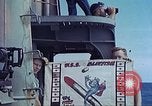
U.S. Navy submarine USS Bluefish underway with Japanese prisoners aboard it in the Pacific Ocean during World War II.
U.S. Navy submarine USS Bluefish submarine underway in the Pacific Ocean during World War II. An insignia aboard the U.S. Navy submarine USS Bluefish. Japanese prisoners go topside aboard the submarine. Smoke rises in the background as a small boat burns. Two small boats burn in the background as the submarine pulls away. Lookouts with binoculars. The USS Bluefish approaches a Japanese schooner. A lookout with binoculars on the background. Oil afire on the surface at night. The oil fire is from the i350, a Japanese submarine sunk by the Bluefish on 15 July 1945.
German officers surrender to Allied Forces at end of World War II
Film begins with nighttime bombardments of rockets and artillery. Then at one minute after midnight, on May 9th, 1945, the guns stop. Next, a day earlier, German Field Marshal Wilhelm Keitel enters a conference room on May 8th, accompanied by German staff officers. He salutes with his Marshal's baton and takes a seat. He signs surrender document. Soviet Marshal Georgy Zhukov stands before being seated. British Air Marshal, Sir Arthur Tedder, is seen signing the document along with Marshal Zhukov. General Carl Spaatz, Commander of Strategic Air Forces in Europe, shakes hands with Marshal Zhukov. Several scenes of battlefield cemeteries are seen next. German officer prisoners are seen from the back as they walk with hands behind their heads. Views of Surrendered German senior military officers, including: German Admiral Erich Raeder; German Marshal Walter Model; German Marshal Wilhelm Keitel; and Marshal Hermann Goering (being disarmed).
CRITICALPAST.COM: About Us | Contact Us | FAQs - How to Order | License Agreement | My Account | My Lightboxes | Shopping Cart | Advanced Search | Featured Collections | Website Terms & Conditions | Privacy Policy ©2026 CriticalPast LLC.
License Agreement |
Terms & Conditions |
Privacy Policy
©2026 CriticalPast LLC.