


 Francais
 Deutsch
 Italiano
Refine Your Search
Naha Okinawa Ryukyu Islands 1945 stock footage and images
- Showing 1051 to 1056 of 9403 results more
more Hide
Hide
United States and Russian troops in Germany after World war 2; division of West Germany and East Germany
Bomb damaged and ruined buildings of Nazi Germany in 1945, including the Reichstag. Nazi Eagle symbol of Third Reich pulled down from building and crashes to the ground at end of World War 2. United States Army of occupation marches into city as German population lines sidewalks and watches them parade. Sign on a shop reads "Gaststatte Schosser." Many buildings in view are damaged or destroyed from bomb attacks during World War 2. American soldiers occupying German give candy to German children who at first hide from them. Nazi leaders including Hermann Göring, Rudolf Hess, Joachim von Ribbentrop, and Wilhelm Keitel, seen on trial in the Nuremberg war crimes trials. German people struggling to rebuild. women and children trying to gather wood from stumps of trees for fuel. A woman sawing a log. Women and children scraping food from inside trash cans and refuse bins, to stay alive during scarcity and shortages after the war. Americans providing food assistance and feeding German children in relief lines. Close up of a smiling boy as he receives food or drink. Soviet Russian Army soldiers occupying East Berlin and marching in formation. Russians removing an industrial lathe and other machinery and tools from Germany as the Soviet Union continues to strip Germany of resources after the war. A map of Germany and Berlin seen with divided regions as American, British, French and Soviet zones. Views of empty streets and heavily damaged buildings of Berlin after the end of the war. Children play amidst the desolation and destruction in East Berlin. View of Kammergericht, Headquarters of the Allied Control Council. Leaders seen meeting inside include American General Joseph T. McNarney, French General Marie Pierre Kœnig (Marie-Pierre Koenig), Soviet General Georgy Konstantinovich Zhukov,. British Field Marshal Bernard Law Montgomery. View of Spandau Prison guarded by troops of occupying powers. Soviet and American troops drill and march on the grounds of Spandau Prison. An American soldier relieves a Soviet soldier at a watch post. Soviet blockade of West Berlin begins in June 1948. View of a man shutting down power in a power plant and lights going dark in Berlin. Blackout conditions in Berlin during the blockade. Germans plant vegetables in city to survive. Germans exchange goods in black market setting. A man plants vegetables in view of the Brandenburg Gate. The Berlin Airlift operations underway. U.S. Air Force C-54 aircraft flying low and arriving in Berlin, bringing supplies to West Berlin. C-97 landing. U.S. military forces unloading relief supplies and food from airlift aircraft. American C-47s and C-54s in the Berlin Airlift. Soap and milk being unloaded from airplanes. German children gather on a hill and watch low-flying American airlift planes as they approach to land at Tempelhof Aerodrome in Berlin. An Air Force airman throws a package out of the aircraft. It is a very small parachute with candy that drops from the American airplane to the waiting children. Children run to retrieve it and they share and eat the candy. Blockade is lifted in 1949 and rebuilding of West Berlin resumes. View of railroad tracks being re-linked, a locomotive running on tracks, and trains cross between East and West Berlin. Ships loading goods onto trains for Berlin. A coal processing factory running again in Germany. German workers producing industrial parts and goods again in production factories. West German construction workers rebuilding structures in West Germany. German people cast votes, establishing Federated German Republic (West Germany). Figures seen include U.S. General Alfred B. Gruenther with Konrad Adenauer, President of the new German Republic, together in Bonn, Germany. Soviet Russian troops marching on parade in East Germany. East German workers rioting in 1953, in protest of increased production quotas in Communist controlled East Germany. Soviet forces in armored vehicles patrol the streets and disperse the crowd. A large electronic billboard banner flashes West German messages and propaganda to those who can view it in East Berlin. Citizen refugees from East Germany arriving in a processing center in West Germany, carrying bags and luggage. East German refugees laying on the ground on blankets in a crowded immigration processing center of West Germany. A woman irons clothes in the immigration center, while a child plays with dolls.
USAAF XX Bomber Command B-29s attack Japanese positions on Formosa in World War II
U.S. Army Air Forces XX Bomber Command Operations during World War 2. A Boeing B-29-10-BW Superfortress, number 42-6347, named "King Size," of the 462nd Bombardment Group, 769th Bombardment Squadron. It is seen here, at their forward operating base on Kiunglai Airfield, China. Tents are seen near the flight line. Numerous bombs are lined up on the ground ready to be loaded aboard the bomber. A B-29 taking off at nightfall. A formation of B-29s in flight. Bombs being dropped over Japanese installations at Hatto, Formosa (aka Taiwan). View of B-29 landing after the mission. (Note. Formosa was a Japanese colonial territory from 1895 to 1945.)
German prisoner, Otto Richard Struller, is transferred by jeep from Béverce near Malmedy, Belgium during World War II.
A U.S. Military policeman leans against his jeep in front of a small building in Béverce near Malmedy, Belgium during World War 2. Two German prisoners emerge from the building escorted by an armed American soldier. A military photographer passes to the left, in front of them, as two American military policemen escort another German prisoner (Otto Richard Struller) from the building. They each hold one of his arms. The prisoner is bareheaded. They pause and pose for a photographer (unseen). Closeup of the prisoner with MPs at his sides. Camera zooms in on prisoner, Struller. The MPs direct him to a waiting jeep. They all get in and drive away. Closeup of the jeep passing the camera. It drives away along a muddy road, past an overturned vehicle. (Note: The principal prisoner in this film, is Otto Richard Struller, a ballet dancer, who during the war served as a corporal with Panzerbrigade 150 unit Stielau/Stab solar, where he masqueraded as an American soldier behind the lines. He was executed, as a spy, on January 13, 1945 at the Palace of Justice in Huy, Belgium)
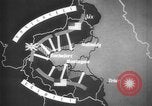
U.S. C-47s drop supplies to troops at Bastogne. General Taylor congratulates General McAuliffe for his defense of Bastogne
Map shows Allied army drives toward Germany in World War 2, and Battle of the bulge counter attack by Germans. Smoke rising from ruins. An American Army engineer douses a fire. In the ruins of Malmedy, Belgium, a sign reads: "Tower Room Malamedy, Protestant Church." Map shows Bastogne. Some of 400 C-47 transport aircraft resupply flights are seen in the air after weather clears. They airdrop food and ammunition to U.S Army troops who had been holding their position and preventing Germans from overtaking in the snow at Bastogne. U.S. gliders, that brought medical assistance, are seen on the snow-covered ground. Aerial view snow covered town. View of food bundles and supplies. Elements of General Patton's 3rd Army arriving to break through German lines and reach the embattled 101st Airborne at Bastogne. Dead and captured German soldier prisoners of war (POW). Destroyed tanks and equipment. Later (January, 1945) Commander of the 101st Airborne Division, Major General Maxwell Davenport Taylor congratulates Brigadier General Anthony McAuliffe for his defense of Bastogne. American troops in Bastogne find time to rest up and smile for the camera after enduring difficult battle.

Protests as Allied troops withdraw from Trieste, Mobs storm the American embassy in Belgrade.
Protests in the Balkan Peninsula as Allied troops withdraw from Trieste and it is handed over to Italy. Yugoslavians vow to never give up Trieste as United States and British troops prepare to withdraw. View of Trieste's port, streets and a soldier guarding from behind a barbed wire fence. Sign says "Trsta ne damo". Italians in Zone A of the Free Territory of Trieste. Man in car speaking to a border control officer crossing to Italy. Italian flag and writing "W Trieste Italiana". Italians see the raising of their flag for the first time since 1945. Italians with Italian flags and placards saying "Viva Trieste" and "L'Istria e Italiana" ("Istria (region) is Italian" in English). Mobs raising their fists in front of the United States embassy in Belgrade, storming the embassy following defiant speeches in which Marshall Tito of Yugoslavia threatens to invade Trieste. Yugoslav rioters break into a fight in front of the American embassy. Yugoslav policemen marshal unruly rioters in the street.
Early allied victories in Europe during World War II are challenged by German counter attacks in late 1944
Elements of U.S. Army arriving in a town in France, in August, 1944, during World War 2. Local people line the sides of the roads to welcome them. Young French women reach up to American soldiers in the back of an open stake truck and later mingle with them on the ground. Some of them kiss the soldiers. Some American flags are displayed by people in the crowd of well-wishers. One American soldier holds up a souvenir Nazi flag.Large crowds of French people gathered in a square to welcome the Americans. Many display the "V for Victory" sign with their hands. Film fades to a brief glimpse of a fallen soldier, and new slate reads: "Counterattack." Next, U.S. Medical Corpsmen are seen carrying American wounded to ambulances in the field in December, 1944.Several views of medics attending to American wounded soldiers. American infantrymen advancing across a field beside a Pershing T26E3 tank. (Note: It has 6 bogey wheels. Not designated M26 until 1945.) American infantry advancing into area of burning buildings and then into built up part of town, where they take up defensive positions inside a building. A U.S. soldier firing out a building window. Other U.S. soldiers firing from positions behind a wall. One is next to a mortar. Buildings burning and destroyed all around them. Close-up of American soldiers firing M1 Garand rifles from behind the wall. Infantrymen hunkered down behind a stone wall with light snow atop it. An explosion from a hand grenade raises smoke. A medical Corpsman checks a fallen American soldier for sign of life. Next, a Chaplain is seen reading from a small bible or prayer book, as he stoops over the fallen soldier. Fallen and wounded soldiers are carried to a truck, from the battlefield, on stretchers. Scene shifts abruptly to captured German film depicting two junior officers conversing in the field and then to German Field Marshal Erwin Rommel conversing with an artillery assault gun officer. Rommel holds a pair of eyeglasses in his right hand. The gun officer wears binoculars around his neck. A war torn city. German Volkssturm (People's Militia) parading. Some carry panzerfaust anti-tank weapons over their shoulders. A field full of German King Tiger II Ausf. B Heavy Tanks. One being driven out of the field. A German SdKfz 251 halftrack maneuvering in woods. it is covered with foliage for camouflage. German soldier in an open single seat courier car. It and he are spattered with mud. Close-ups of the mud-spattered driver smoking an cigar. German infantry moving across a field and moving along a road, in the mist. German infantry moving along a muddy road near a forest. A German V-1 Buzz bomb seen overhead with engine running. It flames out. Next an explosion and rising smoke is seen inside a town.
CRITICALPAST.COM: About Us | Contact Us | FAQs - How to Order | License Agreement | My Account | My Lightboxes | Shopping Cart | Advanced Search | Featured Collections | Website Terms & Conditions | Privacy Policy ©2026 CriticalPast LLC.
License Agreement |
Terms & Conditions |
Privacy Policy
©2026 CriticalPast LLC.