


 Francais
 Deutsch
 Italiano
Refine Your Search
Naha Okinawa Ryukyu Islands 1945 stock footage and images
- Showing 1081 to 1086 of 9403 results more
more Hide
Hide
African American units U.S. 769th Field Artillery, 761st Tank Battalions, and other units in action in European Theater during World War II
U.S. 769th Field Artillery and the 761st Tank Battalions, as well as other African American units battling enemy together with other Army units in the European Theater during World War 2. Tanks advance along a rough terrain. Soldiers run across a field. Column of African American soldiers of 370th Infantry march along a road toward an attack in the Po Valley, supported by the 695th Field Artillery, who are seen loading and firing an artillery piece. African American soldiers of 761st Tank Battalion running interference for the 409th Infantry as it is seen crossing the dragon's teeth of the Siegfried Line in March of 1945. U.S. Army tanks fire at enemy targets on a field. Soldiers advance. African American soldiers of 761st Tank Battalion loading shells into a tank near battlefield and then participating in battle, firing from tanks during battle. Close view of African American soldiers with their tanks, and firing rifles.
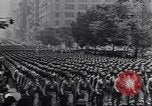
U.S. troops and WACs (Women's Army Corps) including African American soldiers parade along a street in the United States.
From a film about U.S. troops including African American soldiers who battled courageously during World War II. U.S. troops and WACs (Women's Army Corps) including African American soldiers parade along a street. An African American pilot. U.S. Army Major-General Clarence H Kells decorates Sergeant Joe Louis (famous boxer) with the Legion of Merit medal at Fort Hamilton, New York, in 1945. U.S. soldiers perform different tasks. Closing slates include a slate saying the film is not to be shown to the general public, and a second slate stating "Seized Enemy Material...under License Number LM-185"

Japanese bombers bomb a Chinese cities, including Shanghai, and infantry advance during Second Sino-Japanese War (WW2)
A 1945 film titled 'The Enemy Japan Dream of Empire' details Japanese conquests starting with China during Second Sino-Japanese War in 1937. United States Ambassador to Japan Joseph C. Grew speaks about the ruthless nature of Japanese. Wall maps in the background. Aerial formation of Japanese bombers over a Chinese city, possibly Shanghai, during Second Sino-Japanese War (World War II), 1937. Smoke billows up from bomb bursts. Dead bodies of civilians on bombed streets. View of damaged Palace Hotel in Shanghai. Japanese infantry and horse-drawn munitions carts advance into the city. Car pulls up in front of building in Japan and a guard opens door. Japanese military leaders exit car. View of many tall banners with Japanese rising sun symbol hanging from ceiling. Japanese statesmen and army Generals confer in Japan.

The Signal Corps recruits being trained and study communication equipment in the United States.
A U.S. military training film titled "Pro Patria Vigilans" on the wartime and peacetime activities of the U.S. Signal Corps. United States Army General Douglas MacArthur aboard the U.S. Army Battleship USS Missouri during the Japanese surrender ceremonies of World War 2 in 1945. General MacArthur speaking on board the ship at the closing of the surrender proceedings. Aircraft flying in formation overhead. Antiaircraft guns directed towards the aircraft. Signal Corps recruits train at Fort Monmouth, New Jersey. The recruits dive and swim across water. The soldiers attend lecture by an officer. A sign reads: 'Field Radio Course'. Men working in the radio room are trained. Views of soldiers learning to operate radar. Various radar dishes. Closeup views of radar screens. An officer training the soldiers with the help of a model. The coastal defense training of the soldiers. The soldiers study the communication equipment. Soldiers working on communication switchboard equipment, telegraph, and teletype machines. A small messenger aircraft takes off and lands near the message center. A sign outside the building reads: 'Master Message Center'. Soldiers receive a map and clear it through the message center. Spinning equipment in the message center (possibly related to decoding or encryption). Officers seated at a desk, discussing a map.
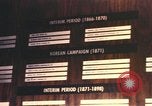
Hall of Heroes at the Pentagon showing hero names from Korean Campaign to the Vietnam War
View of the Hall of Heroes at the Pentagon, in the United States, during the Vietnam War. Names of the war heroes in the hall. Nameplates of the war heroes of each historical conflict on the wall. Names of the soldiers and officers who served the best in the wars. Names under the nameplates reading: 'Interim Period (1866-1870)', 'Korean Campaign (1871)', 'Interim Period (1871-1898)'. Other nameplates read: 'War with Spain (1898)', 'Philippine insurrection (1899-1913)', 'China Relief Expedition-Boxer Rebellion (1900)'. Several other conflicts mentioned in the hall. Other nameplates read: 'World War I (1917-1918)', 'Haitian Campaign (1919-1920), 'Second Nicaraguan Campaign (1925)', 'Word War II (1941-1945) and 'Vietnam (1964-Present).
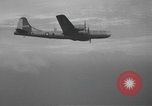
A WB-29A Hurricane Hunter aircraft returns and lands at Kindley Air Force Base, Bermuda
WB-29A of the 53rd Weather Reconnaissance Squadron (Hurricane Hunters) returning from a mission. The aircraft seen flying between smooth cloud layers. It banks to the left and descends. View of the WB-29 flying over part of Bermuda. Inside the aircraft, crew member fastens down equipment in preparation for landing. View from the ground as the WB-29 passes overhead. Another from the ground, of the aircraft touching down, bouncing up gently, and then staying down on the Kindley Air Force Base runway. (Note: During World War II, this B-29, tail number 42-94047, named the City of Jamestown, belonged to the 330th Bombardment Group, 459th Bomb Squadron stationed on Guam. On April 24, 1945,it was ditched near the shore of Japan, while returning from a bombing mission against the Hitachi aircraft factory in Tachikawa, Japan. Obviously, it was recovered and placed back in service after the war ended.)
CRITICALPAST.COM: About Us | Contact Us | FAQs - How to Order | License Agreement | My Account | My Lightboxes | Shopping Cart | Advanced Search | Featured Collections | Website Terms & Conditions | Privacy Policy ©2026 CriticalPast LLC.
License Agreement |
Terms & Conditions |
Privacy Policy
©2026 CriticalPast LLC.