


 Francais
 Deutsch
 Italiano
Refine Your Search
Naha Okinawa Ryukyu Islands 1945 stock footage and images
- Showing 1945 to 1950 of 9403 results more
more Hide
Hide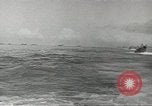
Shells, food, ammunition and fuel drums are unloaded from landing crafts on Munda, Solomon Islands during World War II.
A U.S. Naval Task Force takes Munda in the Solomon Islands during World War II. The naval task force underway at sea. Soldiers with guns on landing crafts. The soldiers move towards Munda island. They disembark from the landing crafts. Crates, shells, food, ammunition and fuel drums are unloaded from the landing crafts and are arranged. Big guns and artillery are moved into position on the island. Coconuts trees are fell by using dynamite. Artillery is fired, explosions occur and smoke rises. The material needed for war - iron, rubber, medical supplies and ammunition. Dead lying on the ground. Wounded are evacuated and carried on stretchers to battalion aid stations. The wounded are treated.
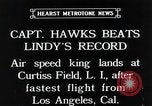
Captain Frank Hawks completes a flight from Los Angeles to Long Island in a record time of 12 hours and 25 minutes.
American aviator Captain Frank M. Hawks lands in Long Island after a record flight in the United States. A Travel Air Mystery S aircraft comes in for landing at Curtis Field in Long Island on August 13, 1930. Aircraft lands and taxis. People gathered around the aircraft. Newsmen interview the pilot Captain Frank M. Hawks. Captain Hawks talks about the speed record set by him during his flight from Los Angeles to Long Island.
U.S. 13th Air Force B-24 Liberator bombers drop bombs over Japanese installations in Buka Island during World War II.
U.S. Army Air Force aircraft attack enemy installations on Buka Island, Papua, New Guinea during World War II. U.S. 13th Air Force B-24 Liberator bombers drop bombs over Japanese positions on Buka Island. Smoke billows up from the explosions. Japanese fighter aircraft attack the B-24s. An aerial view of Buka Island.
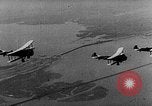
U.S. Army B-6A bomberst fly in formation over Long Island and Hudson River in New York
Formation of B-6A bombers flying over Southern Long Island, New York, above Jones Beach and South shore residential estates. They head northward where Long Island Sound and the North Shore of Long Island can be seen. In one aircraft, a West Point cadet is seen , sitting next to the pilot, in open cockpit of bomber, looking at map. The formation proceeds towards the Hudson River and over a dam, reservoir, and water aeration plant providing water to New York City..
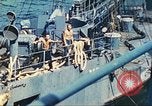
Allied Logistic operations on Tulagi Island, Solomon Islands, prior to advance against Peleliu during World War II
Film begins as a Yard Oiler (YO-12) pulls up alongside the Gunston Hall (LSD-5). Next the LCT-925 (one of the three aboard the Gunston Hall) exits the well dock, filled with supplies. Next, men are seen attaching a fuel transfer line from the YO-12 to the Gunston Hall's fuel port. Scene shifts completely to U.S. Marines of 1st Tank Battalion, receiving supplies aboard the transport ship,USS DuPage (APA-41), by means of net slings, from one of her Higgins boats (LCVP), alongside. Marines open the nets and remove the contents. Views of loaded slings being raised from another boat and being opened on deck of the transport ship. Silhouette of freighter offloading supplies, to be ferried to the DuPage, is viewed from a a boat moving towards her. A Higgins boat is beside the freighter. Camera pans up to show Panamanian flag on freighter's top mast. A large bundle of boxes being lowered from the freighter to sailors in Higgins boat beside, that has PA 41 stenciled on its bow.
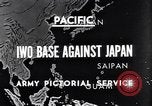
United States base built at Iwo Jima island, Japan; US aircraft bombing Tokyo, Japan.
"Iwo Base Against Japan" showsU.S. Army trucks, vehicles and other supplies being unloaded from an American ship in Iwo Jima island during World War 2. Construction work being carried on to build an advanced base on the island. Vehicles getting stuck in volcanic ash beach areas and being pulled out by bulldozers. Construction of Motoyama airfield number 2. U.S. P-51 Mustangs taking off for escort of American B-29 bomber aircraft in bombing raid over Tokyo, Japan. United States P-51 aircraft shoots down enemy Japanese planes and escorts B-29 to raid Tokyo Japan. 200 pound general purpose bombs are dropped over Tokyo causing fire and smoke. Damaged B-29 Superfortress aircraft return to American air base at Iwo Jima. Flack damage and engine damage shown on several B-29 aircraft after landing at Iwo Jima. Aircraft are repaired.
CRITICALPAST.COM: About Us | Contact Us | FAQs - How to Order | License Agreement | My Account | My Lightboxes | Shopping Cart | Advanced Search | Featured Collections | Website Terms & Conditions | Privacy Policy ©2026 CriticalPast LLC.
License Agreement |
Terms & Conditions |
Privacy Policy
©2026 CriticalPast LLC.