


 Francais
 Deutsch
 Italiano
Refine Your Search
Naha Okinawa Ryukyu Islands 1945 stock footage and images
- Showing 3031 to 3036 of 9416 results more
more Hide
Hide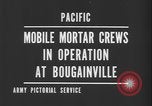
U.S. Army mobile mortar crew operates and transports a mortar on Bougainville Island, Papau New Guinea, during World War 2
A mobile mortar crew from the U.S. Army operates a 4.2 inch mobile mortar. The shirtless U.S. Army soldiers fire multiple shells rapidly. A soldier using a field telephone receives information on a new Japanese enemy position and the mortar crew disassembles the weapon in a practiced manner. The soldiers load the heavy mortar into a two-wheeled cart, which is lifted into the bed of a truck to be transported to the new position. The crew unloads the mortar and wheeled cart from the truck and runs toward their destination. Men follow behind with ammunition boxes. At the new position the crew swiftly reassembles the mortar, laying for fire. A soldier is hoisted up to an observation post in a tree. Wide view of the surrounding jungle and wetland with Mount Bagana in the background. The narrator notes that the Japanese have been located at the base of the mountain. Close up shots of the mortar crew loading and firing shells toward the Japanese position.
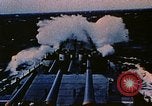
Documentary titled 'To the Shores of Iwo Jima' about the American attack on Iwo Jima in the Pacific campaigns of World War
Documentary titled 'To the Shores of Iwo Jima' about the American attack on Iwo Jima. Map shows location of Iwo Jima Island near Japan, Japanese defense lines and the American front lines. U.S. Navy forces attack on the island. Planes from carriers take off to drop bombs at Japanese targets on the island. Scenes of heavy shelling on enemy's beach installations. U.S. Navy forces head towards the beach in the initial assault. Troops debark from landing craft onto the beach. Soldiers pinned down due to heavy enemy fire. Navy corpsmen carry wounded soldiers on litters.
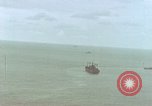
U.S. Navy warships of Task force 51 bombarding Japanese positions on Iwo Jima prior to invasion during World War II
U.S. Navy warships of Task Force 51, Joint Expeditionary Force, commanded by Vice Admiral Richmond Kelly Turner, bombard Japanese positions at the start of the campaign against Japanese-held Iwo Jima, during World War 2. Mount Suribachi visible at end of the island. The Eldorado (AGC-11), Vice Admiral Turner's flagship is seen. At time 00:20 to 1:04, the heavy cruiser USS Chester ( CA-27 ) is seen in camouflage Measure 32, design 9d, following another unidentified heavy cruiser, shelling the island of Iwo Jima. Time codes 1:05 to 1:12 show the battleship USS Tennessee (BB-43). In time codes 1:14 through 1:31 the heavy cruiser USS Salt Lake City ( CA-25) and the USS Vicksburg, CL-86, a Cleveland Class light cruiser, in camouflage (measure 33, design 6D), are seen shelling Japanese anti-aircraft gun emplacements around the east side of Motoyama airfield. The battleship, USS Idaho (BB-42) is seen in time codes 1:32 to 1:53. Other, unidentified U.S. warships are also seen bombarding the Island.

U.S. Marines land and advance near Mount Suribachi amidst enemy fire during the Battle of Iwo Jima in World War II.
'Action on Iwo Jima' depicts the Battle of Iwo Jima or Operation Detachment during World War II. United States Marines Divisions eliminate positions on Mount Suribachi. Mount Siribachi on the island coast. Additional waves of Marines arrive at the island. 3rd Marine Division arrives to enforce the 4th and 5th Divisions. Landing crafts and ships approach the shore amidst enemy fire and explosions. Crouched Marines in a Landing Craft Vehicle Personnel (LCVP). Marines advance inland amidst mortar fire and machine gun fire by the Japanese. They advance across mine fields on the beach. Soldiers unload supplies from landing crafts and ships. They pull a tank across the beach. A view of the battle from inside a tank. Marines battle around Mount Suribachi. Advanced units scale cliffs and take cover against grenades and demolition charges from the Japanese in caves and pill boxes. The Marines use flames to flush Japanese soldiers out of dug in positions. A Japanese soldier takes cover from machine gun fire. Guns fired and explosions on the island.
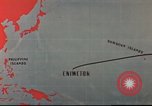
Man flashing blinker light and some men watching other ships underway in the Pacific Ocean.
The sea voyage of the victory ship Hannibal Victory from San Francisco to the Philippine Islands during World War II. The ship underway in the Pacific ocean. Animated map locates Hawaiian Islands, Philippine Islands and Eniwetok. A man at the controls of the ship. Mountains in the foreground. Man flashes the blinker light for the purpose of signaling. Men watching other ships underway from the deck of the ship. A man watching through binoculars.
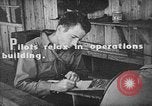
U.S. pilots in 19th Fighter Squadron operations building at Aslito Airfield, Saipan during World War II.
U.S. Army Air Forces 19th Fighter Squadron personnel on the Island of Saipan, Mariana Islands in World War 2. Pilot writing a letter at Aslito Airfield, Saipan Island. Interior operations building showing the men lounging around and relaxing. Barber giving a haircut in outside area, P-47 Thunderbolt planes in background. Airman taking a nap. Bulletin board of the fighter squadron with chalk reference to 19th Bomb Squadron (possibly meaning fighter-bomber Squadron).Contains a note reading: "Minimum buzzing alt 50 ft." Alert duty roster is posted with names of pilots, shifts they will pull, & assigned aircraft numbers. Pilots cleaning and inspecting their sidearms.
CRITICALPAST.COM: About Us | Contact Us | FAQs - How to Order | License Agreement | My Account | My Lightboxes | Shopping Cart | Advanced Search | Featured Collections | Website Terms & Conditions | Privacy Policy ©2026 CriticalPast LLC.
License Agreement |
Terms & Conditions |
Privacy Policy
©2026 CriticalPast LLC.