


 Francais
 Deutsch
 Italiano

Refine Your Search
Naha Okinawa Ryukyu Islands 1945 stock footage and images
- Showing 3421 to 3426 of 9417 results more
 Hide
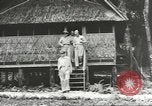
General Douglas MacArthur inspects 6th Army headquarters in New Guinea, during World War II
General Douglas MacArthur (Supreme Commander of Allied Forces in the Southwest Pacific Area) steps from the wood and palm structure, serving as Headquarters of the 6th Army, on Goodenough Island, New Guinea, during World War 2. He poses with Lieutenant General Walter Kreuger, Commander of the Sixth Army in the South West Pacific Area. Members of Kreuger's staff pose with them. After the picture-taking, MacArthur shakes hands with one of the staff officers, as the group make their way to jeeps. Next, MacArthur is seen posing with several armed soldiers wearing steel combat helmets. They salute MacArthur as he walks away. General Kreuger stands in front of the headquarters hooch conversing with two of his staff. He and one of his staff hurry to a jeep, with two stars on the front plate. They drive away. . Generals MacArthur and Kreuger are seen sitiing in back seat of a jeep with modified roof cover. MacArthur converses with staff officers. They are next seen walking through a grove of trees, with staff officers behind them. Later, MacArthur leads the entourage along a pathway, with tents visible in background. As they walk, he converses with Major General Edwin F.Harding, Commander of the 32nd Infantry Division. An official photographer lingers in background. MacArthur and Kreuger lead the group past a large mess tent. (At this point the footage repeats starting back with their entry into the grove of trees and ending as they pass the mess tent.) After that MacArthur is seen speaking to two bareheaded officers. He then speaks with several soldiers, individually, as Generals Kreuger and Harding stand nearby. MacArthur converses with a Field Grade officer. He visits an infirmary tent and speaks to a patient and to members of the medical staff, including a woman Lieutenant nurse. He and General Kreuger are seen inspecting various areas in the camp.
U.S. Aircraft destroyed on the ground by Japanese air raid in Wakde, New Guinea, during World War II.
Aftermath of Japanese air raid on Wakde Island, New Guinea during World War 2. Numerous destroyed U.S warplanes litter the field. Some are still burning. Most are unrecognizable, but the wrecks appear to include B-25s, B-24s, and P-38s.

U.S. Marines shown in combat aftermath on Saipan
U.S. Marines in Saipan, Mariana Islands during World War II. A Japanese tank on fire. A wounded Marine being given blood plasma and first aid. Wounded on litters placed into a jeep ambulance. A wounded man being looked after by a doctor. Wounded being made to lie down on a litter and being placed into a jeep ambulance. A dead Japanese machine gunner near a gun mounted on a tripod.
The battle of Saipan during World War II in the Pacific.
U.S. forces battle against the enemy on Saipan, Mariana Islands during World War II. The 4th Marine Division advances on the eastern side of Saipan. Marines fire rifles. The 2nd Marine Division fires at enemy snipers. The 8th Marine Regiment advances amidst heavy firing. A Marine M3 Stuart (M3A1) light tank equipped with flamethrower (Satan flame tank) is seen in action. Marines moving slowly behind a tank. Two marines running, under fire, carrying a wounded on a stretcher. Others run for cover before a huge explosion. The 8th Marines capturing Mount Tapochau. The 4th Division moving M16 rocket launchers into position for deployment. barrages of rockets striking distant targets in the Bluff Point area. Closeup of rockets being fired from launcher on back of a truck. Map showing Saipan and the disposition of the various Marine units as of 24 June, 1944. American P-47 aircraft parked at Aslito airfield. One has the name "Rosemary" painted across its engine cowling. P-47s taking off on 26 June, to strike at Tinian. A Grumman TBF Avenger is seen taking off at the same time. Another status map shows improved U.S. positions.

U.S. Naval bombardment of Saipan during World War II
Views from a U.S. warship firing its guns at Saipan, Mariana Islands, in World War 2. Smoke rising from strikes along the shoreline. At TC:00:17, a smoke ring can be seen from a gun. View from deck above pair of 5-inch guns firing. A twin Bofors 40mm gun, quiet, but ready for action. Shell explosion raising water near the ship. A huge fireball rising from a shell strike ashore. A flush deck destroyer near the camera ship. Empty shell casings littering a gun deck. Sailors directing water hoses on gun batteries to cool them. Sailor Fire fighter dragging a hose up to a gun battery where another sailor uses it to cool gun barrels. Gunners throwing spent shells into a well on deck. Series of explosions in the water near the shore. The Heavy Cruiser, USS Indianapolis (CA-35) in Dazzle camouflage paint, nearby. Sailors eating rations on camera ship deck. A battleship in camouflage paint, firing heavy guns at Saipan. Sailors aboard camera ship looking over the railing at something of interest. Behind them are stacks of spent shell casings. View of OS2U Kingfisher aircraft on catapult aboard the camera ship. Glimpse of what appears to be a triple turret of 6-inch guns. A Navy pilot, in flight gear, walks on deck, where sailors are stacking spent shell casings. Empty plane catapult in background.

An oil abatement product is thrown in water and a H-52 helicopter photographs a fire on the water offthe shore of Newport.
An oil abatement experiment aboard USS Compton (DD-705) off the shore of Newport, Rhode Island. A small civilian tanker laying oil on the surface of water for the experiment resulting in an oil slick on the surface of water. Officers and men on the deck of USS Compton. A United States Coast Guard (USCG) H-52 Seaguard helicopter hovers over the water in the background. Crewmen walk back and forth in the foreground carrying bags of an oil abatement product. The H-52 hovers close over USS Compton. A bag of the product is handed over to a man on the deck. The man walks off. A USCG patrol boat in the open sea. Oil slick on the surface of water off the side of the destroyer. A man stands looking down over a side in the foreground. The product being dumped over the side from the bags. Grayish powder on the surface of water. Empty bags float on the surface of water. A weather deck passageway. An officer runs down the passageway. Smoke over water on the starboard side of the ship. A fire burns off the starboard bow. Black smoke rises. Men on the weather deck. The smoke fills the area in the background. Men rush with a fire hose. A fire burning on the surface of water. Smoke rises from the fire. The H-52 circles to photograph the fire. It hovers some distance from the fire. A little bit of smoke drifts from the fire as it stops burning. The smoke hangs over the surface of water after the fire has burned out.
CRITICALPAST.COM: About Us | Contact Us | FAQs - How to Order | License Agreement | My Account | My Lightboxes | Shopping Cart | Advanced Search | Featured Collections | Website Terms & Conditions | Privacy Policy ©2026 CriticalPast LLC.
License Agreement |
Terms & Conditions |
Privacy Policy
©2026 CriticalPast LLC.