


 Francais
 Deutsch
 Italiano
Refine Your Search
Naha Okinawa Ryukyu Islands 1945 stock footage and images
- Showing 3481 to 3486 of 9416 results more
more Hide
Hide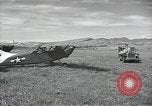
25th Liaison squadron pilots take off in Stinson L-5 Sentinel at Dansalan airfield in the Philippines during World War II.
U.S. Army liaison mission over Malabang in the Philippines Islands, during World War 2. A jeep is being driven up to the 25th Liaison Squadron Stinson L-5 Sentinel, at Dansalan Airstrip. The aircraft is serial number 42-99146 "Gayle Ann" of the "Guinea Short Lines." The crew of the aircraft lay out an aerial photograph on the tail for briefing. Captain Kellet, with a pen in his hand, huddles over the horizontal stabilizer discussing the mission and photograph, with pilot Tech Sgt. Loyd Herbert Summers Jr. as Staff Sergeant Felter stands next to them. The officers board the aircraft. (As they do so, a man is seen in the background, riding a horse. He stops short of the airplane and dismounts Sgt. Peterson checks the gasoline and secures the cap. Captain Kellet aboard the aircraft, makes a radio call to the local control. The L-5 takes off from the airstrip. The aircraft in flight over Dansalan Airstrip. Aerial views of inhabited areas in the region. Aerial views of Camp Keithley Headquarters, 10th Military District. 42-99146 in flight being filmed by airplane flying in formation.
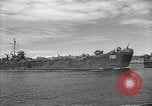
U.S. LST arrives on the Malabang beach with military vehicles and troops, during Malabang mission in Philippines.
U.S. Army attack mission over Malabang in Philippines Island. An LST (Landing Ship, Tank) approaches the Malabang beach. Number '722' written on the LST. A bulldozer pushing dirt and trees over to the doors of the LST. Men unloading sand bags from the LST. Military vehicles disembarking the LST for the beach. The guerilla fleet and the crew watch the military vehicles disembark. Troops disembark the LST. The troops digging gun emplacement pits. Mobile antiaircraft guns in the pits. The bulldozers grading road. Trucks and vehicles disembark the LST. Trucks move along the road. Several LSTs along the Malabang beach. The trucks and vehicles move along the paved road in a line. The troops on the sides of the road, watch. (World War II period).
LST (Landing Ship, Tank) with military vehicles aboard, along the Malabang beach, during Malabang mission in Philippines.
U.S. Army attack mission over Malabang in Philippines Island. View of several LSTs (Landing Ship, Tank) along the Malabang beach. Military vehicles and trucks aboard the LST. Men in a small boat approach an LST. (World War II period).
LST (Landing Ship, Tank) reaches the Malabang shore, and bulldozers disembark, during Malabang mission in Philippines.
U.S. Army attack mission over Malabang in Philippines Island. An LST (Landing Ship, Tank) approaching the Malabang beach. Military vehicles and troops aboard the LST. Number '722' written on the LST. The LST reaches the shore. The doors open and the ramp lowers. Bulldozers move down the ramp from the LST on to the beach. Guerilla troops on beach watch the bulldozers disembark. (World War II period).
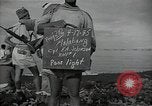
Guerilla troops on the Malabang beach, and the LST (Landing Ship, Tank) with troops, during Malabang mission in Philippines.
U.S. Army attack mission over Malabang in Philippines Island. Guerilla troops on the beach. A few of them smoking. The troops, holding guns in their hands, walk towards the LST (Landing Ship, Tank). The troops beside the LST. The military vehicles and equipment aboard an LST. Troops aboard the LST. The LST moves into the shore. (World War II period).
Guerillas on the Malabang beach, and an LST (Landing Ship, Tank) moves with troops, during Malabang mission in Philippines.
U.S. Army attack mission over Malabang in Philippines Island. A small landing craft, with men aboard, leaves the Malabang shore. The landing craft beside an LST (Landing Ship, Tank). The landing craft moves away. Guerillas and the soldiers on the shore. The soldiers aboard an LST. Nimber '722' written on the LST. Several LSTs along the shore in vew. An LST with number '680' written on it. The LST moves away from the shore. (World War II period).
CRITICALPAST.COM: About Us | Contact Us | FAQs - How to Order | License Agreement | My Account | My Lightboxes | Shopping Cart | Advanced Search | Featured Collections | Website Terms & Conditions | Privacy Policy ©2026 CriticalPast LLC.
License Agreement |
Terms & Conditions |
Privacy Policy
©2026 CriticalPast LLC.