


 Francais
 Deutsch
 Italiano
Refine Your Search
Naha Okinawa Ryukyu Islands 1945 stock footage and images
- Showing 4021 to 4026 of 9416 results more
more Hide
Hide
Food items and watches in windows of stores in New York City, United States.
Displays in windows of different stores in New York City, United States. A woman serves fresh oysters at a shop. Sign reads, "Fresh Long Island Oysters". A restaurant with sign "B/G. A meal a minute" and a chef turning chickens on a rotisserie. A pizza maker tosses a large crust into the air as onlookers watch him through the restaurant window. Numerous watches on display in the window of a jewelry shop. A man at work in the shop. At a cobbler shop, a sign on a window reads 'Ripple soles'. Cooks grilling steaks over a grated fire in a restaurant.
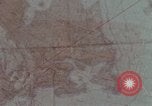
A map in the United States traces routes of possible B-58 Hustler aircraft missions to Europe, China and the Soviet Union.
A Cold War era film about the low angle flying ability of U.S. Air Force B-58 Hustler aircraft in the United States. A map traces the route to be taken by B-58 aircraft to the Soviet Union. A U.S. Air Force KC-135 Stratotanker refuels the B-58 in mid air. A map traces the route of a possible B-58 Hustler aircraft mission to Kiev, Ukraine from England. The route of a B-58 mission from Pacific islands to China. A B-58 Hustler in flight carrying a free fall bomb pod. A crewman aboard an airborne B-58 aircraft. The B-58 aircraft makes a low pass over an airstrip.

Anna Roosevelt reviews troops and Jean Marie Faircloth MacArthur Christens the Australian Destroyer, Bataan the during World War II
Opening scene shows a Boeing B-24 Liberator bomber arriving at an airfield in the Caribbean during World War 2 . U.S. First Lady, Eleanor Roosevelt steps from the aircraft, stopping here on one of her many trips. She strolls among U.S. servicemen and others. She is escorted by a General and reviews American Troops on parade at an army base. Scene shifts abruptly to the Cockatoo Island Dockyard, Sydney in New South Wales Sydney Australia, where the Australian Destroyer, Bataan, is being Christened on 15 January 1944 by Jean MacArthur, the wife of General Douglas MacArthur. Dockyard workers drive wedges from beneath the destroyer's hull, to free her for launching. Mrs. MacArthur announces the name, Bataan, and swings a bottle of champaign to christen her. The ship proceeds down the ways. View from below of sailors on deck as she launches.
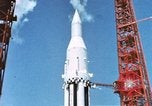
Saturn rocket test launch; John F. Kennedy present at Polaris missile launch in the United States
A film about missile launches in the United States. A Saturn rocket on a pad. The launch of the rocket. Cameramen in action. Arrival of U.S. President John F. Kennedy in a United States Air Force Boeing VC-137C (Air Force One) and tour of Cape on November 16, 1963. President Kennedy in a car with Major General Leighton I. Davis Commander Air Force Missile Test Center (AFMTC) and James Webb, National Aeronautics and Space Administration (NASA) Administrator, together with Launch Operations Center Director Kurt Debus. Astronauts Major Leroy Gordon Cooper and Major Virgil Grissom in civilian clothes brief Kennedy on the Gemini program. The President with Senator George A. Smathers and Werner Von Braun at the base of the Saturn rocket. President Kennedy boards a United States Marine Corps (USMC) VH-3A helicopter. The helicopter takes off and lands on USNS ( United States Navy Ship ) Observation Island (T-AGM-23). President Kennedy wearing a sailor jacket meets the commander of the ship. He observes the Polaris missile launch from USS Andrew Jackson submarine on 16th November, 1963. President Kennedy talks to Major General Davis and Dr. Kurt Debus at the launch operations division of the NASA. He boards a Boeing VC-137C aircraft at Cape Canvaeral and bids farewell.
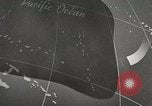
American Forces advance against Japanese held areas of New Guinea during World War II.
Animated map shows U.S. forces extending control in the Pacific the the Marshall and Gilbert Islands in the Pacific during World War 2. An American soldier sentry near a destroyed Japanese reinforced concrete bunker. Another looks at a destroyed Japanese coastal gun. More American soldiers looking over destroyed Japanese coastal defenses. A destroyed Japanese type 95 HA-GO tank. A U.S. troops look at a destroyed Japanese Mitsubishi G4M (Betty) bombers on a captured airfield. Animated map of New Guinea.showing Allied advance to Hollandia. U.S. aircraft carriers with their aircraft flying overhead. Closeup from behind of a Navy Grumman F6F Hellcat aircraft taking off from a carrier. Formations of U.S. Navy carrier-based aircraft in flight overhead. Escort aircraft carriers (called "Jeep" carriers by the narrator) are seen with decks full of airplanes. Douglas SBD Dauntless aircraft taxiing on a carrier deck. An F6F fighter plane taking off. A formation of Douglas SBD Dauntless airplanes viewed from above, flying over the sea. Gun camera films from U.S. aircraft strafing parked airplanes on Japanese airfields.
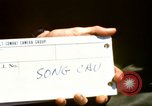
Aerial view of Vietnamese Coastal Group 23 Junk Base and surrounding area in Song Cau, Vietnam.
Vietnamese junk bases in Song Cau, Vietnam during the Vietnam War. Aerial view : Vietnamese Coastal Group 23 Junk Base. A small village on one side of the base. Another junk base on an island.
CRITICALPAST.COM: About Us | Contact Us | FAQs - How to Order | License Agreement | My Account | My Lightboxes | Shopping Cart | Advanced Search | Featured Collections | Website Terms & Conditions | Privacy Policy ©2026 CriticalPast LLC.
License Agreement |
Terms & Conditions |
Privacy Policy
©2026 CriticalPast LLC.