


 Francais
 Deutsch
 Italiano
Refine Your Search
Naples Italy 1943 stock footage and images
- Showing 145 to 150 of 4566 results more
more Hide
Hide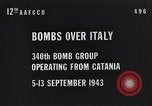
Bombs over Italy: Destruction of bridge in Amantea.
U.S. Army Air Force 340th bomb group bombs over Italy, operating from Catania in September 1943. Aircraft of 340th bomb group in flight. American bomber in flight above target bridge. Destruction of bridge in Amantea, Italy. (World War II period).
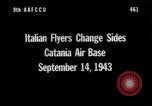
Kingdom of Italy aircraft and crews surrender to Americans at Catania Air Base in Sicily, Italy, during World War II.
Italian aircraft and crews surrender to Americans at Catania Air Base, in Sicily, during World War 2, under terms of the Armistice of Cassibile , signed on September 3, 1943 and publicly announced on September 8th by U.S. General Dwight D. Eisenhower, on Radio Algiers. Under its terms, the Kingdom of Italy ceased hostilities against the Allies and Kingdom forces were to surrender to the Allies. An Italian SIAI-Marchetti SM79 ("Sparviero") Torpedo-Bomber is seen in flight over water, as viewed from another airplane. It carries the number 1NS-20. View of Catania Air Base, with U.S. B-25 Mitchel bomber, of the 340th Bombardment Group, landing, in background. The Italian SM79 is seen taxiing to the ramp, after landing at the Base. A Italian crew man opens the door and an officer exits using the aircraft ladder. He is followed by Giulio Cesare Graziani, torpedo bomber ace and winner of the Italian Gold Medal of Military Valor. (He is framed at 1:12.) Another officer also exits and the three shake hands with U.S. 9th Army Air Force officers on the ground. Commander of the 340th Bomb Group Lt Col Adolph "Tik" Tokaz appears in frame 1:05. The Italian officers present some documents and discuss them with the U.S. officers. The officers from both countries gather around the Italian seal, of the kingdom of Italy, on the tail of the plane and discuss it. The officers turn to watch another Italian SM79 land, taxi in, and park. Italian fliers exit this airplane and walk across the ramp to join the others, with whom they exchange salutes, and shake hands.
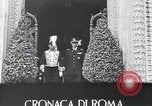
New Japanese ambassador to Kingdom of Italy, presents credentials at Quirinal Palace in Rome, Italy (WW2)
Zenbei Horikiri, the new Ambassador of Japan to the Kingdom of Italy, presents his credentials to King Victor Emmanuel III in Rome, Italy during World War II. Hokiri stands with an Italian officer during the ceremony at the Quirinal Palace. To his right, behind him, similarly dressed, is Shun'ichi Kase,secretary to Japanese Foreign Minister Yōsuke Matsuoka. (Shun'ichi later served as chargé d’affaires in Italy commencing in 1943.) Japanese and Italian officers are part of the two-nation entourage that emerges from the palace following the event. They proceed down the steps of the Quirinal Palace (Palazzo del Quirinale, Piazza del Quirinale, 00187 Roma RM, Italy) and across the Piazza del Quirinale, where camera shows a glimpse of one of the statues at the Obelisk and Fountain of Castor and Pollux (containing sculptures of Castor and Pollux as horse tamers). Next, a motorcade of the officials' cars drives out of the palace complex, past two guard posts.
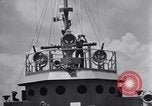
Allied Invasion of North Africa during World War II
Allied warships move towards North Africa during World War 2. A U.S. Navy sailor on a destroyer monitors sonar indicating presence of a submarine. A sailor looks through a pair of binoculars and another U.S. Navy sailor nearby has a pair of headphones. Loudspeaker signals call to general quarters. Sailors rush up the stairs. Numerous depth charges are launched and explode in the water. Next, a wide oil slick on the surface indicates the submarine has been struck by the depth charges. An officer looks through a pair of binoculars. A man speaks into a radio. Soldiers amuse themselves on a troop ship. One plays the piano and others playing play cards, read novel while eating an apple. Flags of Major General Patton and Rear Admiral H. Kent Hewitt aboard the USS Augusta (CA-31) off the coast of North Africa. Semaphore flags and signal lights communicate between ships. Soldier with 'map of West Africa' in his back pocket. Two soldiers read a language guide. An animated map detailing Plan Acrobat to invade North Africa. Map includes Casablanca, Algiers, Tripoli, and Libya. Soldiers exercise, peel potatoes and relax on a troop ship. Clothes hung on a line. British soldiers write letters home. A soldier pastes news on a bulletin board. The bulletin announces that the 'German Afrika Corps' are in full retreat. Night time aerial views of bombing of cities in Italy. Narrator states the bombing included Naples, Genoa, and Turin. Explosions and smoke on the ground below from the bombing. Aerial view of daylight bombing at lower altitude of a Renault tank factory. Submarine on surface at twilight. Eighth Army plane. General Eisenhower, General Mark Clark and French General Giraud. Night scene. Soldiers on the deck. German WWII headquarters at night with guards in Rome and at the The Reich Chancellery in Berlin. Hitler at Berghof . German switchboard, terminal, and radio communications. Messages passed between Allied ships via signal light and ship-to-ship cargo transfer. ( Note The Operation Acrobat discussed in this film is misleading. That plan was scrapped, and the Allied North African campaign was conducted as part of Operation Torch.)

Kennedy and Johnson speak about peaceful aims of the United States in 1963 during the Cold War.
"To keep the peace" about need for peace, during Cold War. Expansive farm field of wheat waving in breeze under a sunny to partly cloudy sky in the United States. Wide shot of ocean waters and sun breaking through low clouds near dawn or dusk. President John F Kennedy delivering a speech on peace and nuclear testing, on July 2, 1963, in Naples Italy at NATO headquarters. Kennedy says, "The purpose of our military strength is peace. The purpose of our partnership is peace. So our negotiations for an end to nuclear tests and our opposition to nuclear dispersal are fully consistent with our attention to defense--these are all complementary parts of a single strategy for peace." Shortly after President Kennedy's death, President Lyndon B Johnson addresses a joint session of Congress on November 27, 1963. Shows segment of speech where President Johnson says, "We have proved that we are a good and reliable friend to those who seek peace and freedom. We have shown that we can also be a formidable foe to those who reject the path of peace and those who seek to impose upon us or our allies the yoke of tyranny."
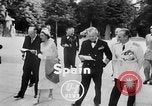
Admiral Forrest Sherman attends a diplomatic reception and meets General Francisco Franco in Madrid, Spain.
U.S. Navy Chief of Staff Admiral Forrest Sherman in Madrid, Spain prior to his death in Naples, Italy. He is accompanied by his wife. He attends a diplomatic reception. Sherman with Spanish dignitaries. Sherman with General Francisco Franco.
CRITICALPAST.COM: About Us | Contact Us | FAQs - How to Order | License Agreement | My Account | My Lightboxes | Shopping Cart | Advanced Search | Featured Collections | Website Terms & Conditions | Privacy Policy ©2026 CriticalPast LLC.
License Agreement |
Terms & Conditions |
Privacy Policy
©2026 CriticalPast LLC.